
What started as a wrong turn near a crowded hospital became my ‘first date’ with the wild—and the day I finally began to grow roots.
Published June 2014 · Updated February 2026
Life’s changed tracks since that World Environment Day in June 2014. It all started with volunteering for the Habitat Restoration programme, organised by the Bombay Natural History Society (BNHS), inside Asola Bhati Wildlife Sanctuary. Looking back, it was my introduction to the wonders of the Aravallis, one of the oldest mountain ranges in the world, and the bounty that exists on Earth. That day was the return of a love that connects us to Earth, our roots.
What started as a desire to find a new career path, something that would make me shift gears from loss, became my first step into a consciousness that has evolved over the decade. Till then, I’d thought of trees only as Bollywood romance props. However, this was a chance to know Nature intimately. The Conservation Education Centre, set up by BNHS at Asola Bhati has since dissolved, unfortunately for many like me.
My old Maruti Zen, my first car, my beloved was still in running condition. The music going great guns, I drove right past the Asola Bhati Wildlife Sanctuary (Delhi) on the curvy road from Surajkund towards Tughlakabad. When I reached the crowded Batra hospital, I knew I had missed the turn! Paridhi Jain, then education officer at the Conservation Education Centre inside the sanctuary, had mentioned that it was near Dr Karni Singh Shooting Range.
Doubling back, I thankfully reached the sanctuary on time. Briefed about the basics of enviromentalism and BNHS’ conservation practices dating to 1883, we were armed with jute sacks, branch cutters and a phawda (spade used for gardening). A truly novel experience for me. I’d always been a city person, I mean the concrete-driven individual.
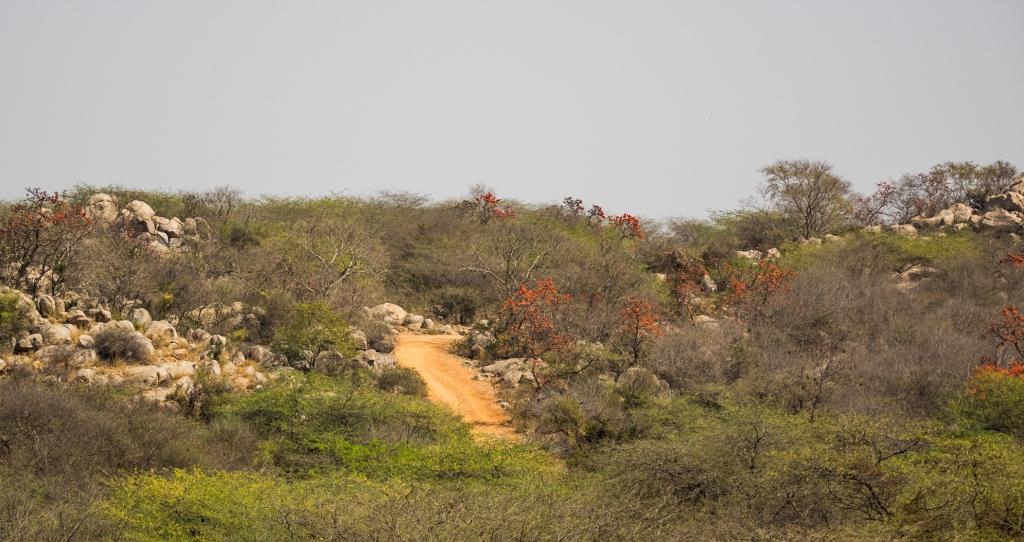
The sanctuary, I believe, has four trails. I would have to go exploring again to update myself. We were on the ‘Palash Tree Trail’., walking in a forest full of Vilayati Keekar (scientific name: Prosopis juliflora), an invasive tree native to Mexico and South America, introduced to Delhi by the British between 1910-1930s.
Peacocks strutted, jungle babblers chattered, and little butterflies crossed our path often. Coming across a thorny branch, we trimmed them, ‘path clearing’. It was sad to see broken liquor bottles, plastic bottles, and bags on the trail, which went into the jute sacks. We marked the trail with stones, just like our ancestors.
Along the trail, Jain introduced us to:
- A Tiny Wonder: a tiny violet flower among the shrubs, Shankhpushpi, a traditional medicine for the brain.
- The Praying Mantis: a flash of green in the shrubs turned out to be a female Mantis guarding a nest full of babies. We learned her “prayer” is a bit dark; she’s known for decapitating the male during mating!
- More Lives: Insects ran over the barks. We stopped near a termite mound, home to termites, rats, snakes, monitor lizards. We listened in awe about the other residents: nilgais, jackals.
Amid this thorny trail, on red rocks a single Palash tree, the ‘Red Flame of the Forest’, was a showstopper in the stark landscape. Lakhan, our guide and a local who knew the land like an old friend, led the way. The Palash flowers during spring, which is now! The flowers are used to make colour for Holi. In ancient times, the leaves were used as plates. The leaves are found in a cluster of threes.
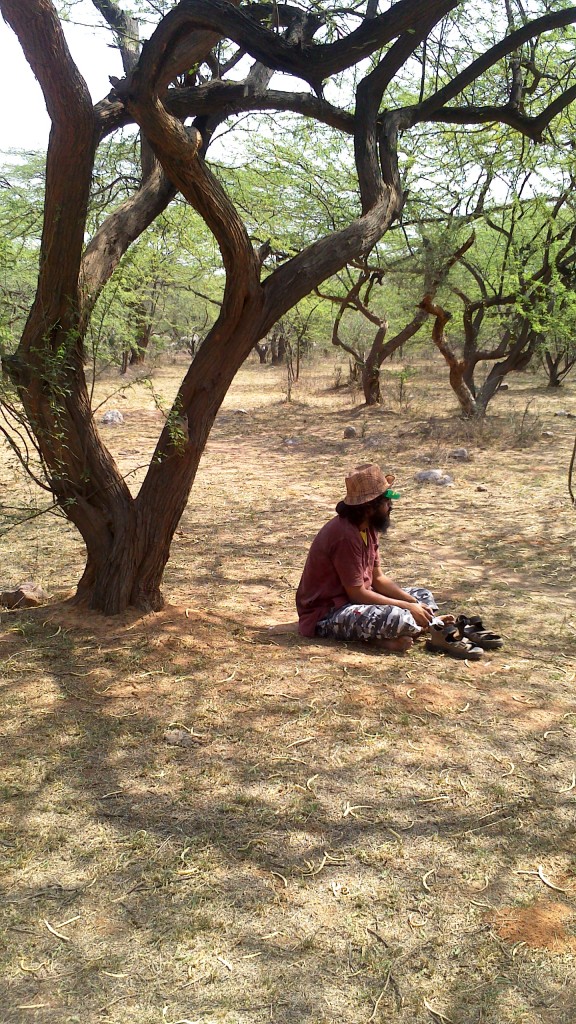
Heads covered, taking water breaks, through twists and turns, we reached the enclosure for the endangered blackbucks. A magnificent black male with spiraling horns watched us from a distance, poised and powerful. A herd of females, rested in the shade, hiding from us. But the magnificent black male with its horns watched us longer. Sadly, the herd of 50 didn’t survive the rescue from their captive, is what I came to know during my last visit in 2022.
We also climbed a machan to see the panoramic view of Delhi. But the strong sun didn’t help.
Back at the centre, refreshed with samosas and sandwiches, we sat down to watch a documentary on ‘Saving the Yamuna’. We were introduced to simple ways to save the environment. Some of them have now become habits such as segregating waste, donating old clothes and milk packets (after cleaning and drying them), preserving seeds of fruits and vegetables, saying goodbye to plastic.
The day ended with planting a neem sapling, an action I replicated again in Asola Bhati Wildlife Sanctuary years later. The Aloe Vera sapling gift didn’t survive under my novice care, but its memory lives long. As do the lessons that I learned that day, my life shifted from concrete to green.
My little ways to keep the environment green:
- Never leave litter in the forest.
- Use cloth or jute bags. Polythene bags are not allowed in the sanctuaries.
- Use public toilets.
- Do not play loud music in the sanctuary. Loud sounds scare the animals and birds.
- Do not break plants or disturb nature in any way.
- Do not throw stones at the animals and birds.
- Do not throw water unnecessarily. Keep taps closed.
- Keep water bodies in the sanctuaries clean.
- Forests love silence, and in silence you experience so much more, hear the birds and absorb the scents and sense the animals.
The Sanctuary Today
That year I visited the sanctuary multiple times for programmes related to butterflies and snakes, but I need to go again because much has changed. I penned these for Patriot newspaper. If you are visiting today, then you should go to:
- The Neeli Jheel: The “Blue Lake” is now the crown jewel of the sanctuary.
- Butterfly Park: This matured habitat now hosts over 90 species of butterflies.
Plan Your Visit
- Location: Near Dr. Karni Singh Shooting Range, Tughlakabad, New Delhi.
- Contact: Asola Bhati Wildlife Sanctuary is managed by Department of Forests & Wildlife, NCT of Delhi. It is open from 7am-3pm (except Mondays). There is an entry and parking fee.
- Best Time to Visit: October to March (though World Environment Day in June offers a unique, albeit hot, perspective on the forest’s resilience).
A decade has passed since that first seed was planted in my heart. But I’ve not forgotten my date. Have you ever had a “first date” with nature that changed your perspective?
—Ambica Gulati is a journalist and editor writing on travel, culture, world affairs and the unseen.
From the Archives
If you loved this date, then maybe you would like to continue the journey with these recommendations:

 Queen of Treasures
One thought on “My First Date With Earth: Asola Bhati Wildlife Sanctuary”