

Originally published in The Times of India, May 18, 2015
Updated for digital clarity: March 2026
A pause on the Kalindi Kunj bridge becomes a meditation on how cities remember, restore, or abandon their rivers.
Crossing the Kalindi Kunj bridge in Delhi, I paused for a few seconds, scanning the water for birds. The nearby Okhla Bird Sanctuary was once alive with them. Below, the Yamuna looked tired, its surface opaque. Despite repeated promises, the river remains neglected. My mind drifted to another river, far away in Seoul.
I had encountered it years ago, shortly after landing in South Korea. The air was light, the city unfamiliar, and fatigue had not yet dulled curiosity. I found myself standing on a small stone bridge near my hotel, watching people try to toss coins onto a stone in the middle of a gently flowing stream. It felt oddly ceremonial, quite like India. That was my first meeting with Cheonggyecheon.

A River That Forgot It Was a River
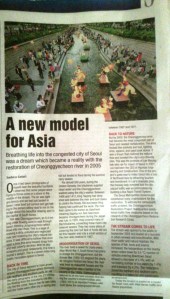
Stretching 8.4 kilometres through the heart of Seoul, Cheonggyecheon flows west to east before joining the Han River. Today it is a public recreation space, lined with walkways, art installations, and shaded seating. But it had not always been so. It was difficult to imagine that this calm, carefully restored waterway had once been choked with waste, lined with informal settlements, and buried under concrete.
Seoul grew around this stream. In its early geography, as many as 23 tributaries descended from surrounding mountains to feed it. During the Joseon Dynasty, Cheonggyecheon played a critical role in urban life. Between 1406 and 1412, King Taejong ordered the river to be deepened and widened, and dykes were built to control seasonal flooding. His successor, King Sejong, continued the work, recognising both the river’s utility and its danger. At this time, the stream came to be known as Gaecheon, meaning “dug-out stream.”
Even then, Cheonggyecheon was contested ground. King Sejong’s advisors were divided. Idealists, guided by principles of feng shui, argued that the water should remain clean and unobstructed. Realists countered that a growing capital needed a channel to carry away waste. Over time, pragmatism prevailed, and the river increasingly became a conduit for sewage.
As Seoul expanded, so did interventions. By the mid-eighteenth century, when the city’s population crossed 190,000, King Yeongjo initiated further dredging and reinforced embankments to manage both waste and floods. The river survived, but at a cost to its ecological health.
Under Japanese rule in the early twentieth century, Cheonggyecheon’s fate shifted decisively. Renamed Chonggyecheon, many of its tributaries were covered and converted into underground sewers. Plans were drawn up to cap the river entirely. Financial constraints meant only parts were covered by 1937, but the direction was clear. The river was no longer seen as a living system, but as an obstacle to modernization.
After World War II and the devastation of the Korean War, the stream became a symbol of poverty. Refugees built makeshift homes along its banks. During South Korea’s rapid industrialisation between the 1950s and 1970s, Cheonggyecheon was finally buried beneath concrete, and an elevated freeway rose above it. What had once sustained the city was erased in the name of speed and progress.
For decades, this was accepted as inevitable.
Removing the Road, Revealing the Water
By the late 1990s, however, the buried river corridor had become one of Seoul’s most congested and polluted zones. What followed was a rare reversal. The expressway was dismantled, traffic reimagined, and the stream brought back to the surface. Water was pumped in daily from the Han River, concrete banks were reshaped, and pedestrian corridors were created to reconnect historic neighbourhoods long severed by infrastructure.
When Cheonggyecheon reopened in 2005, it was not merely an environmental project. It was an act of historical correction.
Temperatures in the surrounding districts dropped. Birds, fish, and insects returned. Public transport usage increased as vehicle traffic declined. More importantly, the restoration rejoined the northern and southern halves of Seoul, healing a rupture created over centuries.
Cheonggyecheon:
A Timeline
Pre-1400s
A natural stream fed by mountain tributaries forms the spine of early Seoul, dividing the city into northern and southern halves.
1406–1412 | Joseon Dynasty
King Taejong orders the stream to be deepened and widened. Dykes are built to control flooding and manage seasonal overflow.
15th century
King Sejong continues river works. The stream is named Gaecheon (“dug-out stream”). Philosophical debate emerges: feng shui idealists argue for clean water; pragmatists support its use as a sewage channel.
1760–1773
Under King Yeongjo, major dredging and embankment reinforcement take place as Seoul’s population crosses 190,000.
1910–1945 | Japanese Rule
The stream is renamed Chonggyecheon. Tributaries are covered and converted into underground sewers. Partial capping of the river begins in 1937.
1950s | Post-Korean War
Refugees settle along the polluted riverbanks. Cheonggyecheon becomes a visible marker of urban poverty.
1967–1971 | Rapid Industrialisation
The stream is fully covered. An elevated highway is constructed above it, erasing the river from public view.
2001–2005 | Urban Reversal
As mayor of Seoul, Lee Myung-bak initiates the Cheonggyecheon Restoration Project. The highway is dismantled; water flow is reintroduced; pedestrian corridors are created.
September 2005
Cheonggyecheon reopens as a public ecological and cultural space.
After 2005
Biodiversity increases, local temperatures drop, vehicle traffic declines, and the project becomes a global reference for river-led urban renewal.
Two Futures Flowing Side by Side
Standing by the Yamuna years later, this memory feels less like travel and more like a provocation.
Indian rivers, too, carry long memories of royal interventions, colonial engineering, post-independence neglect, and modern ambition. Cheonggyecheon reminds us that rivers can be buried, but not erased. Restoring them demands more than cleanup drives. It requires political will, civic patience, and the courage to undo what was once celebrated as development.
Rivers remember their paths. Cities must decide whether they are willing to remember too.
Ambica Gulati is a journalist and editor whose work explores global affairs, travel, environment, and the intuitive arts. From short stories to wellness mantras, she focuses on meaningful experiences in a complex world.
From the Archives
If you enjoyed reading this, you may like to continue the journey:

 Queen of Treasures
19 thoughts on “Cheonggyecheon and the Yamuna: Two Rivers, Two Futures”