

Originally published in The Times of India, May 18, 2015
Updated for digital clarity: February 2026
Queen Heo Hwang-ok, Ayodhya, and a 2,000-year-old story of cultural diplomacy
Why This Story Still Matters
In an age where foreign affairs coverage is dominated by breaking news and social media noise, this story draws attention to something quieter and far older: legend, lineage, and belief.
In recent years, India–Korea relations have increasingly invoked shared civilisational memory alongside economic and strategic partnerships. Memorials, cultural exchanges, and official visits continue to reference the story of Queen Heo Hwang-ok as a symbol of early transnational connection, migration, and soft power.
A divine dream united two souls and, in time, two nations.
A Marriage Written in the Heavens
The Karak clan was born when an Indian princess, Suri Ratna, sailed from Ayodhya to marry King Kim Suro of the Gaya dynasty.
India may be nearly 4,700 kilometres away from the Republic of Korea, but distance dissolves in the presence of shared memory. This is evident at the ancient royal tomb in Gimhae, in South Gyeongsang Province, where the legend continues to be honoured.
Much like the love of Mumtaz Mahal and Shah Jahan lives on in the Taj Mahal, the tomb at Gimhae preserves the romantic and sacred story of Princess Suri Ratna and King Kim Suro, whose union in 48 CE gave rise to the Karak clan.
Queen Heo Hwang-ok and the Samguk Yusa
Known today as Queen Heo Hwang-ok, the princess’s story is recorded in the 13th-century Korean chronicle Samguk Yusa.
The text narrates how Princess Suri Ratna of Ayuta—identified by many historians as Ayodhya—was guided to Korea by a divine command. On a hot May night, both her parents dreamed that the Korean king was seeking a queen. The Heavenly Lord, or Sange Je, instructed them to send their daughter across the seas.
Only sixteen years old, Suri Ratna set sail for Korea, following her parents’ shared dream.
After her marriage, she revealed her name as Hwang-ok, meaning Yellow Jade, and her family name as Heo (also rendered as Hur or Huh), now one of Korea’s most common surnames.
The Birth of King Kim Suro
Legend holds that before this union, the Gimhae region was ruled by nine chieftains.
In 42 CE, during a spring festival, a divine voice instructed the people to climb a mountain. There, they discovered a golden bowl wrapped in red cloth. Inside were six golden eggs, from which emerged six princes.
One child was named Kim, meaning gold, given the title Suro, and proclaimed king. He was said to grow rapidly, reaching a height of nine feet. The other five princes became chiefs of the Gaya tribes.
King Kim Suro founded the kingdom of Karak, with its capital in present-day Gimhae.
A Sacred Voyage Across the Seas
According to legend, Princess Suri Ratna arrived in a ship with a red sail and red flag, taking three months to reach Korea.
During the journey, she encountered Beondo, a mythical peach said to fruit only once every 3,000 years. Regarded as a sacred symbol of love, she consumed it after steaming it.
Her convoy included courtiers Sin Po and Cho Kuang, along with their wives Mojeong and Moryang, and attendants described in legend as extraordinarily tall. The ship carried gifts of gold, jewels, silk, brocade, tableware, and a tea plant.
Tradition holds that Queen Heo later planted the tea sapling in Korea, marking the beginning of tea cultivation in the region.
A Meeting Guided by Fate
King Kim Suro, too, was following divine guidance. He delayed marriage proposals until the appointed time, when he sent an officer, Yuch’ŏn-gan, to Mangsan Island.
There, Yuch’ŏn-gan spotted a ship with a red sail and red flag and escorted it safely to the shores of Gaya. Another officer, Sin’gwigan, informed the king of the ship’s arrival.
The king sent the nine clan chiefs to escort the visitors to the palace, but the princess declined to be accompanied by strangers. Instead, a tent was pitched on a nearby hillside, where she and her entourage stayed.
Before the wedding, Princess Suri Ratna performed a ritual of thanksgiving to the mountain spirit, offering her silk brocade garment as a sacred gift.
When it was time for some of the Queen’s escorts to return home, King Suro gave each 30 rolls of hempen cloth (one roll was of 40 yards) and 10 bags of rice. The two courtiers and their wives stayed back with the queen.
The Karak Clan Is Born
Queen Heo Hwang-ok and King Kim Suro had twelve children—ten sons and two daughters.
She requested that two of the children carry her maiden surname. As a result, many Koreans with the surnames Kim and Heo/Huh/Hoon from Gimhae, and Lee from Incheon, trace their ancestry to the Karak clan.
By 2014, this lineage accounted for more than six million people, over a tenth of South Korea’s population at the time.
Legend states that Queen Heo lived to the remarkable age of 157.
Temples, Pagodas, and Living Memory
Years later, King Suro constructed a grand temple at the site where he first met the princess. In front of Queen Heo’s tomb stands the Chimpungtap, or Wind-Calming Pagoda, built with stones said to have been sent from India.
The legend has continued to shape real-world connections.
- 1999: Korean Prime Minister Kim Jong-pil invited descendants of the Mishra dynasty of Ayodhya to a memorial ceremony for King Kim Suro.
- 2001: Gimhae and Ayodhya formally became sister cities.
- 2014: Uttar Pradesh Chief Minister Akhilesh Yadav invited the Governor of Gyeongsangnam-do to strengthen cultural ties.
- 2016: A memorial dedicated to Queen Heo Hwang-ok was established in Ayodhya with support from Gimhae and members of the Karak clan.
- 2022: An upgraded cultural park was inaugurated at the site.
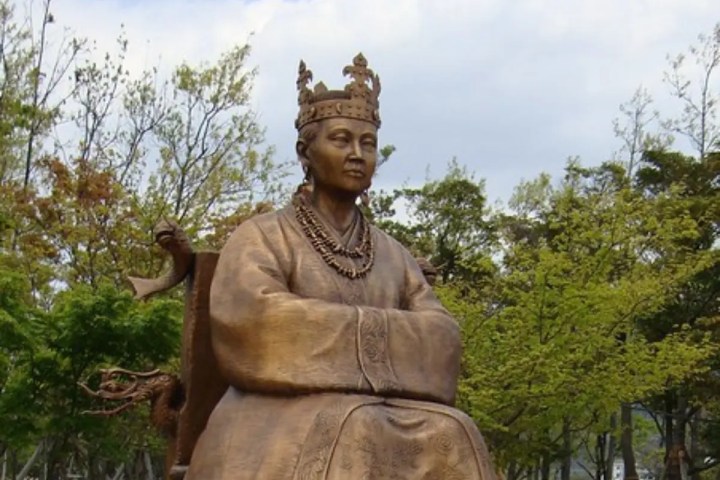
- December 2025: A ten-foot bronze statue of Queen Heo Hwang-ok, imported from Korea, was unveiled in Ayodhya
Legend as Living Diplomacy
Today, the Gimhae Gaya Theme Park in Korea even presents a musical retelling of this ancient love story, transforming legend into cultural performance.
As relations between India and Korea continue to deepen, this divine marriage remains a reminder that diplomacy is not built on treaties alone, but on stories people choose to remember and honour.
Ambica Gulati is a journalist and editor whose work explores global affairs, travel, environment, and the intuitive arts. From short stories to wellness mantras, she focuses on meaningful experiences in a complex world.
From the Archives
If you enjoyed reading this, you may like to continue the journey:

 Queen of Treasures
4 thoughts on “A Divine Dream That United India and Korea”