

Kaizen or the art of improvement is a Japanese concept floated by Masaaki Imai. The easy principles can be applied in any area of life: social, working, home or personal.

In the early days of my career, I edited a magazine related to management and soft skill practices with focus on training and development. While the subject area was all corporate, it helped me gain insights into being a productive professional and create a work-life balance. Over the years, some lessons became healthy habits that carried on to my personal life.
Looking back, it was the good old practice of constant learning and always upskilling that has helped me in the toughest of times. I am sharing the best practices that help me stay on top of the game.
What is Kaizen?
The Japanese art of improvement is called Kaizen. Kai is change and Zen is good. Simply put, it means the art of constantly improving all areas of life: social, personal, home and working.
The principles for improvement were created by Masaaki Imai. Born in 1930 in Tokyo, he passed away in June 2023 at the age of 92. I had attended his live workshop in Delhi in 2002; he was 75 years old then. He founded The Kaizen Institute in June 1985, at the age of 54. He wrote three books on Kaizen, the last one being at the age of 90. I haven’t read any of the books, but picked up about the art of improvement from his talk.
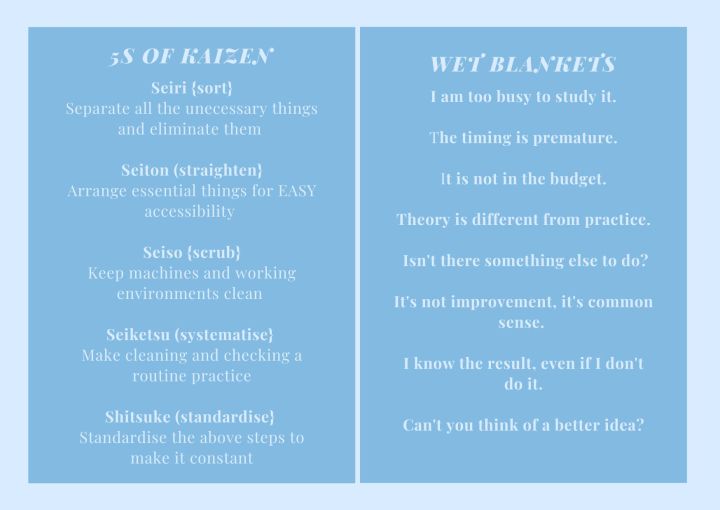
Improve yourself and your life with these practical principles
I am putting the learnings in a point format, so it’s easy to understand. When you put these into practice, keep in mind which area of life you are focussing on. In management, data and worksheets matter. If you are choosing to do this for yourself, then do keep a pen and notepad handy to jot down the thoughts as they come. Treat yourself as the CEO of your life and how you are going to reach your designated spot.
1. The decision maker or you must always be motivated to make the change. Keep your focus on the change and don’t lose heart. Change was never a fast process.
2. The process of change would comprise three activities: Develop, Produce, Implement. What do you want to develop or have developed? What is it going to look like? How would you execute your ideas into practical ways to achieve your produce/product/goal?
3.The changes should be made in the place of action, that is known as Gemba in Japanese. For instance, for personal changes, view yourself and your space, then see what you need to do. Maybe a new haircut will make you feel on top of the game. Learning a new skill or upgrading your skills would put you on top of the game too. Maybe you would like to buy a new table for your workspace.
4. Begin by defining your vision and then work on the mindset. Identify the root cause.
What is the problem? (What?)
Why is it a problem? (Why?)
Where is the problem located? (Where?)
When did it become a problem? (When?)
Who is it a problem for? (Who?)
What is the impact of the problem? (How much?)
If you have no money, use your brain. If you have no brain, sweat it out.
Japanese proverb
5. Focus on change with growth rather than innovation. Take small, regular and disciplined steps. Use existing resources. Innovation requires more energy, much bigger steps, more resources, and you might not be ready for that.
6. Map your goals through SMART objectives (Specific, Measurable, Achievable, Relevant, Time-bound).
7. Set clear targets so that you can make change without spending much money.
8. Evaluate to design your solutions and eliminate Muda or waste.
9. Always keep a record of your activities and continuously cross check. Quality is the key to the best change. Keep quality control.
When in a crisis, do Kaizen
Masaaki Imai
10. Stay in Gemba and observe. Do not miss information. Stay in the place of action, remain motivated and stick to your goal. Keep giving yourself cues through documents, signs, symbols, pictures, sketches.
11. Most people lose steam due to the 3K’s: Kiken (dangerous), Kitanai (dirty), Kitsui (stressful). Change is scary, it needs work and it can be very stressful. Develop a support system. Always be open to learning, communicating, seeking advice.
Wisdom comes from everywhere, never overlook the lesser educated.
Masaaki Imai
12. If something goes wrong, observe it, fix it.
13. Along the way, maintain a record and keep measuring your performance. Then, standardise it.
Remember, Kaizen means continuous improvement. After seeing the productive results with one goal, work on betterment of another one. Small steps, assured steps.

A short exercise to begin with

Find a quiet corner in the house. Take a pen and a notepad and list the one thing you want to change. Why do you want to change it? What do you hope to achieve? Who can help you on this path—is it a person or education or something else?
Keep noting your thoughts. Give yourself an hour and close the notepad. Keep it in a safe place.
Give yourself a nice break for a few hours, don’t think about what you have written. After the refreshing break, sit down and evaluate your process. You will gain clarity as you go along. Be prepared for the unexpected in this path of change.
If you stick to the path, you should see the shift in 3-4 weeks. All the best!
This blog post is written for SpeakEasy 3.0 hosted by Dipika Singh and Ruchi Verma .
This post is part of Blogchatter’s CauseAChatter.

 Queen of Treasures
I came across the concept of Kaizen last year. I found it very interesting to work towards personal development. Your post is a comprehensive guide to implement Kainzen in life with a step-by-step process. Thanks for all the tips and guidance.
LikeLiked by 1 person
I am glad you found this useful.
LikeLike
Love the concept of Kainzen, continuous improvement. I personally feel that none of us are perfect but moving towards perfection will make us work harder and in the process we would see us growing.
LikeLiked by 1 person
As I have ADHD, I cannot survive without change. Be it my furniture, career, or anything that I invest time in, in constantly look for a change. When I try to have a routine for a longer while, it would suffocate me. I am relieved to see that there is an art of change as well.
LikeLiked by 1 person
Change was never a fast process. – THIS was like a light bulb going on for me. Everyone thinks that you can just decide today and change. and thats it. but the truth is far from this – and the steps definitely would help keep one on track.
LikeLiked by 1 person
I must commend you for crafting such a comprehensive and thought-provoking article on overcoming challenges through Kaizen strategies. Your in-depth exploration of how Kaizen principles can be applied to problem-solving and decision-making is truly enlightening.
Your article’s breakdown of the Kaizen philosophy and its emphasis on continuous improvement resonates deeply. The concept of incremental progress, coupled with the notion of involving all levels of an organization, speaks volumes about the effectiveness of this approach. It’s remarkable how Kaizen doesn’t merely provide solutions but also cultivates a mindset that embraces change and growth.
The real-world examples you’ve included demonstrate how Kaizen strategies can be applied across various domains. The story of Toyota’s success through Kaizen exemplifies how a commitment to constant improvement can lead to extraordinary results. Additionally, your focus on the personal aspect of Kaizen, and how it can positively influence our daily lives, is a reminder that these principles aren’t limited to the corporate world.
Furthermore, your article’s insights into how Kaizen strategies foster collaboration and engagement among teams are invaluable. The idea that every member’s input is not only valued but actively sought after fosters a sense of ownership and empowerment. This collaborative spirit can undoubtedly foster a more positive work environment and enhance problem-solving capabilities.
Your thorough breakdown of the Kaizen process, from identifying problems to implementing changes, provides a practical roadmap for anyone seeking to apply these strategies. The emphasis on data-driven decision-making and the PDSA cycle (Plan-Do-Study-Act) is particularly noteworthy. This approach ensures that changes are well-informed and yield measurable results—a crucial aspect of any successful problem-solving methodology.
In conclusion, your article has not only shed light on the transformative power of Kaizen but has also inspired a fresh perspective on how challenges can be navigated effectively. Your eloquent writing style, coupled with your well-researched content, makes this a must-read for anyone seeking to enhance their problem-solving and decision-making skills. Thank you for sharing such valuable insights, and I look forward to reading more of your work in the future!
LikeLiked by 1 person
A very thought provoking and comprehensive article on change . As rightly said, change is the only constant and we need to change for a better future. And also to be a better version of ourselves. Loved the concept of Kaizen and the step by step guide to bring change.
LikeLiked by 1 person
I really liked the way you shared to find the root cause of the probe based on Kaizen strategy. If we can answer them half battle is won!! Great post keep sharing such inspiring articles.
LikeLiked by 1 person
Kaizen was really eye-opening and something that can be applied in daily life. I especially liked how SMART was broken down in such precise and clear words that can truly improve how good change will impact our lives from all perspectives. Thanks for sharing this.
LikeLike
I have read about Kaizen in the past, but thank you for elaborating it for readers. It has all the ingredients to achieve dreams and stay focused. Thank you for participating in SpeakEasy.
LikeLiked by 1 person
Ive heard about Kaizen but not read its book or had any detail knowledge about it. After reading this post and gaining some insight on how it works, i am going to read more on this and try implementing it.
LikeLiked by 1 person
Kaizen ..New concept for me. The line which caught my eyes was ” Be a CEO of your life” You have explained everything in this single statement.
LikeLiked by 1 person
Yeah..taking charge is a good 💡 idea
LikeLike
I have heard about Kaizen, however never got into such detail. Your post have given me a lot of clarity on what is Kaizen and how it can enrich our life.
LikeLiked by 1 person
The concept of Kaizen is completely new to me. Implementing these success techniques will definetly help to improve personal and professional efficiency. Thanks for sharing such an insightful post.
LikeLiked by 1 person
A very comprehensive blog with detailed description of the values. Clear sweet goals is a practice to inculcate!
LikeLiked by 1 person
Kaizen is a new concept for me. I had never read about it before this. Thank you for putting together a great piece on the concept and explaining it so very well. Indeed life is all about imporving constantly and the Kaizen concept very well defines how step by step we can improve life by overcoming challenges
LikeLiked by 1 person