
For all those people, who dig into biryanis and kebabs without a thought, this anthology will make food a language of love and an art that deserves more appreciation
Among the most famous walks in Delhi are the food walks around the Jama Masjid area. Loaded with eateries doling out delish kebabs, niharis, biryanis, ghosht curries, the Muslim dominated community takes us back to the Mughal legacy of lavish cuisine. Then there are the khansamas, the erstwhile halwais and cooks, who cater to all the celebrations. Their mouthwatering and finger licking delicacies turn even the non-foodie like me into a glutton, albeit a vegetarian glutton.
Why am I beginning this review with this walk? In the current context when Muslim communities are lynched, the culinary heritage that comes from Muslim kitchens gains more importance. Food has always been a community builder; it has the potential of being a ‘love language’ as the editors point out in the preface to this book.
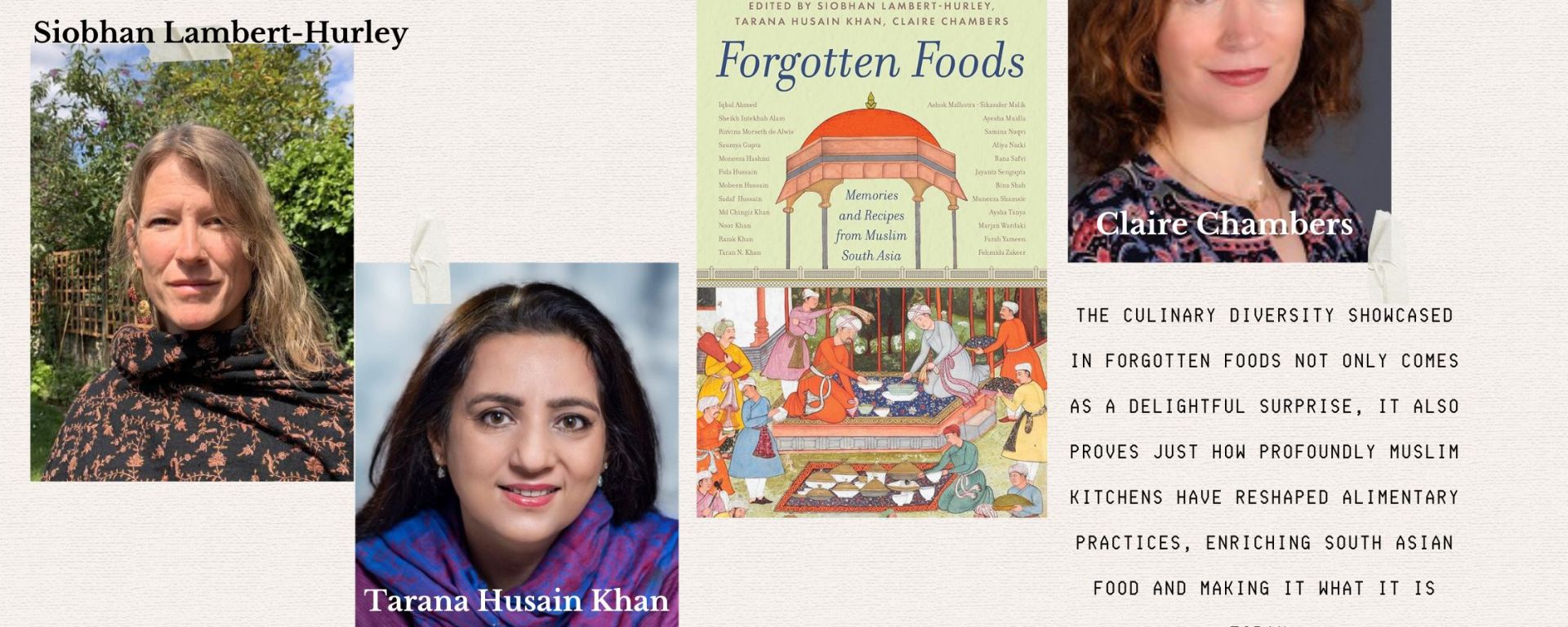
The editors—Siobhan Lambert-Hurley, Tarana Husain Khan, Claire Chambers—worked on the research and public engagement project, ‘Forgotten Food: Culinary Memories, Local Heritage and Lost Agricultural Varieties in India’, for years before giving it a shape in the form of a book. If you haven’t read the precursor Desi Delicacies: Food Writing from Muslim South Asia, published in 2021,then now is the time to add that to your list as well. You can read all about it here.
The project was funded by the Global Challenges Research Fund through Arts & Humanities Council in the United Kingdom (2019-2023). The main goal of the academic research was to ‘improve lives and opportunity’ by addressing the United Nation’s sustainable development goals. As you read through, you will understand how the editors made their selection, “a response to the devastating assault on food cultures connected to Muslim communities in contemporary India”.
The book is replete with stories and unique recipes by 33 eminent historians, literary scholars, plant scientists, heritage practitioners, writers and chefs. It is a journey through Pakistan, India, Sri Lanka. It breaks stereotypes of food preferences and habits.
Unlike 3-second opening hooks propagated on reels, these stories touch hearts; they ignite the fire to know more and taste more. Foodies will also cook more! Like many, I enjoyed reading what the famous Urdu poet Faiz Ahmed Faiz ate and where he lived. His daughter has shared a healthy ‘Sarson ka Saag and Spinach’ recipe.
Another story that I liked was ‘Food Myths and Unani Recipes’. For the uninitiated like me, the world of Unani medicine is a Pandora’s box. I want to use the kitchen ingredients for getting rid of my wrinkles, warts and sunspots, all the signs of ageing. The story ends with three good tips.
There is a very poignant incident of the murder of 15-year-old Junaid Khan, penned by Siobhan Lambert Harley in her story, ‘You Are What You Eat’. Victim of mob attack because of the prevalent belief that ‘Muslims eat beef’, she gives this teenager a tribute by sharing the recipe of soyabean biryani that he loved.
Exploring the world behind the food proved to be a more satisfying experience. Cooking might not be my forte, but stories are another dimension—their power to survive eras and changes is something to be reckoned with. Also, I am not a fan of fast food or restaurant kitchens.
This book explores the explosion of cultures, regions and their ability to form a new culture. It gives an idea about the way erstwhile kitchens worked, beyond Wonderchef utensils and microwaves. Slow cooking, huge stone pots and clayware, fresh herbs and spices adding to the flavours, creating everlasting memories.
It also reminded me of the days when travel writing focussed on collecting information to understand cultures and countries. (The era of listicles has changed that). The vivid descriptions and recipes remind me of the many trips I have undertaken but never got down to documenting stories that make a difference.
To understand food, you need to slow down, inhale the fragrance of spices and then prepare your dish. This is definitely a book for those who like to savour a healthy and flavoursome meal with a close-knit community. A good meal turns a foe into a friend, we all agree with that.
The bonanza is the QR codes that you scan to watch a documentary on Rampuri cuisine and celebration of food with Jashn-e-Benazir, a Rekhtigoi performance, on YouTube.
Book Details
Publisher: Picador India (Pan Macmillan India)
Language: English
Paperback: 296 pages
Price: Rs 499 (Kindle Edition available)
This book was part of the blogger outreach programme by Pan Macmillan India. However, the views expressed are under my editorial purview.

 Queen of Treasures
2 thoughts on “Book Review: Forgotten Foods: Memories and Recipes from Muslim South Asia”