

In a world overrun with digital algorithms, the quiet pace of the forest and the gentle waters of the wetlands act as a balm for the soul. The mesmerising flutter of waterbirds, the sweet songs in the forest canopies, curious deers and the search for the elusive tiger and magnificent elephants are enough to soar the spirit.
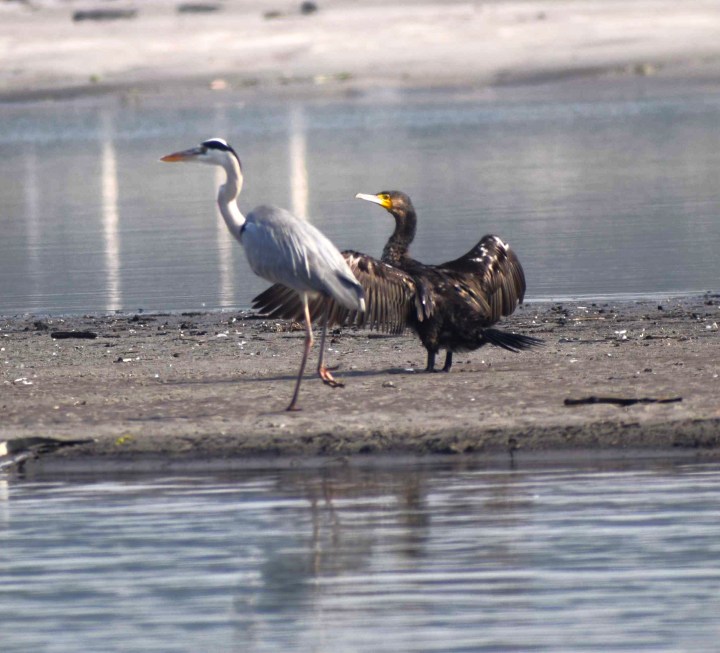
My tryst with Nature is just a decade old. Perhaps, it began as a simple jungle safari, but has now turned into respect for the abundance it nourishes, the surprises it yields and the beauty that resides there.
The USP: it is the best teacher and the best healer.
Perhaps, this is why I never miss a chance to escape to Nature’s cradle. Most of my nature escapes are to city parks, but then I got an invite by the district magistrate’s office, Bijnor, to discover the hidden gems in Bijnor—Haiderpur Wetland and Amangarh Tiger Reserve. The good part: the 48-hour exploration of the nature reserves proved to be a digital detox, a learning on community-led conservation practices and birds, jungles and riverine life.
In a span of few hours, an army of 20 birders and wildlife enthusiasts spotted many winged and furry species.
Haiderpur Wetland
A man-made wetland,this UNESCO Ramsar Site is located within the boundaries of Hastinapur Wildlife Sanctuary. Fed by the river Ganga and its tributary river Solani, this was formed in 1984 when the Madhya Ganga Barrage was constructed. It shares borders with the neighbouring Muzaffarnagar district. There are eight to nine villages on the periphery of the sanctuary.


Haiderpur Wetland lies on the strategic Central Asian Flyway, an important stopover site for winter migratory birds. It supports a diverse species of plants, animals and birds. This includes over 30 species of plants, more than 300 species of birds including 102 waterbirds, around 40 fish and more than 10 mammal species. Besides being a migratory paradise, it is also the breeding ground for thousands of birds.
An easy trail of 15km with viewing huts at strategic points, Haiderpur Wetland is a treasure trove for nature lovers. Our walk through the sanctuary was conducted by avid birder Ashish Loya and his team of young naturalists, who are natives and trained by Loya. He heads the Art of Living centre in Bijnor and has been instrumental in creating this community of nature enthusiasts. The initiative is supported by the district administration.
Each youngster brings a different expertise to the nature walk, adding more value to the birding experience. Ashish Gujjar, the most experienced, is adept at identifying the calls of the birds and rediscovered the near-threatened Indian grassbird (Graminicola bengalensis) there. Gaurav Singh keeps a lookout for the last bird and has saved many a suicidal human being from jumping off the barrage. There is a young 17-year-old in the team as well. Loya has also trained a group of enthusiastic girls, who have broken barriers in their community by choosing to become a part of the conservation movement.
These young enthusiasts also sensitise their community and the neighbouring villages about the need to keep the area pristine and welcoming the winged and furry friends. Their efforts, combined with measures undertaken by Worldwide Fund for Nature (WWF) and supported by the district administration, have yielded positive results–poaching and land encroachment have come down, the forest department created an entry barrier with a guard, there are cycles on rent to explore the wetland. The area is clean, as plastic is banned and other garbage is cleared immediately.
The barrage has proven to be haven for 15 globally threatened species such as the critically endangered Gharial (Gavialis gangeticus), Hog Deer (Axis porcinus), Black-bellied Tern (Sterna acuticauda), Pallas’s fish eagle (Haliaeetus leucoryphus), Indian Skimmer (Rynchops albicollis) and Gold Mahseer (Tor putitora). The sanctuary is also believed to be a refuge for the vulnerable Swamp Deer (Rucervus duvaucelii) during its seasonal flood-driven migration. It is also the state animal of Uttar Pradesh.

It’s easy to spot the gharials, cormorants, turtles, but the river dolphins have travelled further away, possibly due to human activity (the ghat is used as a funeral and prayer ground) and the closed gates of the barrage.
As we walked on the designated trail at the edge of the wetland, we spotted waterfowls such as Bronze-winged Jacana, Lesser-Whistling Duck, Grey Heron, Black-necked Stork, Red-crested Pochard, Coots, Great Egret. The site supports more than 1% of the population of Greylag Goose (Anser anser). The nearby branches swayed with the flitting of Oriental Magpie Robin, House Crow, Jungle Crow.

Endangered Indian Skimmer, photo courtesy: Jasminder Singh Waraich, taken at Ganga Barrage, Haiderpur Wetland, Bijnor, Uttar Pradesh, India 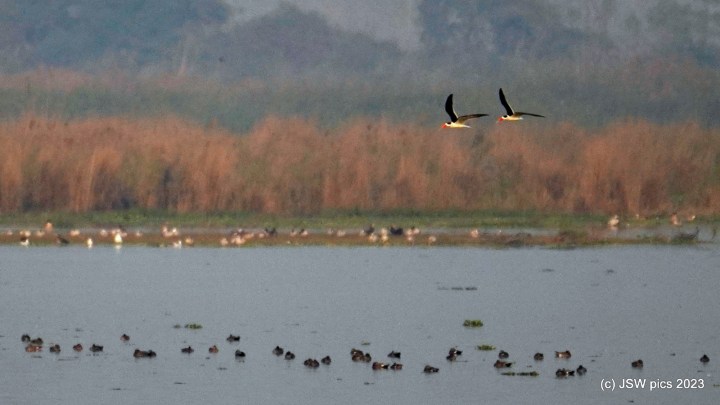
Endangered Indian Skimmer, photo courtesy: Jasminder Singh Waraich, taken at Ganga Barrage, Haiderpur Wetland, Bijnor, Uttar Pradesh, India
Of course, we needed more time to observe the smaller birds in the shrubs. But one patient birdwatcher, Jaswinder Singh Waraich, did manage to see the coveted Indian skimmers—two of them skimming the water surface in search of food. Loya and other seasoned birdwatchers say they have changed their habitat, gone 20km downstream now, as the barrage has too much water. “The entire riverside is an eco-sensitive zone, not just the wetland borders,” said Loya.
The evening at the Madhya Ganga Barrage ended with stargazing. It being a clear sky, we saw Saturn with its rings. The district administration has established astronomy labs in schools and astronomy courses are conducted by Delhi-based startup AstroScape. The young man behind the programme is a self-taught astronomer, Aryan Mishra, who is credited with finding a near-Earth asteroid at the age of 14. The children are taught the basics of a telescope and how to watch the stars. They even have a special Khagol Ratri, a monthly night sky watch.
Nature had more wonders for us the next day.
Amangarh Tiger Reserve & Pili Dam
The morning safari at Amangarh Tiger Reserve (ATR) began with birdsongs and furry friends in search of food.I have visited Jim Corbett National Park many times, but ATR was a new experience. Adjoining the Jhirna zone of the famous park, this buffer zone was created in 2012 as part of Project Tiger. Today, it boasts of 32 tigers. Spread across 95 sq km, it opened to the public in November 2022.

The morning filled with swaying forest canopy, the path strewn with elephant dung and tiger pug marks, this safari was as serene as any winter morning could be. Sunlight filtered through the trees, as deers foraged for food, crossing our path frequently.
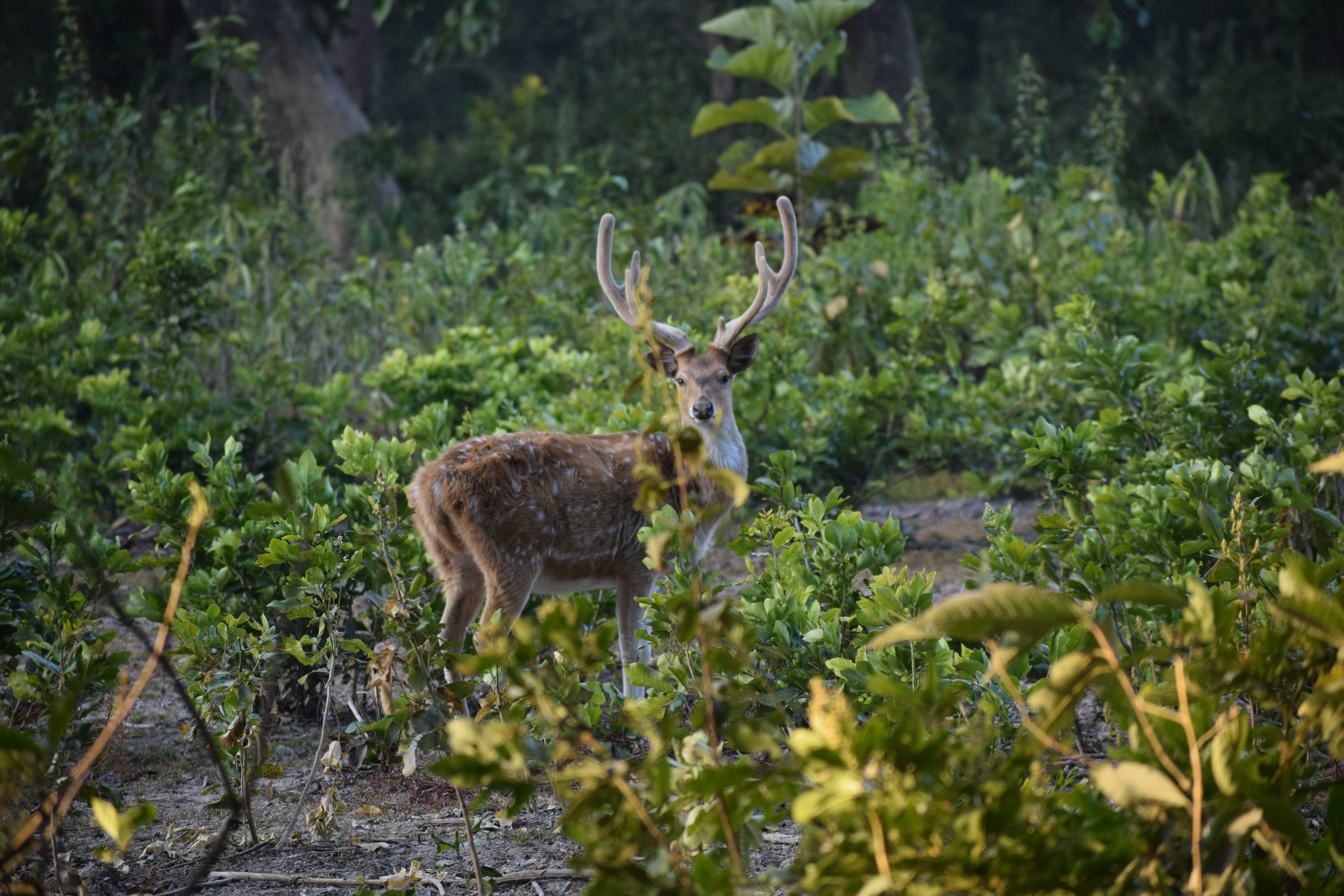

The Spotted Deer continued his breakfast as the shutters clicked. More spotted deers and sambar retreated behind the trees. We chased the fresh tiger pug marks, all to no avail. Elephant dung made us turn our heads in all directions, hoping to catch a glimpse of the gigantic one. The agile langoors watched us with suspicion.


With binoculars moving to the sound of bird calls, it was an exhilarating few hours here in the pristine environs. It is home to Minivets, Alexandrine Parakeet, Red Junglefowl, Rock Pigeon (Feral Pigeon), Eurasian Collared-Dove, Spotted Dove, Yellow-footed Green-Pigeon, Greater Coucal, Little Swift (Indian House Swift), Oriental Honey-Buzzard (Crested Honey Buzzard), Crested Serpent-Eagle, Changeable Hawk-Eagle, Black Kite, Forest Owlet, Great Hornbill (Great Pied Hornbill), Oriental Pied-Hornbill, Brown-headed Barbet (Large Green Barbet), Black-rumped Flameback (Lesser Golden-backed Woodpecker), Plum-headed Parakeet, Black-hooded Oriole, Black Drongo, Ashy Drongo, Hair-crested Drongo (Spangled Drongo), Greater Racket-tailed Drongo, Rufous Treepie, House Crow, Large-billed Crow, Grey-headed Canary-Flycatcher, Red-whiskered Bulbul, Red-vented Bulbul, Himalayan Bulbul, Jungle Babbler, Common Myna, Booted Eagle, Blue Whistling-Thrush, Taiga Flycatcher (Red-throated Flycatcher), Black Redstart, Siberian Stonechat (Common Stonechat), Pied Bushchat, Golden-fronted Leafbird (Golden-fronted Chloropsis).
Adjacent to ATR is Pili Dam. Touted as Asia’s largest earthen dam with a bund of 15km, it is located in Rehar village on the border of Uttarakhand and Uttar Pradesh. The reservoir is fed with water by three rivers-Pili, Dhana and Pheeka. It fulfills the agricultural needs of close to 1200 villages. Environmentalists and conservationists call it a potential Ramsar Site, and we agree for it is home to precious avifaunal species.
Pili Dam is a water haven for animals in the summer. We spotted the Greylag Goose, Ruddy Shelduck (Brahminy Duck), Gadwall, Little Grebe, Eurasian Moorhen, River Tern. Then there were the migratory species, listed as ‘Vulnerable’ on the global IUCN Red List of Threatened Species–Red-crested Pochard and Common Pochard from Central Asia and parts of Europe. The Great Crested Grebe and Hume’s Warbler were also spotted.
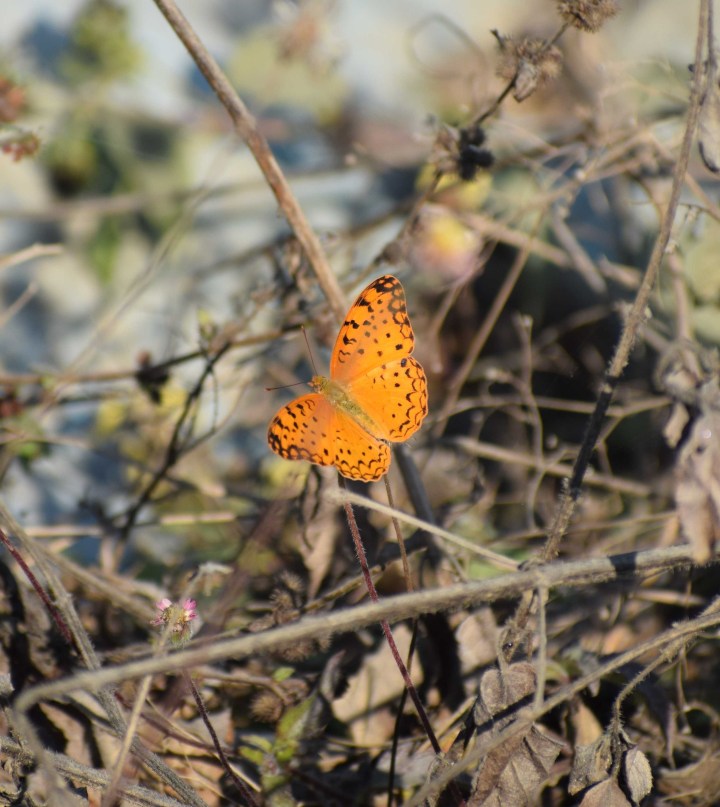
In the neighbouring forest and fields, on tall trees the Great Hornbills kept a watch. Red-whiskered Bulbuls and Common Leopard butterflies fluttered on the edge of the water body.
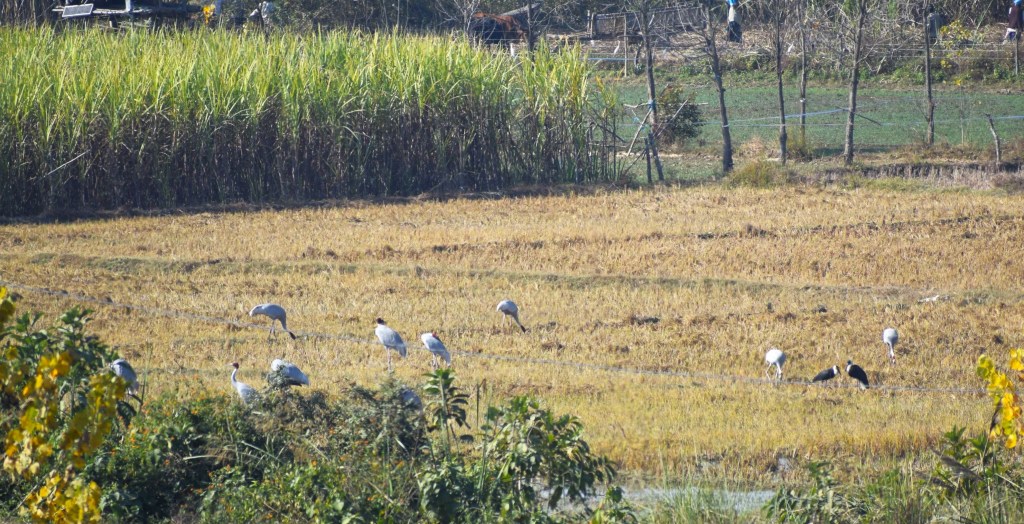
It was enthralling to watch 22 Himalayan Griffons (Himalayan Vulture) circling high above us; 10 Saras Cranes and 2 Asian Woolly-Necked Storks pecked in the fields. The Red-wattled Lapwings shrieked their famous alarm calls.
The 48 hours of digital detox were over, all too soon. However, some glorious moments came back with us, as digital algorithms took over life once again.
How to reach Haiderpur Wetland & Amangarh Tiger Reserve, Bijnor, Uttar Pradesh
It is a 4-hour drive from Noida to Bijnor. It is also connected by road with major cities like Moradabad, Meerut, Haridwar.
The nearest airports are at Dehradun and New Delhi. Dehradun is 142 km from Bijnor, New Delhi airport is 170 km.
Bijnor is connected with Moradabad and Delhi through trains, and Najibabad and Dhampur are major railway stations in district Bijnor. There are trains from Lucknow and Delhi to Bijnor city.
Where to stay in Bijnor
We did not stay in Bijnor, but as Amangarh Tiger Reserve is close to two hours drive from Bijnor, a stay at Royal Castle hotel was recommended.
Entry and safari fee
Both Haiderpur Wetland and Amangarh Tiger Reserve have an entry fee.
The cycles within the Haiderpur Wetland are also available on rent.
There is a fee for Jeep Safari at Amangarh Tiger Reserve as well; it is best to book the safari in advance.
There are tour guides in both places. For Haiderpur Wetland, you can contact Ashish Gujjar at 6395437851

Nature lovers adhere to the rules of the jungle
1. Silence is important, noise drives away the birds and animals. Put your phone on silent, keep your voices low.
2. Listen to your guide. As natives, they can teach you many things.
3. Wear muted clothes to blend in with the foliage. Wear comfortable clothes and steady shoes.
4. Take dry snacks and water bottles and a garbage bag with you. Birding and wildlife observations need patience.
5. Bring memories in your cameras and phones, do not leave behind any plastic materials.
6. Do not go close to the edge of the water, you might slip.
7. Do not gaze at the animals continuously or go close. Wild animals live on fight or flight syndrome and you never know what the reaction is going to be.
8. Keep extra batteries and back up of your pictures.
9. Do not play music or get off the safari jeep in the jungle.
10. Do not feed the birds and animals. Your food is not their food and it might do more harm than good.
11. A good sunscreen and mosquito repellent help.
12. It’s best not to use chemical-laden face washes and soaps if cleaning yourself in the fresh water bodies.
13. Do not pluck leaves and trees or bring back anything, you never know what bacteria, fungi or virus comes back with you.
This trip was on invitation by District Magistrate, Bijnor, Uttar Pradesh.

 Queen of Treasures
You’ve described so many things so beautifully from the start to end. Just spell bound. I never knew this sleepy small town has so much to offer to tourists. Will surely visit some day. Happy New Year in advance.
LikeLike
Haiderpur Wetland sounds like such a serene place where you can connect with nature whilst observing the wildlife in their natural habitat. This place sounds like a birdwatcher’s dream, with so many species living there. It’s a shame that you didn’t see any tigers in the Amangarh Tiger Reserve, but I guess that is a great reason to return to this little paradise.
LikeLiked by 1 person
What an amazing post. I have never heard about Haidarpur Wetland or the Amangarh Tiger Reserve, but I will put them both on the list for a future visit to India. I love watching animals in the wilde. Unfortunately I do it far too rarely. You didn`t see any tigers?
LikeLiked by 1 person
No, Natascha we didn’t see any tigers as the reserve opened to visitors only in 2022. The animals are used to their habitat and not humans.. it must be more terrifying for them than for us.
LikeLike
How great to enjoy a digital detox for 2 days in the Bijnor Haiderpur Wetlands. Our ornithologist daughter would definitely want to visit and look for all the 102 species of waterbirds. We would just enjoy wandering to see what we could find. Great to hear about the efforts to keep this a welcoming environment for wildlife. I must admit that the Amangarh Tiger Reserve would be more exciting for us. You sure did see a lot on your visit!
LikeLiked by 1 person
These reserves are still not on the tourist circuit, so it was all nice and beautiful.
LikeLike
What a great way to get back to nature and leave the modern world behind as you did spotting all the animals in their natural habitat. The Bijnor Haiderpur wetlands is holding its own when compared to the more famous safaris in Africa. Although here there are tigers! It is quite amazing how many animals you spotted on your trip here.
LikeLiked by 1 person
Wow! That’s a lot of birds in these area. Happy to know that made this into a wildlife sanctuary to serve as a home to these beautiful creatures. We’d love to visit soon and do some bird photography. It would be such an amazing experience.
LikeLiked by 1 person
A small sanctuary but pristine and lovely. I hope you do get a chance to visit it
LikeLike
Haiderpur Wetlands indeed sounds like a birdwatcher paradise. I can’t believe you got to see so many different birds! It’s interesting how Loya and other birdwatchers noticed the Indian skimmer has moved farther to an area that has less water. Too bad you didn’t get to see the tiger at the ATR.
LikeLiked by 1 person
I loved that open area. It was a beautiful experience as it’s a lesser known sanctuary, thankfully.
LikeLike
Oh my goodness! What an honor for you to be invited to experience this. The Haiderpur Wetland and Amangarh Tiger Reserve in Bijnor seem like such a worthy visit, and the workers seem to really care. I can’t imagine the emotional weight of saving folks from jumping off the barrage! The animals seem really beautiful and diverse there, too. What a great place to reconnect with nature and spend time!
LikeLiked by 1 person
Truly, it was a pristine place. very serene and safe.
LikeLike