

Home to the majestic Saras Crane and more endangered birds, Dhanauri Wetlands simmers with an ecological tug-of-war: environmentalists stand guard, farmers seek sustenance and authorities weigh their options. Will paradise prevail?

Wish lists become reality in an uncanny way. For years, I thought about visiting the famed Dhanauri Wetlands on the Yamuna Expressway, Greater Noida, Uttar Pradesh, India, to see the magnificent Saras Crane and other waterfowls. I did get a glimpse of the magnificent bird at Surajpur Bird Sanctuary a few years ago, but the talk of sightings at this oasis has been a lure, until it became a reality in January 2024. This wetland is just a 45-minute drive from my home.
A world away from boundaries, this wetland turned out to be small marshy landscape with few waterfowls and around six Saras Cranes. The fate of these beautiful birds hangs on a precarious edge, as government agencies and environmentalists lock horns over officially notifying Dhanauri as a wetland area in need of conservation and preservation. Enviornmentalists have also rooted for nominating it as Ramsar Site.
What is a Ramsar Site?
The Convention on Wetlands is the intergovernmental treaty that provides the framework for the conservation and wise use of wetlands and their resources. The Convention was adopted in the Iranian city of Ramsar in 1971 and came into force in 1975. Since then, almost 90% of UN member states, from all the world’s geographic regions, have acceded to become ‘Contracting Parties’.

This home of the beautiful Saras Crane was discovered by avid birder Anand Arya in 2014, who saw 150 of them here. The wetlands then came into the limelight, as he approached the Uttar Pradesh State Forest Department to declare the 112 hectares into a wetland. In the last decade, development of Yamuna Expressway, infrastructure for a new international airport, and more residential projects underway, have shrunk the habitat drastically. Added to this are the invasive species.
To understand all about the legal status for Dhanauri Wetlands, read the article here. The matter has now been escalated to the National Green Tribunal. To know more about this, read here.
The Day at Dhanauri Wetlands
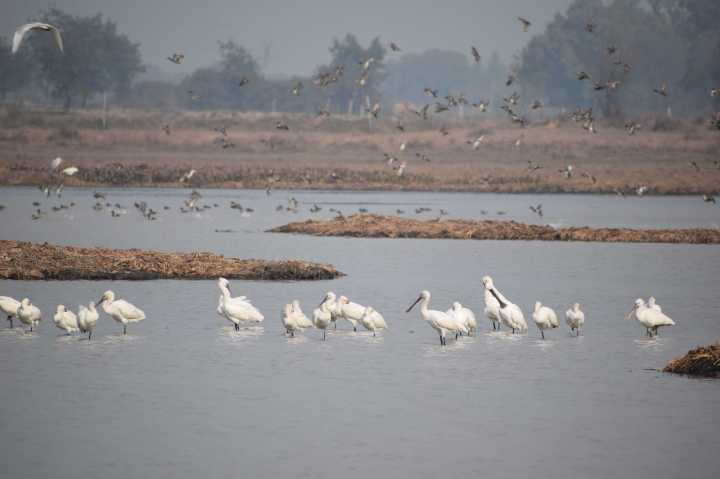
I did not see the 100 plus cranes, or even 10, though avid birders say that they congregate around the small waterbody in the evening, a dozen of them. Old timers claim that they have seen a better population of migratory birds in these waters. The village area would be full of birds: small, big, raptors, grassland loving and nilgais.

However, as everywhere else, urbanisation and infrastructure projects along the Yamuna Expressway have forced the birds to find new homes. I saw signs of residential projects, half-constructed roads marring the habitat. I can’t say that the pleasure of finally visiting the wetland overcame my despondency of seeing the dwindling number of birds.
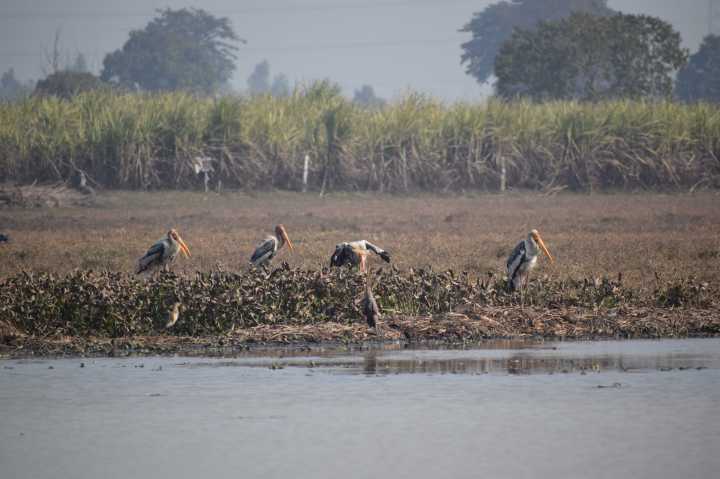
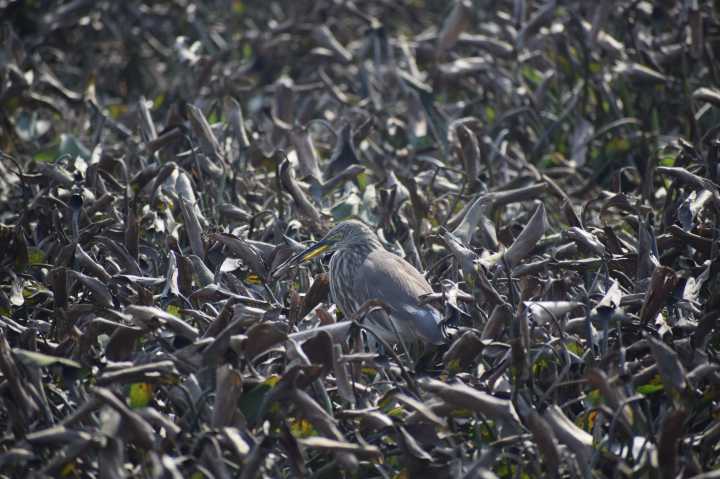
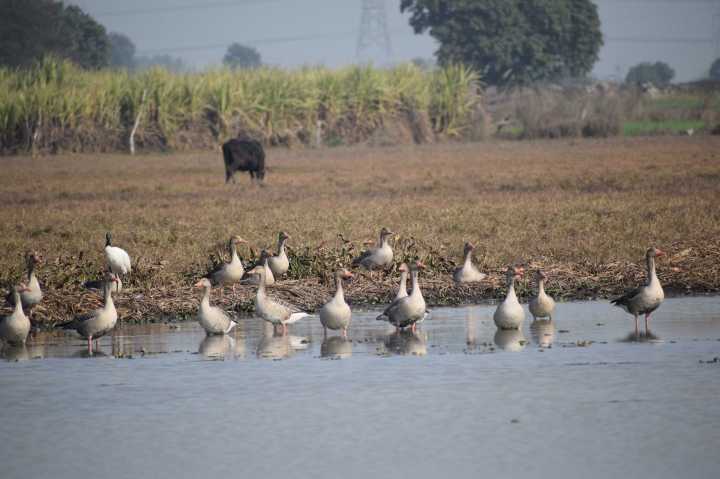
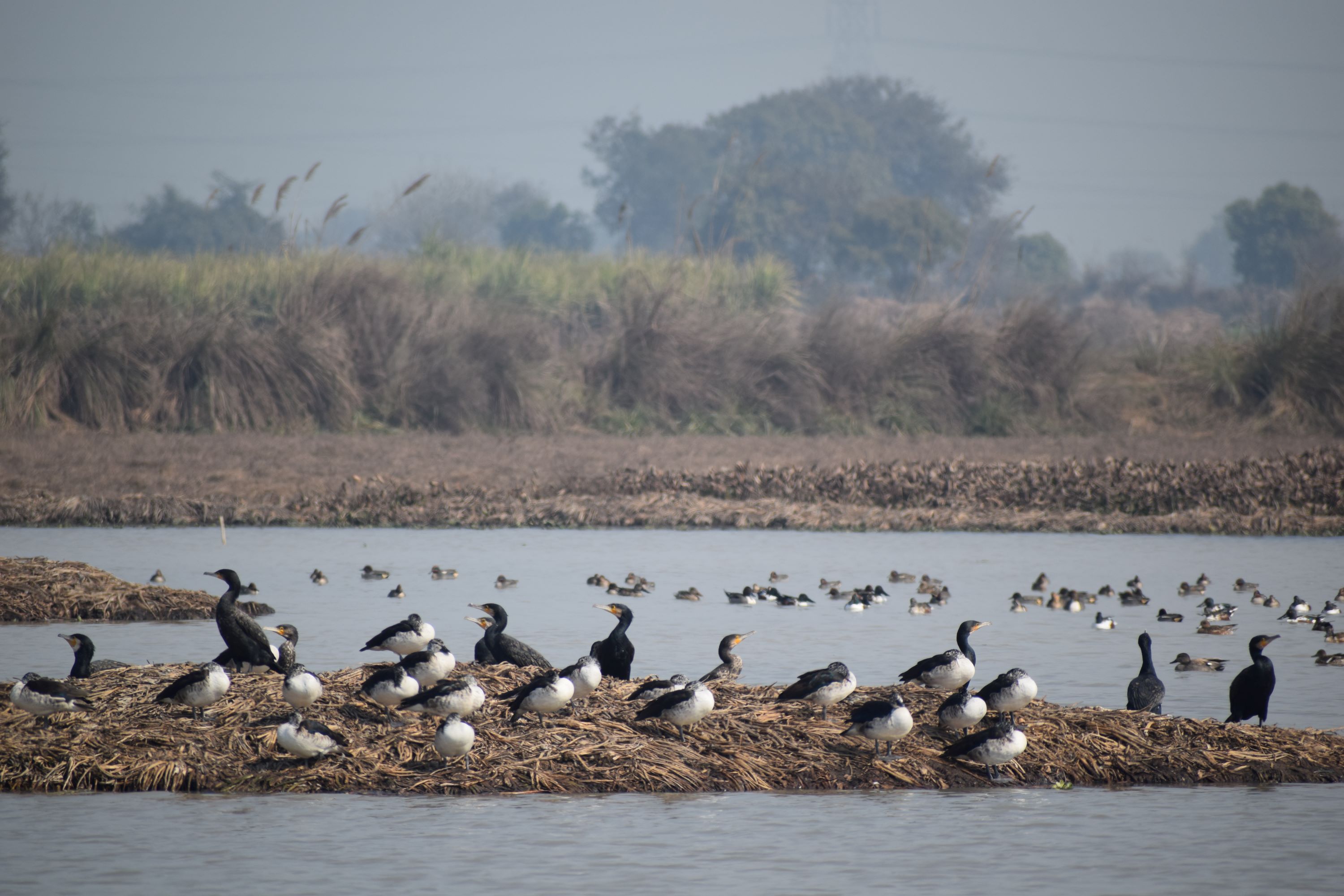
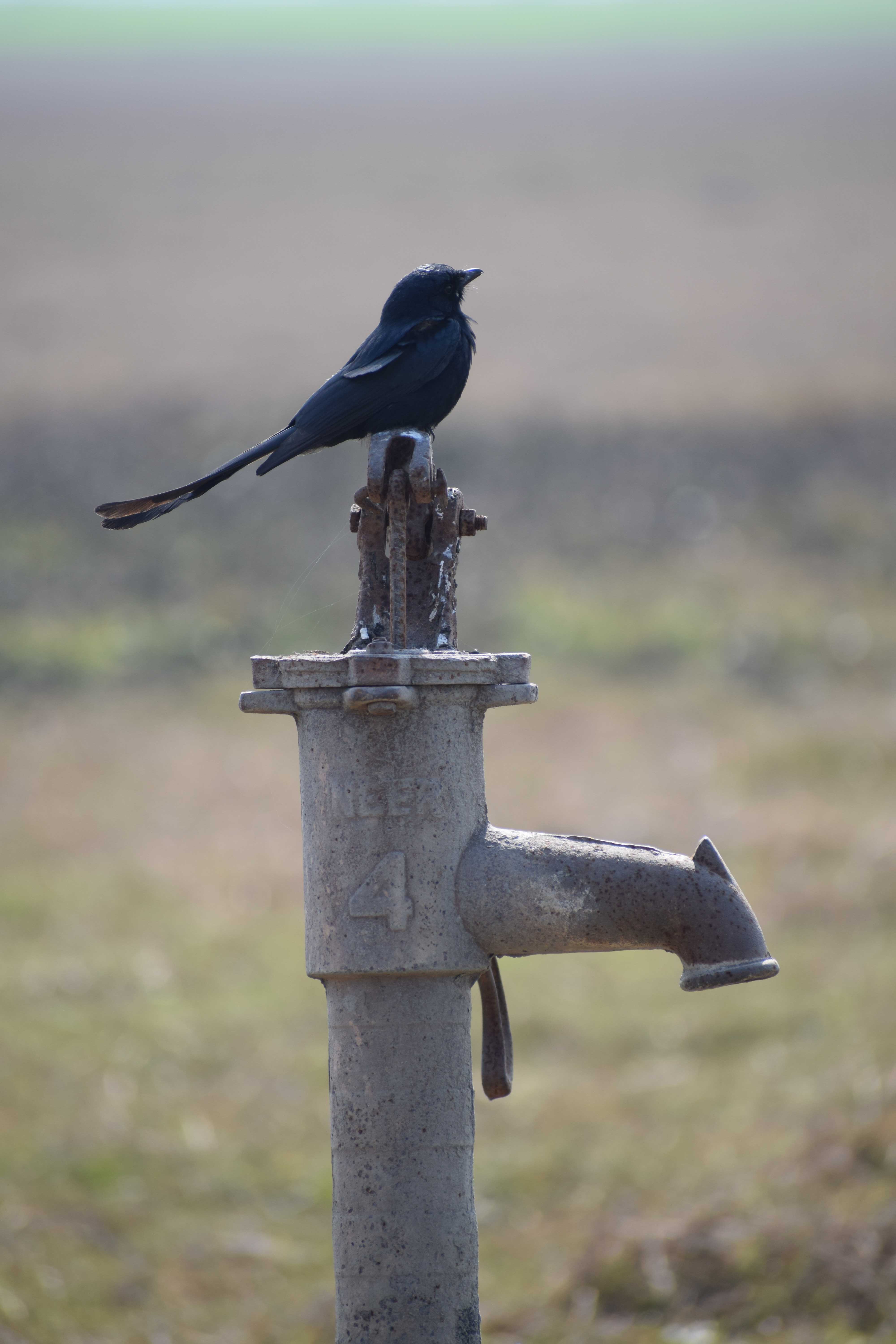
According to reports, the area was home to over 217 species, and I saw around 20 during my 4-hour stay. Of course, I need more frequent visits to spot more avian friends. Some I couldn’t get good pictures of included white-throated kingfisher, weavers, treepie, lark, red-naped ibis, kite, eagle, buzzard, european collared dove, jungle babbler.
World Wetlands Day is celebrated annually on February 2. The theme for 2024 is ‘Wetlands and Human Wellbeing’.

Models of Habitat Restoration
Well, I have visited sites where government agencies and communities have worked together for rewilding and preserving habitats. In fact, in some places the results have been more than rewarding. Take the miraculous case of Cheonggyecheon river going through the heart of uptown Seoul in South Korea. Closer home, the government set up a special committee to make Chilika Lake, Odisha, the state’s best kept secret. The result is flourishing flora, fauna, wildlife and fishing community. Go deeper into the hinterland of Manglajodi, where poachers-turned-protectors have together placed the wetland on the international birding map. More recently, a visit to Haiderpur Wetlands in Bijnor was an eyeopener on youth-centric community helping in preserving the paradisical environs.

Importance of Wetlands
For most of my life, as a city dweller, I have been caught in the glitter of lights, race of cars and air-conditioned glass buildings. But climate change has been an awakening to the natural world. Its impact on health, environment and other life forms has compelled me to see the plight of our companions on this planet.
Read this article, WHAT IS A WETLAND? AND 8 OTHER WETLAND FACTS, by WWF to understand how important wetlands are in the grand scheme of life on the planet.
Wetlands matter:
Biodiversity Hotspot: Dhanauri Wetlands is a haven for diverse flora and fauna, including many threatened species. It acts as a crucial wintering habitat for migratory birds. Loss of the wetland would disrupt vital ecological processes and endanger these species.
Water Security: The wetland acts as a natural sponge, absorbing and filtering rainwater, preventing floods and replenishing groundwater reserves. Its disappearance would exacerbate water scarcity issues, especially during the dry season.
Pollution Mitigation: Wetlands act as natural filters, removing pollutants from water and improving air quality. Dhanauri Wetland helps control pollution levels in Noida, but its degradation could worsen air and water quality, posing health risks to residents.
Reasons for Environmental Degradation
Encroachment: The wetland faces constant encroachment for development purposes like housing colonies and infrastructure projects. This reduces the wetland area and disrupts its ecological balance.
Pollution: Untreated sewage and industrial waste discharge pollute the wetland water, harming plant and animal life. This contamination also poses health risks to humans who come into contact with the water.
Waste Dumping: Illegal dumping of solid waste like plastic and construction debris pollutes the wetland, impacting its ecosystem and reducing its aesthetic appeal.

Consequences of inaction
Loss of biodiversity: The disappearance of Dhanauri Wetlands would lead to a decline in plant and animal species, disrupting the delicate balance of the ecosystem. This could have cascading effects on the wider environment.
Water scarcity and floods: Loss of the wetland’s natural flood control function would increase the risk of floods during monsoon season and exacerbate water scarcity during dry periods.
Public health risks: Pollution of the wetland could pose health risks to residents through contaminated water and air.


What is the best time to visit Dhanauri Wetlands?
Early morning and late evening are the best time.
There are no provisions here, as it is in the middle of the villages. It is best to carry your own food, water, garbage bags.
Bio breaks can be in the shrubs, as the marshy parts have water snakes.
There is a road and you can park your car on the side, but do not play loud music, carry chemical-based soaps, facewashes, handwashes.
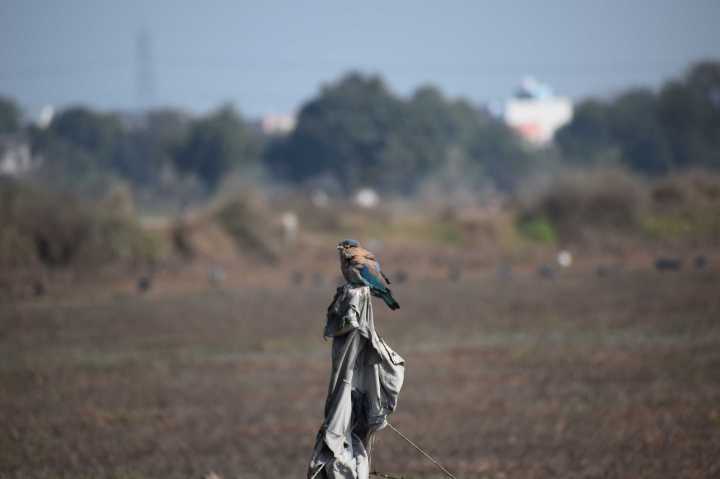
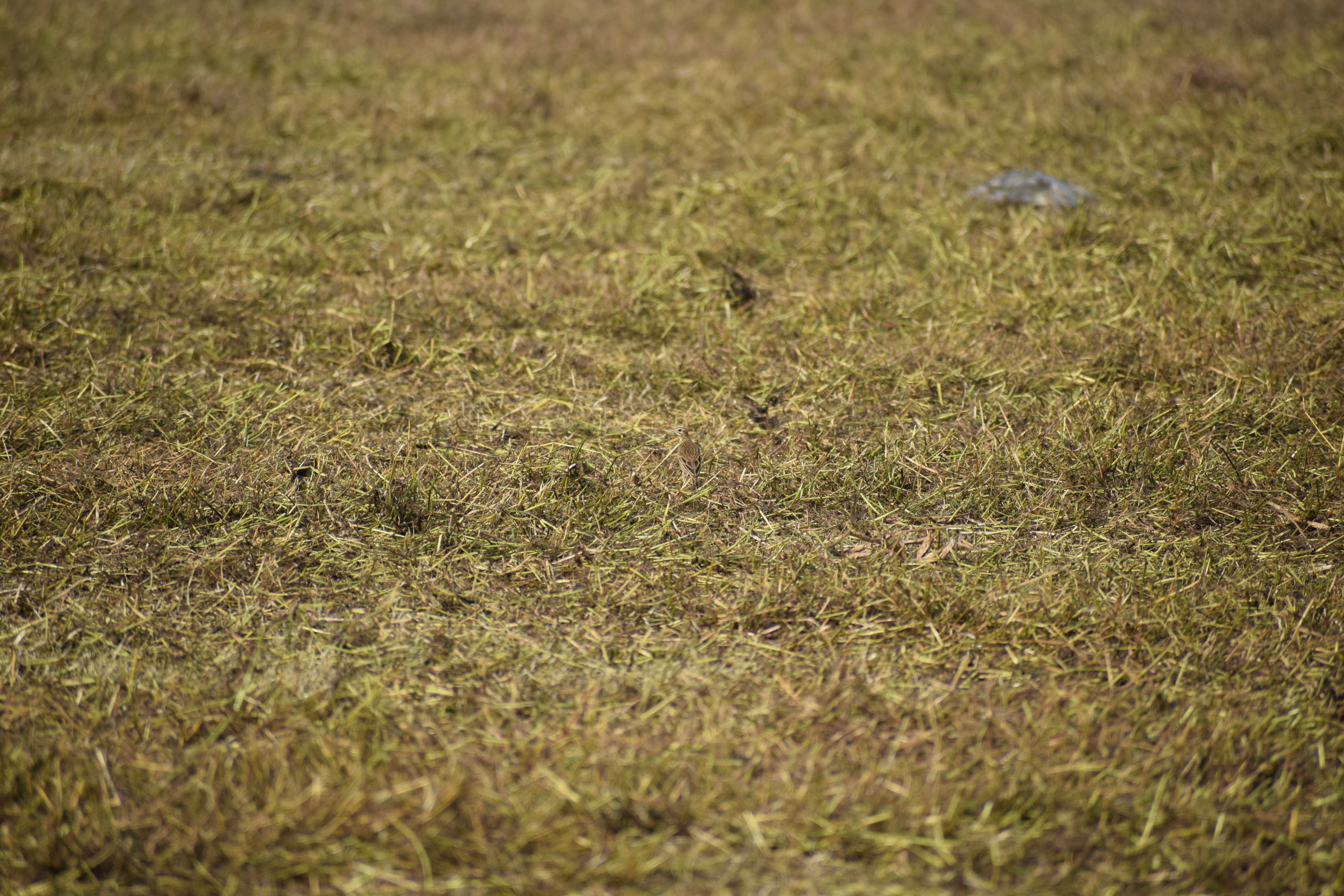
You might like to explore the grassland and see the nests of baya weavers. Other smaller birds can also be spotted here.
Wear waterproof shoes, carry your binoculars and extra battery for your phones and cameras.
Walk along the waterbody, sit around and watch the sky for raptors.
Become a solution by sharing your experiences in the natural habitat.




Where is Dhanauri Wetlands?
This birdwatching area is located in Dhanauri village near Dankaur, Yamuna Expressway, Greater Noida, Uttar Pradesh, India.
How to reach Dhanauri Wetlands
This post is part of Blogchatter’s CauseAChatter.
This blog post is part of the blog challenge ‘Blogaberry Dazzle’ hosted by Cindy D’Silva and Noor Anand Chawla in collaboration with Bohemian Bibliophile.

 Queen of Treasures
Such a lovely place! I wish we humans were more sensible and sensitive… All that damage we do to such places is unpardonable.
LikeLiked by 1 person
Truly! It’s a great place to sit and watch the birds, the villagers just living their lives by that area. I guess, we, in concrete homes need to also learn a lot from them.
LikeLike
Such is the state of affairs that if we pass through this area we will likely think of it as an upcoming landfill. I love the pictures. Thank you for doing your bit for these majestic birds. The cranes mate for life! I did not know that. How sad is their love story that their home is being destroyed…
LikeLiked by 1 person
It truly is sad that we want so much concrete and we don’t fight for green.
LikeLiked by 1 person
I hope many people read this article. The byproduct of progress often leads to environmental destruction. We must find a balance between development and preserving nature.
LikeLike
I am glad that you got to visit the Dhanauri Wetland but too bad it was not as you expected. Always disappointing when natural areas like this don’t have priority. And to learn that local development has forced many of the birds to find new homes. My ornithologist daughter would be very sad to see the wetlands degradation. Good to remind people of the benefits of such biodiversity.
LikeLiked by 1 person
Landfills are a common problem that has in every state. But reading this post, made me realize even we contribute our share to the landfills. Government strict action for it and ways to tackle this waste should be implemented. I have never got a chance to see these birds in live but enjoyed your pictures.
LikeLiked by 1 person
This is such an informative article! I learned a lot about the Dhanauri Wetlands and their importance for wildlife and ecology. You have raised some valid concerns about the impact of development projects on these wetlands. Thanks for spreading awareness about this issue! 😊
LikeLike
Every city is India face the same problem on its natural assets. Landfills, encroachments, unauthorized construction, improper waste management… All these are affecting the nature around it. People now don’t even care it. Some I talked to says its all done to improve human living condition, so its ok. I dont expect any improvement, untill people change.
LikeLiked by 1 person
true, lack of awareness, no vision for long-term scenario and only capitlaistic intents, these are the bane of this century.
LikeLike
All these happens when the focus is on economy alone. There is no holistic thoughts on to create sustainable environment which is needed for ecenomic growth.
LikeLiked by 1 person
I live near Noida and have lived for decades now and never knew about the existence of such a wetland even though I have traveled to that area many times. With the establishment of the Jewar airport, land prices are skyrocketing, and in the race for urbanization, the shrinking wetland may well dwindle unless authorities take quick action and declare it a protected area.
LikeLiked by 1 person
It’s sad to see the end of greens. I have lived in Noida since 1992 and I only see the greens dying
LikeLike
Interesting to know about wetlands and this one in particular. I’ve forgotten all I’ve learnt in school.
LikeLike
Exploring Dhanauri Wetlands through your words felt like a journey into nature’s wonders. It’s saddening to see the challenges it faces, but your insight inspires hope for its preservation.
LikeLiked by 1 person
Dhanauri Wetlands and that too in Noida… I am wondering where I am leaving that i dont know about this place in my locality. I am ashamed of my lack of knowledge. Words cannot express how grateful I am to you for sharing this post and enlightening me with your information about this wetland. I will ensure that I visit this place with my son and no guarantee when he will grow up this wetland will exist anymore or not. When will we people will understand that saving the earth and nature is our responsibility only and we need to work as a team to protect these wetlands still existing on earth.
LikeLiked by 1 person
True, but you must go with an experienced person, for it’s a twisted road through the village and open fields.
LikeLike
This line about Saras Crane, “It mates for life with a single partner. Spiritually, it is considered a symbol of fidelity.” reminded me of the line, “He’s my lobster” from F.R.I.E.N.D.S. It also made me wish that I could witness these beautiful creatures, hopefully soon and before they become extinct. If ,”its degradation could worsen air and water quality, posing health risks to residents” isn’t a wake-up call I don’t know what else would lead to people understanding the importance of such spaces. Thanks for sharing your experience of visiting Dhanauri Wetlands and I applaud your efforts for doing your bit to help save it. Let’s hope more and more people read it and like you spread the word on how it impacts us if spaces like these are damaged.
LikeLike
If we become more sensitive to our world, we would save so much of the beauty around us!
LikeLiked by 1 person
I loved the way you wrote about your visiting experience and include environmental awareness also. The subtitle consequences of inaction effectively highlights the multifaceted consequences of inaction regarding the preservation of the Dhanauri Wetlands. It addresses the interconnectedness of ecological, hydrological, and public health concerns that stem from neglecting the protection and conservation of the wetlands. By emphasizing the potential impacts on biodiversity, water resources, and public health, it underscores the urgency of taking proactive measures to safeguard this critical ecosystem.
LikeLiked by 1 person
The more birds and better habitats, the better our life!
LikeLike
This is such an important topic. The ever expanding population and urbanisation has eaten up everything. We humans should save whatever is left, before too late. Such protected ecological zones are important for species to thrive.
Keep writing gal! more people need to read this.
LikeLiked by 1 person
Thanks for the encouraging words!
LikeLike
We have somewhat similar situation in Mumbai with flamingos in this season. Very well researched post and much needed in current times.
LikeLiked by 1 person
Thanks! I so have the Thane Creek on my list, I hope to surely see it before the birds disappear.
LikeLike
Your post really sheds light on an important issue. It’s heartbreaking to think that such a beautiful and vital ecosystem might be at risk. The struggle between environmentalists, farmers, and authorities is really palpable here, and it makes you wonder what the future holds for this precious habitat. Very well researched post .
LikeLiked by 1 person
A very informative post. I have been living in Noida for almost 30 years now and have been green belts gradually converted into buildings. I hope the authority lets the Dhanauri wetlands remain.
LikeLiked by 1 person
Yes, We have also been living here since 1992, and it’s no longer the green town that was planned.
LikeLiked by 1 person
This is really informative and well-written article. People in India have a vast and deep ignorance about wetlands in general.
Sadly every government in the country have given a strong push for migration towards cities and neglected the rural development. This resulted in the huge profit making land market which looks at land as a commodity to be traded. It’s a very strong force to tackle with. But one has to take that role to safeguard the natural resources and use them sustainably…
LikeLiked by 1 person
We are nothing without our environment! I hope the authorities realise that too.
LikeLiked by 1 person
Thanks Ambica. Very well written and informative. I was not aware of this wetland. Truly sad to see how human encroachment is costing us our bio diversity. I do hope that we are able to protect these wetlands.
LikeLiked by 1 person
I’m saddened by the encroachment and pollution threatening the survival of Saras Cranes and other endangered species at Dhanauri Wetlands. Kudos to Anand Arya for his efforts in bringing attention to the importance of preserving Dhanauri Wetlands for future generations.
LikeLiked by 1 person
I agree with every word you have shared, Ambica. Even we have a bird sanctuary closeby and I love going there but the encroachments and the noise will lead to the birds not returning in future. We are murdering our ecosystem.
LikeLiked by 1 person
Every little bit counts!
LikeLike
Looking from the pictures this place really seems to have been home to many flying friends whom have migrated elsewhere and it is high time this is made to realise that we do not lose out on the very few that come here.
LikeLiked by 1 person
Such a great place Dhanori but it is sad to see such kind of destruction. Government should take proper action and we as a citizen also have to contribute to save this kind of habitats. I
LikeLike
An extremely well reasearched and interesting blog. We see pink flamingos in Pune and Mumbai during their migration, the crane would be fascinatig to see.
LikeLiked by 1 person
I have flamingos on my wish list. I hope I see the sanctuaries and wetlands in Mumbai and Pune
LikeLiked by 1 person
I had visited Dhanauri wetlands when I was really younger. Birds have always held a special place in my heart. Too sad their numbers are dwindling. We really need to take control of our mindless anti nature activities and focus on preserving our mother Earth.
LikeLiked by 1 person
It is sadly the truth of the world we live in, nature has taken a backseat as humans encroach on all spaces and upset the natural balance of the ecosystem. Ultimately though I fear that humans will bear too heavy a price for these choices. and sadly, i dont think there is enough action or awareness amongst the people to make a difference.
LikeLiked by 1 person
Wonderful post …must be read by everyone to open up the eyes of all of us… seriously we humans have become destructible to nature…Informative post
LikeLike
I never heard about Dhanauri Wetland, but I am glad to read your post. You have extensively covered so many offbeat places, and I am glad to be a part of your posts. I have visited Bharatpur Sanctuary once and really loved the place. Cranes are my favorite species, and I plan to visit Dhanauri Wetland this winter only.
LikeLiked by 1 person
I was looking at the pics for a long time…beautiful! And to think that there’s so much politics to allow conservation is disappointing. With pollution on the rise in that part of Inida each year and with so many benefits to be acrued, Dhanauri must be protected.
LikeLiked by 1 person
Dhanauri wetlands that house different birds are a rare treasure. So vivid to see the pictures. This a long detailed post as usual covering all the essentials to carry and not to carry.
LikeLiked by 1 person
I love watching birds – they always make me happy. So, even if there are some faults in the conservation of the Dhanauri Wetlands, I would like to visit the area. I also think it is important, that tourists visit projects like this. Hopefully the responsible people will realize that the conservation of the wetlands really matters.
LikeLiked by 1 person
I have been to a few wetlands before, to try and spot migratory birds – especially flamingos. It’s great that this area has been declared as a wetland and somehow protected, even though there are major construction sites nearby. I can imagine an airport is not ideal for a wetland, where there are a lot of birds. The Saras Crane looks so beautiful, and how lucky that you got to see it. Spotting 20 species of birds in four hours is pretty amazing!
LikeLike
I’m sorry to hear about the dwindling number of birds in the area. I hope we can still do something to save them. It is a sad reality that too much progress and development is not really good. There is a huge need to find the balance and understand the importance of biodiversity.
LikeLiked by 1 person
Eek! Conservation and providing natural habitats is so important. I really hope that everyone can agree and come to the conclusion that it’s essential for the health and future of the birds. The Dhanauri Wetlands really needs proactive helpers, and thank you for bringing this to light!
LikeLiked by 1 person
We need more posts like this to raise awareness of the critical importance of saving the natural habitats and environments where the wildlife thrive. Putting human comfort first on this earth has consequences we are paying for today. It was very nice to see the beautiful pictures of the birds that call Dhanauri Wetlands home and we should really see to it that they continually will!
LikeLiked by 1 person
Sad state. We should do more for nature
LikeLiked by 1 person
Your vivid description of Dhanauri Wetlands paints a poignant picture of the delicate balance between nature and development. The struggle between environmentalists, farmers, and authorities reflects the universal challenge of preserving biodiversity in the face of urbanization. The urgency to protect Dhanauri as a Ramsar Site is well-founded, considering its significance as a habitat for the majestic Saras Crane and numerous other species. The juxtaposition of the wetland’s beauty with the encroachment of infrastructure projects underscores the need for sustainable development. Your call for action, emphasizing the importance of wetlands in biodiversity, water security, and pollution mitigation, resonates powerfully. Let’s hope your words inspire positive change and contribute to the conservation of this ecological gem.
LikeLike
To be honest, I’d never even heard of this wetland. Thanks for spotlighting it, we must do all we can to preserve it. I hope to take my son for a visit soon.
LikeLike