


“One big broad branch slanted upwards at the top of the Faraway Tree. Jo climbed on to it and looked down—but he could see nothing, for a white mist swirled around and about. Above him the enormous thick white cloud stretched, with a purple hole in it through which the topmost branch of the Faraway Tree disappeared.
The children felt tremendously excited. At least they were at the very top. Jo carefully pulled himself up the last branch. He disappeared into the purple hole. Bessie and Fanny followed him.
The branch came to an end and a little ladder ran through the cloud. Up the children went—and before they knew what had happened, there they were out in the sunshine, in a new and very strange land.
They stood on green grass. Above them was a blue sky. A tune was playing somewhere, going on and on and on.”
-Excerpt fromThe Enchanted Wood by Enid Blyton
Like many of you, I immersed myself in Enid Blyton’s (11 August 1897 – 28 November 1968) books during my childhood. Her stories had the ability to transport me to another universe, where the magic of the world unfolded before my eyes—a sensation that lingered well into my teens. Needless to say, she is the first author I encountered in my childhood, and her enchanting tales remain evergreen, unmatched by any other writer. Perhaps the closest contender is Ruskin Bond, who, like a newcomer to the planet, invites us into his world with a similar sheen.
The acclaimed British author penned close to 800 books for children, rising to fame in the 1930s. With over 600 million copies sold and translations into 90 languages, she stands as the fourth most translated author globally.
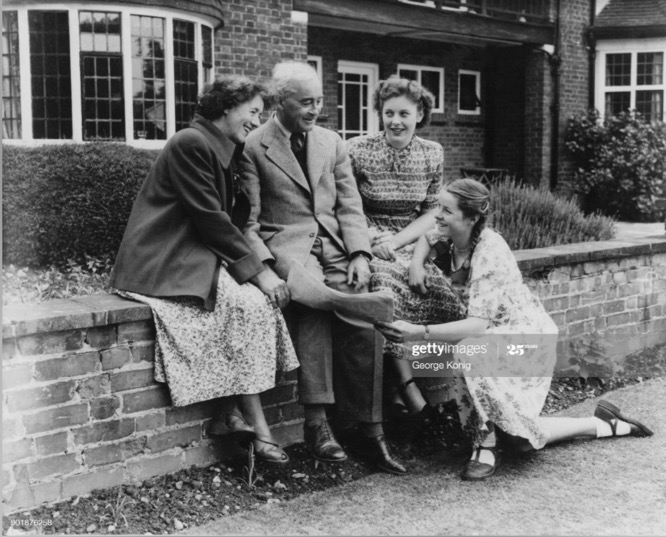
Why Enid Blyton Holds a Special Place in My Heart
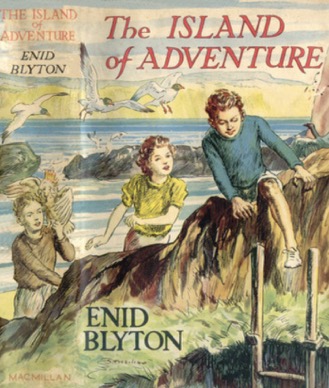
Enid Blyton’s writing exudes a unique charm that transcends generations. Her narratives are characterized by simplicity and honesty, creating a homely atmosphere where characters embody vulnerability, curiosity, and boundless energy. The emphasis on teamwork and an enduring love for the outdoors resonates deeply with me. In fact, I would say that my affinity for the outdoors can be traced back to the adventures of the ‘Famous Five,’ ‘Secret Seven,’ and other characters in her books.
Moreover, Enid’s stories culminate in a happy and learned end—there’s always a lesson and goodwill despite the curvy, turbulent passage through the narrative. Her characters radiate bonhomie.
Based on biographies and accounts of her life, many of her characters, even the pets, were inspired by real people and animals. For instance, Kiki, the parrot in the Adventure books, was based on Enid’s old aunt’s parrot named Kiki. The black cocker spaniel Loony in the Barney Mysteries drew inspiration from Enid Blyton’s own dog, Laddie. Even the stars of the book Bimbo and Topsy, Bimbo the Siamese cat and Topsy the fox-terrier, were real pets belonging to Enid Blyton.
There are narratives suggesting that she modelled the character of George Kirrin, from the Adventure series, on herself.
It was through Enid’s books that I discovered the enchanting worlds of fairies, elves and pixies. I revelled in the adventures of Noddy and his speaking Toyland.
While her books continue to enchant us all, her life and critics attest that being an author wasn’t an easy path for her.
Enid Blyton’s Principles: Reading, Writing, Educating

In her autobiography, The Story of My Life (1952), Enid Blyton recounts that, from an early age, she “liked making up stories better than I liked doing anything else.” At bedtime, stories would flood into her mind “all mixed-up, rather like dreams are, but yet each story had its own definite thread—its beginning and middle and ending.”
Her early realization that she wanted to become a writer set the tone for her life’s goals—reading, writing, and educating. Influenced by books like Black Beauty by Anna Sewell, The Water Babies by Charles Kingsley, and Little Women by Louisa M. Alcott, she aspired to write about real children, much like the characters in her favourite books.
Despite facing rejection, Enid’s determination remained unwavering. Her first published poem at the age of 14 marked the beginning of her remarkable writing journey. She pursued teaching over her mother’s desire for her to become a professional musician and later found encouragement from Mary’s aunt, Mabel Attenborough, to pursue writing.
Enid Blyton’s Early Life
Enid Mary Blyton, the eldest of three siblings (her younger brothers were Hanley and Carey), grew up in Kent amidst a stark contrast in her relationship with her parents. Her father, Thomas Carey Blyton, a lover of nature and adventure, became her companion in exploring the outdoors, instilling lessons of hard work that fuelled her early ambitions. Conversely, her mother, Theresa Mary Blyton, emphasized household chores over the pursuit of knowledge and nature.
Her schooling years at St. Christopher’s School for Girls in Beckenham shaped her academic and creative pursuits, with voracious reading habits fostering her dream of becoming a writer.
However, Enid’s idyllic childhood took a downturn when her parents separated when she was 13. Her father moved to London with his new love, Florence, while her mother maintained a facade of a “pretend and forget” life for the children. This separation had a profound impact on Enid, who found solace in locking herself in her room and expressing her emotions through writing.
Her determination persisted, and she sent stories and poems to magazines from a young age. The publication of her first poem at 14 marked the commencement of her writing journey.
Against her mother’s wish for her to pursue a musical career, Enid chose to become a teacher. She distanced herself from her mother and brothers once she started her training. Despite visiting her father often in London, she struggled to accept his new family and did not attend his funeral.
Upon completing her training, Enid taught at Bickley Park School in Kent and later became a governess to the four Thompson brothers in Surrey. During this time, she ran an “experimental school” with children from neighbouring families.
A Marriage of Minds and Hearts
Enid Blyton’s marriage to Hugh Alexander Pollock, the editor of the book department at George Newnes, marked a significant chapter in her life. The couple’s shared love for literature, coupled with their honeymoon in Jersey, influenced later works like the ‘Famous Five’ series. The early years were characterized by gardening, outings, and seaside holidays, providing the groundwork for the idyllic settings in her stories.
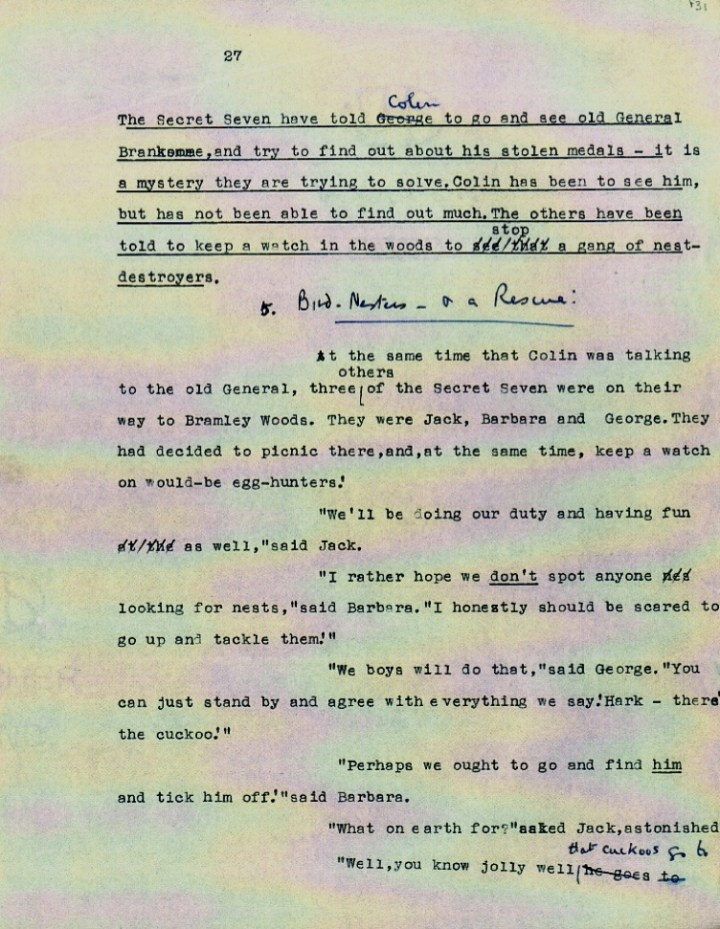
As she delved into educational books and penned her first full-length novel, her writing flourished. The introduction of a typewriter, encouraged by Hugh, streamlined her writing process. The birth of their daughters, Gillian and Imogen, added new dimensions to her life.
Literary Success and Personal Challenges
Enid Blyton’s literary success in the 1920s and 1930s was marked by prolific output and the establishment of her own limited company, Darrell Waters Ltd. The introduction of the fortnightly magazine Sunny Stories for Little Folks further expanded her literary reach.
While her professional life flourished, her personal life faced challenges. Strains in her marriage with Hugh led to their divorce. She subsequently married Kenneth Fraser Darrell Waters, a London-based surgeon, in 1943. The new chapter brought financial prosperity and opportunities for travel. However, the strain of World War II and personal issues created emotional tumult, reflected in her works.


Last Years
Enid Blyton’s health began to deteriorate in the 1950s. Experiencing bouts of breathlessness and a suspected heart attack, she was later diagnosed with dementia. Her final two books (excluding reprints of earlier material) were re-tellings of Bible stories, titled The Man Who Stopped to Help and The Boy Who Came Back, both published in August 1965.
Her husband, Kenneth, passed away on 15th September 1967. Her daughters, Gillian and Imogen, in their 30s by then, visited her regularly at their childhood home, Green Hedges. In the late summer of 1968, Enid was admitted to a Hampstead nursing home, where she peacefully passed away in her sleep on 28th November 1968, at the age of 71. She was cremated at Golders Green in North London. A memorial service was held for her at St. James’s Church, Piccadilly, on 3rd January 1969.
Legacy and Criticisms
Enid Blyton’s legacy is a tapestry woven with threads of enchantment and controversy. Her personal experiences, travels, teaching, and relationships found their way into her books. Her teaching experience offered a glimpse into the world of ‘Miss Brown’s School.’
Her approach to writing was characterized by a lack of pre-planning, more akin to a 3-dimensional mental screen. In The Story of My Life, she explains that she did not plan a work of fiction before starting to write it; instead, she allowed the story to unfold in her mind as she typed, like a movie scene unfolding.
Characters would appear in her head first, vividly described with clear insight into their personalities. Once the characters and setting were established, the story would flow fluently from her fingertips. During her most productive years, she produced around 10,000 publishable words per day, writing an entire ‘Famous Five’ or ‘Adventure’ book in just five days.
Despite raising eyebrows and facing criticism, particularly for her prolific output, Enid remained steadfast, valuing the opinions of children up to the age of 12. The BBC refrained from broadcasting her stories between the 1930s and 50s as her books didn’t meet their literary criteria.
In recent times, criticisms regarding her writing style, portrayals of gender roles, and lack of diversity have sparked debates about her place in modern children’s literature. However, Enid’s life has been portrayed in movies, her series adapted into serials, and postage stamps issued in tribute.
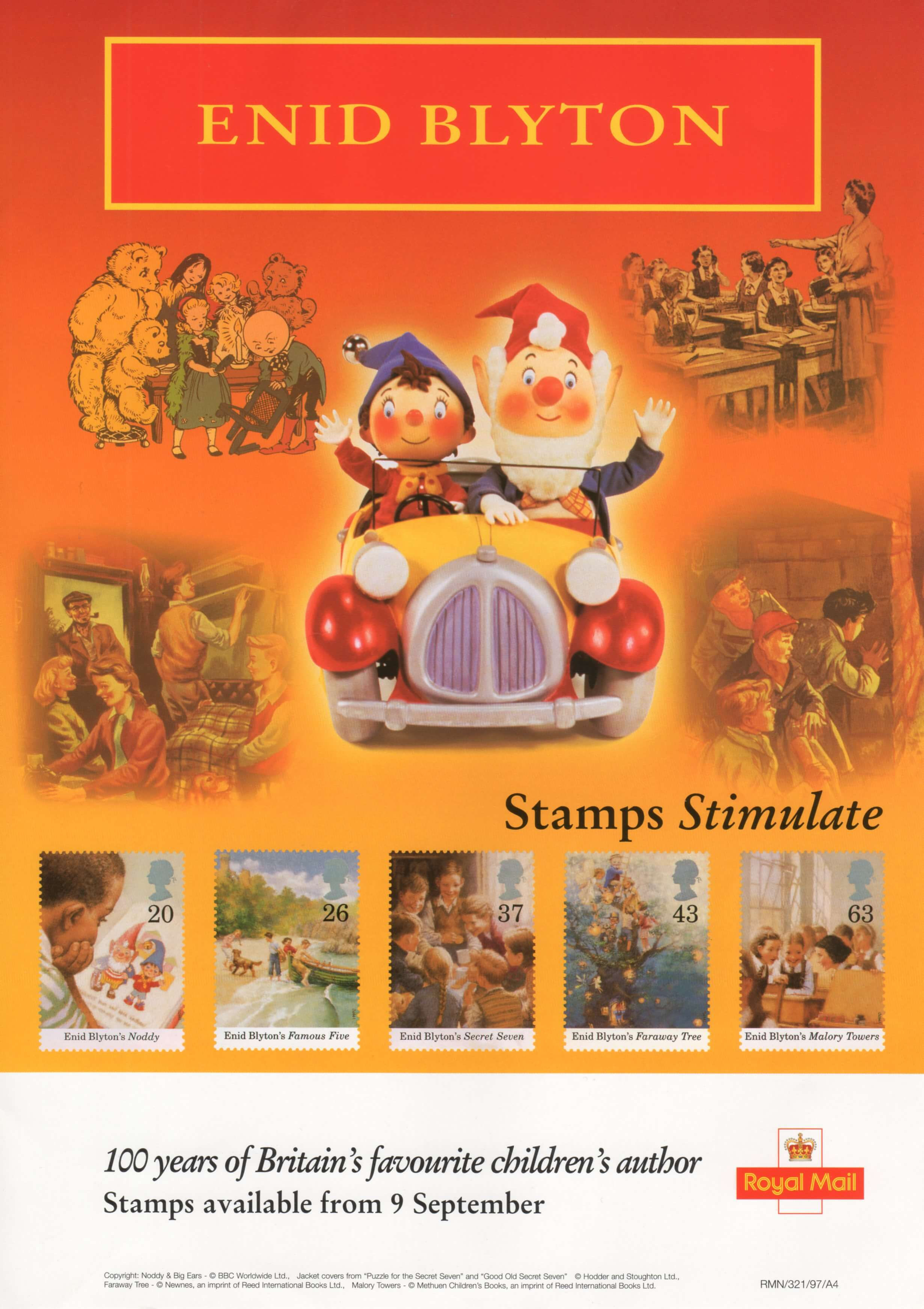


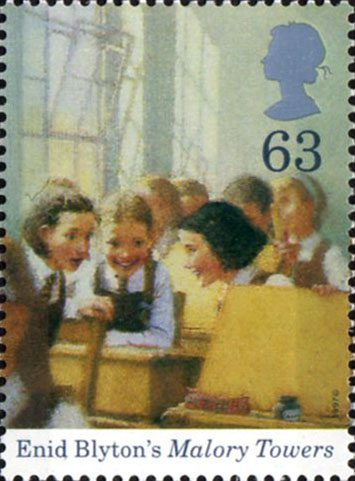
You can read about this stamp pack here.
For me, she remains a powerhouse of honest and inspiring writing. I continue to cherish her books, as they enhance my love for the magic that lies within our planet. She continues to entertain, educate and inspire. Through her books, she encourages us, her readers, to look afresh at the world around them — to observe, explore, investigate, discover and learn.
To quote her advice to all the children who aspire to write: “Fill your mind with all kinds of interesting things — the more you have in it, the more will come out of it. Nothing ever comes out of your mind that hasn’t already been put into it in some form or other. It may come out changed, re-arranged, polished, shining, almost unrecognizable — but nevertheless it was you who put it there first of all. Your thoughts, your actions, your reading, your sense of humour, everything gets packed into your mind, and if you have an imagination, what a wonderful assortment it will have to choose from!”
For an in-depth view of her life, you can go through The Enid Blyton Society website.
To know more and see some real pictures, head to Looking for Enid by Duncan McLaren.
See the chronology of her books on Wikipedia.
Photos courtesy: Enid Blyton Society, Wikipedia, Looking for Enid

 Queen of Treasures
Enid Blyton was part of my childhood too , famous five etc … so nostalgic .
LikeLiked by 1 person
I guess, she has shaped many generations since the 1930s! A wonderful storyteller.
LikeLiked by 1 person
Our all-time childhood hero :) So wonderful stories that built memories for a lifetime. Thanks for writing it. It’s so nostalgic.
LikeLiked by 1 person
true, i hear the audio books and it’s the same feel! some things are timeless.
LikeLiked by 1 person
Ahhh!!! Enid books.. after reading this blog I went to a nostalgic lane, when I used to read his books under the course book🫣 And yes! After him Ruskin bond is keeping the charm of kids stories
LikeLiked by 1 person
Enid is a woman ..hence the his reference I take is a typo error..yes, she is an everlasting memory and I still love her books.
LikeLike
Opps!! Sorry!! Typo 🫣
LikeLike
Wow such a wonderful article. I agree that her writing has influenced childhood of many and I am one among them too but I never thought of dwelling so deep in her life. This article made me close to one of my favorite authors. Thank you for penning it down. :)
LikeLiked by 1 person
Aah… reading this article brought back the good old memories if my childhood which was spent reading Enid Blyton’s books. The famous five , secret seven was love. The article provides valuable information about her life, daughters , siblings which I never knew. Thank you for this detailed post that takes us into the life of an who played a role in entertaining us in our growing up years…
LikeLiked by 1 person
Such a wonderful article! I haven’t read Enid Blyton’s books yet but your article has inspired me to delve into her world. Fairies, pixies and elves are my favourites. Reading her life’s challenges are truly inspiring! Thank you for such a detailed account on Enid Blyton ❤️
LikeLiked by 1 person
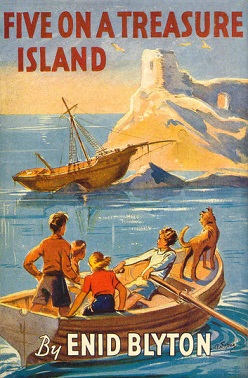
As far as I could remember, five on a treasure island was the first book that my mother helped me to choose and read it thoroughly in my childhood days. And, I truly agree with what you have written above on how Ruskin Bond is a close contender. Enid Blyton’s language is too easy to read I must say.
LikeLiked by 1 person
Very Interesting article. I haven’t read Enid Blyton as I was more of a fairytales child, however I do explore all types of genres from my child’s reading and am gonna check this out for him. Thank you for sharing.
LikeLiked by 1 person
This is such a nostalgic post, Enid Blyton is an author who covered most of childhood and is also my favorite too date. I love every thing she has written and most importantly she is the first entry into the genre of fantasy for me ❤
LikeLike
Enid Blyton is one of my favorite authors of all times. She has been my entry into the world of fantasy with her magical tales, her tales of school have been my utopia to achieve and her mystery tales are my favourite to date. Also the lovely food she mentions in her tales are wonderful.
LikeLiked by 1 person
wow what a wonderful and indepth article. As a reader, I believe we all have been fans of Enid Blyton and I remember vividly reading her books as a kid. What a memory refreshment this article is.
LikeLiked by 1 person
Enid Blyton is one of my favourite Author. I must say it was the time I started spending time in reading seriously. I didn’t know about the stamp release which was news to me but they look amazing
LikeLiked by 1 person
Enid Blyton’s magical narratives, including the ‘Famous Five’ and ‘Adventure’ series, shaped childhoods globally. Her tales, characterized by simplicity and life lessons, fostered a love for reading and the outdoors.
LikeLiked by 1 person
Loved this post, Ambica. Although, I haven’t read any of Enid Blyton’s books yet, but your article makes me want to explore her stories. I am more into non-fiction books but I am surely going to read this one
LikeLiked by 1 person
You will enjoy the books
Simple and heartwarming tales
LikeLike
Enid Blyton is definitely one of the most loved authors of young readers. And people like us can never stop loving her! Really appreciate the efforts you have put into this post. I learnt so many new things about her!
LikeLiked by 1 person
This post got me curious about Enid Blyton’s work. I’m interested in exploring her stories now, they seem like they’d be a lot of fun to read.
LikeLiked by 1 person
Luckily I grew up in a time of no internet, which means that none of her scandals or news reached us, only her books, her wonderful books reached us.. and I have grown up on reading Enid, those stories have been such a profound part of my childhood and my love for reading.
LikeLiked by 1 person
I love Enid and this is a really well written article about her life and books. I did not know she’s written an autobiography too, I’d love to read that. and that stamp collection is gorgeous! I have read all of these books, and I feel even as an old lady I would love to re-read these series… actually, why wait till im older, i should reread them now :)
LikeLiked by 1 person
Apart from the shared love for Enid Blyton, I am amazed at the research and information this post carries. And to be honest, I had one of the stamps that you have shown here, but I had no clue it was related to Blyton. Now to go and relook at the stamp!
LikeLiked by 1 person
How lucky you have a stamp!
LikeLike