

The Kathakar Festival in Delhi promoted cultural exchange and preserved storytelling traditions for future generations. Reliving the magic with international artists, Bollywood stars, and captivating tales.
- All about KATHAKAR INTERNATIONAL STORYTELLERS’ FESTIVAL
- The History of Oral Storytelling
- International Storytellers
- Indian Storytellers
Stories unite us; they make us human. They stimulate us, turning us into deeper-thinking individuals, evoking emotions and triggering action.
The annual three-day storyteller festival, held in the verdant environs of Sunder Nursery in Delhi, was a memorable affair. From Bollywood luminaries to theatre artists and cultural ambassadors from abroad, it spread a message of love, peace, and environmental stewardship.
Over the years, the festival has hosted storytellers from the UK, Australia, Sierra Leone, Mongolia, Switzerland, Estonia, Poland, and many other countries.
I attended Day 2, which featured a grand line-up of oral stories from Sierra Leone, Estonia, and Israel, along with bigwigs from Bollywood.
All about KATHAKAR INTERNATIONAL STORYTELLERS’ FESTIVAL
Kathakar is India’s largest oral storytelling festival. Besides Delhi, special editions are held in Mumbai and Bengaluru. Reaching out to underprivileged children through schools and NGOs, it has touched the lives of over 150,000 adults, children, teachers, and parents to date.
Started in 2010 by NGOs Nivesh and HHACH to preserve and promote the ancient art of oral storytelling, the festival operates under the aegis of UNESCO and is patronized by the Ministry of Culture, India.
The festival is dedicated to the memory of Thakur Vishwa Narain Singh, India’s first Braille editor. One of the two patrons is Sushila Devi, wife of the late Thakur Vishwa Narain Singh. A teacher, writer, and avid reader, she also loves to narrate stories.
The other patron is Mohit Chauhan. An award-winning musician, composer, songwriter, and singer, Chauhan debuted with the band Silk Route. A popular name in Indian cinema, Chauhan has lent his voice to Bollywood stars such as Shah Rukh Khan, Salman Khan, Aamir Khan, Ranbir Kapoor, Shahid Kapoor and more.
His unique strength is breathing new life into folk music by creating new sounds. He has created an international platform for Himalayan folk songs and music. Known as Babaji among his Bollywood friends, Chauhan narrated the story of how he was trekking in the Himalayas when filmmaker and director Imtiaz Ali was trying to connect with him for a song. Ali jokingly referred to Chauhan as ‘the ‘babaji’ and the moniker has stuck since then.
The festival’s founder-directors-curators-authors-storytellers are the Gahilote sisters: Rachna, Prarthana, and Shaguna.
Prarthana Gahilote, a journalist for two decades and a Chevening scholar (UK), has co-authored many books, including the Curious Tales series: Curious Tales from the Himalayas and Curious Tales from the Desert. She also directs short films, documentaries, and digital concerts, and writes poetry in Hindustani, as well as lyrics for songs.
Rachna Gahilote Bisht has served in various national and international organizations, including the National Commission for Women, the World Bank, UNICEF, and UN Women. She has received several awards for her work and is also the founder-organizer of the Ghummakkad Narain Travelling Literature Festival.
An oral storyteller, Shaguna Gahilote works on the conservation of rare and dying folk art forms. She has co-authored the Curious Tales series with her sister and is also at the helm of the Ghummakkad Narain Travelling Literature Festival.
A maths whiz, Raghavendra Ranbir Singh Bisht is an avid reader and writer, and a member of the organising team.
The History of Oral Storytelling
Oral storytelling is among the oldest forms of human communication. Author Yuval Noah Harari writes in his book Sapiens, “It is the distinctive ability to believe in stories that separates sapiens from other creatures. You could never convince a monkey to give you a banana by promising him limitless bananas after death in monkey heaven.”
Oral storytelling serves many purposes, including entertainment, education, and the preservation of history and values.
Evidence of oral storytelling can be traced back to caves across the world. Cave paintings in France, over 30,000 years old, depict visual stories that were accompanied by oral narratives.
Australian Aboriginal storytelling rituals may date back 18,000 to 7,000 years. The Choctaw tribe has preserved two creation stories through oral tradition. In India, bards and sages told epics like the Ramayana and Mahabharata, which were performed with music and dance. In Native Hawaiian culture, storytellers were honored members of society, and their stories taught values and traditions.
The Greeks, renowned for storytelling, introduced the concepts of protagonist, antagonist, and chorus.
International Storytellers
Over the years, many oral storytellers have participated in the festival. On Day 2, I listened to dramatic stories—short, one-person dramas with music, dance, and songs—by three artists.
The stories were a reminder that we are all one. It doesn’t matter which part of the globe we inhabit; ultimately, we are all part of evolution, and nature brings us closer to our roots. Our perceptions of roots and nativity are inconsequential, as Earth gives everyone an equal share.
Spreading a message of peace and harmony, the focus was on climate change and its universal impact.

With roots in Russia, Estonian storyteller Polina Tserkassova was fascinated by folktales from her childhood. Her parents, theatre artists in Estonia, narrated many folktales from Russia, which Tserkassova recorded. Her soul-centric stories are a mix of traditional and modern real-life experiences, some of which she has written herself.
Narrating stories in Estonian, Russian, and English, Tserkassova has recorded three storytelling albums: ‘Singing Stories’ (2017), ‘When We Grow Up’ (2018), and ‘Birds’ Tales’ (2019). ‘Singing Stories,’ dedicated to her newborn daughter, was nominated for the annual literary award in Estonia in 2018.
She taught Social and Cultural Anthropology at Tallinn University, Estonia, and has also lived in Turkey, where she conducted extensive ethnographic fieldwork, studying Sufi practices and Turkish music therapy. Over the years, she has learned to play rare instruments such as the birbyne, rebab, setar, kalimba, santur, lyra, hurdy-gurdy, bagpipes, flutes, percussion, and many others.

Usifu Jalloh, a multi-talented storyteller, educator, motivator, architect for social change, and cultural awakening, captivated the audience with his drumbeats and Bollywood songs. Based in Sierra Leone, his stories are a musical affair.
He broke into popular Bollywood lyrics. Spreading the message of love and respect for Mother Earth, as climate change is a universal phenomenon, he lay emphasis on the fact that ‘we come from Earth, not to her’.
This award-winning performer and educator has worked in arts education for over 20 years. He established the Maambena Fest and the National Storytelling Festival in Sierra Leone. His productions, ‘Africa’s Cowfoot’ and ‘The Cowfoot Chronicles,’ promote Sierra Leonean and African cultures, which embody oral storytelling.

Theatre artist Naama Tel Tsur from Israel is known for integrating nature into her narratives. She conducts workshops in forest settings, exploring the connection between the environment, self-expression, and community engagement. She created the ‘Tribal Playback’ method, a technique that encourages audience participation and emotional connection. She is also a key member of an Arab-Jewish theatre ensemble that performs in both Hebrew and Arabic.
Indian Storytellers
Oral stories are more than simple narrations. They touch hearts through music, songs, and performances. We experienced this through filmmaker Anurag Basu, musician and singer Lucky Ali, and India’s current heartthrob Bhupinder Babbal of ‘Arjan Vailly’ fame.

Anurag Basu, an acclaimed director, screenwriter, and producer, likes to tell stories that transcend words. He is best known for the romantic comedy-drama Barfi! (2012) and the Netflix black comedy crime film Ludo (2020).
A grounded man, Basu referred to our grandmothers as the first storytellers. He also expressed a desire to share a story in the next edition.
He is currently directing Metro… In Dino, the sequel to Life in a… Metro, and the musical sequel to Mohit Suri’s Aashiqui 2, titled Aashiqui 3, starring Kartik Aaryan and Sreeleela.
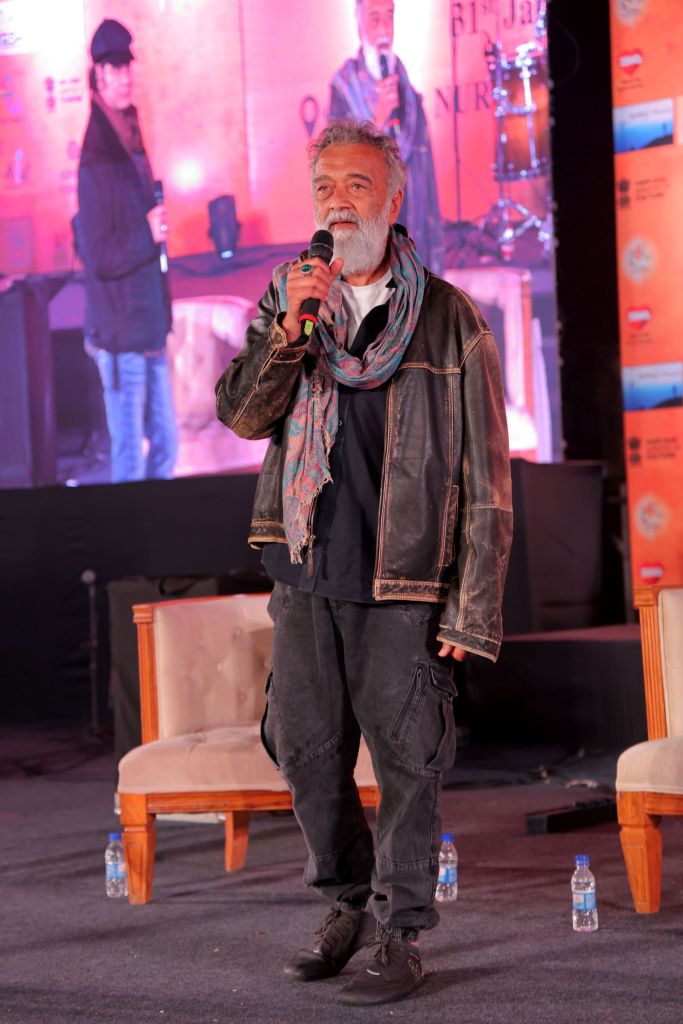
Lucky Ali clearly stole the show with his perfect diction and endearing manners. Named Maqsood Mahmood Ali by his parents, the 66-year-old popularized Indipop during the 1990s. The son of Bollywood actor Mehmood Ali and Mahliqa, younger sister of 1960s Bollywood actress Meena Kumari, Ali set the stage on fire with his popular songs and stories related to Bollywood.
Ali’s story about his encounter with UFOs in Bengaluru was also a highlight. He lives on his farm there, practicing organic farming. Ali has bred horses, worked on an oil rig off the coast of Puducherry, cleaned and sold carpets, besides making music and singing songs.
The song ‘O Sanam’ from ‘Sunoh’ launched his career. His album Sunoh won many awards, including Best Pop Male Vocalist at the 1996 Screen Awards and the Channel V Viewers’ Choice Award in 1997. It remained on the MTV Asia Charts in the top three for 60 weeks.
He has been a playback singer for many successful Bollywood movies, including Kaho Na Pyaar Hai.
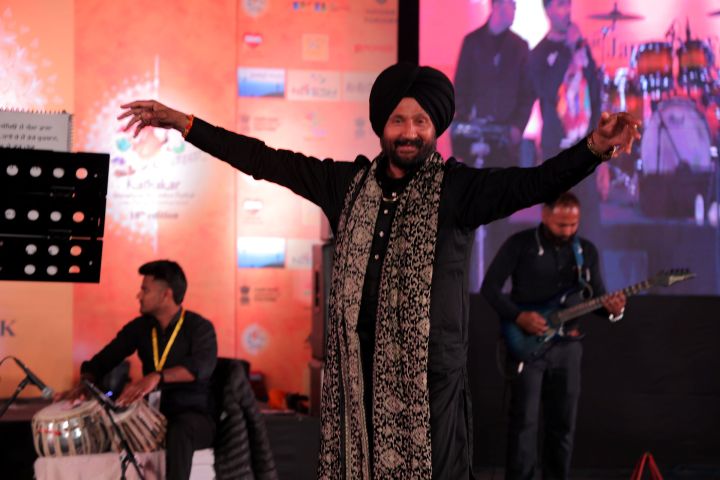

Known for his powerful vocals and emotive delivery, Bhupinder Babbal’s rendition of “Arjan Vailly” from the movie, Animal (2023), is a nationwide sensation. His music blends traditional Punjabi folk influences with a contemporary sensibility, and had us all tapping and swaying to the rhythms. Babbal’s performance was a musical celebration of storytelling.
In a nutshell, Arjan Vailly, also known as Arjan Singh Nalwa, was a notable figure in Sikh history, recognized for his valour and defiance against British colonial rule in the 19th century. Born as the youngest son of the esteemed Sikh military commander Sardar Hari Singh Nalwa, Arjan Singh inherited a legacy of courage and leadership.
Following the Second Anglo-Sikh War, he became a minor jagirdar (landholder) who staunchly resisted British authority in Punjab. In an act of rebellion, he fortified himself in his estate in Gujranwala with a contingent of 100 men, successfully fending off initial attempts by the Lahore Darbar to subdue him. Despite subsequent efforts by British forces, including a company from Skinner’s Horse, Arjan Singh managed to evade capture, ultimately dying on the run a few years later.
In popular culture, Arjan Singh Nalwa’s legacy has been commemorated through the song “Arjan Vailly” from the Bollywood film Animal. This track has been crafted in the traditional Dhadi-Vaar style—a form of musical narration rooted in Sikh tradition to instill courage and recount heroic tales.
Other performances included Rajasthani folk music by Kutle Khan Manghiyar, Sufi Qawaali by Niyazi Brothers. Filmmakers Sajid Ali and Imtiaz Ali also shared their stories.
Have you ever attended a storytelling festival? Do share your thoughts with us.
This blog post is part of ‘Blogaberry Dazzle’ hosted by Cindy D’Silva and Noor Anand Chawla.

 Queen of Treasures
Storytelling festivals like Kathakar are pure magic! There’s something so powerful about listening to tales spun live, transporting you across cultures and eras. I love how these events keep oral traditions alive—it’s storytelling in its rawest, most beautiful form. Seeing global artists and performers share their narratives must have been an incredible experience.
LikeLiked by 1 person
Yes. However I feel oral stories need a closed area and more attentive and less people. This was open air and people kept going back and forth, cutting through the day experience. The artistes were very good.
LikeLike
Wow! I am hearing about this Kathakar for the first time. It must have been a memorable experience for sure. The names who shared the stories are legends themselves. I am a huge fan of Mohit Chauhan and I have a pic with Anurag Basu. Bhupinder singing Arjun Vally, gives you goosebumps. I participated in one storytelling session organised by Kommune, in Srinagar. My daughter was working there and I went to visit her. We went to Winterfell Cafe for the storytelling. It was an amazing experience for me.
LikeLiked by 1 person
I find closed storytelling very absorbing. This one was outside, so a little distractive. Nevertheless, the music parts were amazing.
LikeLike
This sounds like such a magical experience! Storytelling has a way of bringing people together, and it’s amazing to see how Kathakar Festival is preserving this beautiful tradition. Loved reading about the diverse storytellers and performances, must have been an unforgettable event
LikeLiked by 1 person
YES, IT INVOLVES A LOT OF DRAMATICS AND DICTION, AND MUSIC. IT WAS QUITE AN EVENING
LikeLike
Wow! What an amazingly well-curated article about this festival. I lived it through your words. The sentence that is going to stay with me for a while is this: You could never convince a monkey to give you a banana by promising him limitless bananas after death in monkey heaven
LikeLiked by 1 person
good to know that you enjoyed reading this.
LikeLike
Fascinating! I have attended workshops on storytelling and it has become quite popular. Of course, I’ve never attended such a huge event like the one you’ve mentioned. However, in some corner of my mind, I too want to become a storyteller some day–not sure if this wish will ever see the light of the day.
LikeLiked by 1 person
you should get trained in dramatics, that’s going to help. You could join a short term class.
LikeLike
India’s storytelling tradition is so rich, and adding international voices must have created pure magic. Thank you for sharing this!
LikeLiked by 1 person
India’s storytelling tradition is so rich, and adding international voices must have created pure magic. Thank you for sharing this!
LikeLike
India’s storytelling tradition is so rich, and adding international voices must have created pure magic. Thank you for sharing this!
LikeLike
Wow this sounds absolutely amazing! I never knew about this – events like these make me yearn for Delhi!
LikeLiked by 1 person
I’m sure there are around you also. Turkey also has an ancient culture.
LikeLike
True. Slowly figuring out. One big issue though is language. Most such things happen in Turkish.
LikeLiked by 1 person
When you listen to a story from a master storyteller, you are transported to different world created for the story by the master. It’s blissful experience. I am sure you must have enjoyed the celebration fully…
LikeLiked by 1 person
With such an interesting thought behind it’s inception and some amazing personalities gracing it with their presence and voice, this festival sure is a storylover’s paradise. Oral storytelling has a different charm that transcends language and borders. Would love to visit it when it happens in Mumbai.
LikeLiked by 1 person
Attending a festival that celebrates the magic of storytelling must have been an unforgettable experience for you. There’s something truly special about hearing stories told in their purest form, connecting people across cultures and generations. Lucky Ali’s 😍presence must have been a treat—his voice and storytelling have a charm of their own. Would love to attend this someday.
LikeLiked by 1 person
Oh yes, he was the star of the show.
LikeLike
This sounds like such an incredible festival! Celebrating the art of storytelling is so important, especially in preserving oral traditions. I’d love to attend someday—were there any particular storytellers or sessions that stood out for you, by the way? I’d love to check them (and their work) out on socials.
LikeLiked by 1 person
SO, DO CHECK MY INSTA, some snippets are there, you might enjoy that. I liked the artist from Sierra Leone, what a wonderful voice and musical ability.
LikeLiked by 1 person
I really enjoy reading about such cultural festivals and the views of these immensely talented guests and participants. Lucky Ali’s songs were sheer love during the late 90s and early 2000s, my college years.
LikeLiked by 1 person
Well, I seriously listened to his songs now and found them so evergreen and ahead of the times.
LikeLike
Kathakar festival I heard about it but not lucky yet to experience it in my life. All I believe is that storytelling is an art and you need to have a creative soul in you to enjoy it, appreciate it and even to be a part of it. Ambica you are indeed one of the know and creative soul in my circle. I love you for bringing such enriching contents for us to add value in our knowledge bag.
LikeLiked by 1 person
Kathakar Festival …. Incredible experience Ambica. I never heard about it. But after reading your post I like the ideas of storytelling. I think this is the best way to keep this ritual of storytelling. The artist are legendary. You are so lucky to be the part of it.
LikeLiked by 1 person
thanks, I guess it’s a lot of dramatics and like someone telling you a story in childhood.
LikeLike
I hadn’t heard of the Kathakar Festival before and it seems like quite an experience. Your post reminded me of a piece I came across. How some of our stories were lost since they were mostly oral and there are few takers to take the tradition forward. We need festivals like Kathakar for their revival.
LikeLiked by 1 person
yes, oral storytelling does seem to be lost, but so many people are recording them and new ones are being made. It’s pretty interesting.
LikeLiked by 1 person
The Kathakar Festival sounds like a mesmerizing celebration of storytelling! I love how it brings cultures together, reminding us that stories transcend borders and connect us all. Must have been an unforgettable experience!
LikeLike
The Kathakar Festival sounds like a mesmerizing celebration of storytelling! I love how it brings cultures together, reminding us that stories transcend borders and connect us all. Must have been an unforgettable experience!
LikeLike
The Kathakar Festival sounds like a mesmerizing celebration of storytelling! I love how it brings cultures together, reminding us that stories transcend borders and connect us all. Must have been an unforgettable experience!
LikeLiked by 1 person
The Kathakar Festival sounds like a mesmerizing celebration of storytelling! I love how it brings cultures together, reminding us that stories transcend borders and connect us all. Must have been an unforgettable experience!
LikeLike
what a beautiful inclusive festival!! I throughly enjoyed this blog. Truly a well crafted blog
LikeLike
what a wonderful event. Storytelling is an art and is an amazing experience to be witnessing it in live. It was a great experience to read about the event
LikeLiked by 1 person
This is the first time I’m hearing about Kathakar or closed storytelling. Thank you for sharing this well-curated article.
LikeLiked by 1 person
Oral storytelling has always fascinated me! However I was unaware that this is such a big phenomenon! I would love to witness this first hand next time.
LikeLiked by 1 person
The scope of this festival goes much beyond storytelling, it seems. What a wonderful celebration of many creative spheres.
LikeLiked by 1 person