

From engineer to conservationist, Ashish Loya’s childhood fascination with birds sparked a journey that transformed a wetland and a community
Long before us, there was Nature. Our connection with Nature is the oldest relationship on the planet. Yet, we remain in our own cocoons, until a soft chirp, a short tweet sends us a reminder—Nature’s very own notification through the birds that live beside us in the many trees. Sometimes, this call is a gentle nudge, at other times a jolt, but it’s always a bridge to our infinite connection with Earth.

Luckily, for Ashish Loya, it was the gentlest nudge. Ditching the dollar life, a career in bustling New York, this engineer returned home, to native India, and joined the Art of Living Foundation as faculty, teaching meditation and yoga. Now, in-charge of 35 districts in western Uttar Pradesh, Loya has been instrumental in instilling the love for the natural world amongst the community youth in Bijnor, where he is based.
It was an impressive and enthusiastic group that Loya introduced us to two years back at Haiderpur Wetland, a site he has been putting his heart and soul into. We chatted about birds, the community programme under the aegis of Art of Living Service Projects, and more. Excerpts:
When did you discover the joy of birdwatching?
Like every young one, often bored, I would turn my head towards the neem tree that swayed near my classroom window. I was in the fifth grade in Holy Cross Convent, Akola, Maharashtra. One day, I saw a Coppersmith Barbet and was mesmerized by its beauty. That tree became my escape route from boredom.
Birds began to fascinate me, and my father brought a guidebook from his library and a pair of binoculars. The guidebook was The Book of Indian Birds by Dr. Salim Ali, known as the bird man of India. It was the late 1980s, not the era of smartphones or online tools. The book deepened my interest.
The fascination continued all through school and college, BITS, Pilani, where I completed my engineering. I participated in the Asian Waterbird Census at the lake near Akola. I also became a member of the Bombay Natural History Society (BNHS), subscribed to their magazine Hornbill. In college, I was part of the nature club. Every year, I would visit Bharatpur Bird Sanctuary, now known as Keoladeo National Park. It was a lot of learning till 1997.
Did birdwatching continue in New York as well?
Right up till college, it was more of a hobby. In the USA, there weren’t any hotspots close to my workplace or residence. The weather was colder too. I would sometimes go to the park, but I couldn’t really go into it, not the way I did all through college. The fascination didn’t die; it just became dormant.
How did the interest revive?
I had been toying with the idea of moving back to India since 2008. During college, I had done courses at the Art of Living Foundation in Mumbai. In New York, I continued to do more programmes and volunteer work with them. I completed the teachers training programme there.
Finally, in 2012, I joined the Bengaluru base of the Art of Living Foundation as full-time faculty, teaching yoga and meditation. One of the programmes is The Happiness Programme, under which we teach Sudarshan Kriya (a powerful breathing technique).
Then, Gurudev Sri Sri Ravi Shankar appointed me as head of western Uttar Pradesh to facilitate programmes in Bijnor and neighbouring areas. I came for one camp initially, and then it grew from there, through 35 districts.
Bijnor revived my love for birdwatching. One day, I saw a large flock of birds near the floodplains and was so surprised. The Ganga barrage and floodplains were there, but Haiderpur Wetland wasn’t officially declared a protected site. I explored the area daily on my bike and found such a treasure of avian species.
Along with the forest department, experts from BNHS and World Wide Fund for Nature (WWF), and senior bureaucrats, I worked on helping this become a protected site. The result today is a beautiful wetland, a Ramsar Site. This wetland is home to thousands of migratory birds, flora, and fauna, including many vulnerable species.
How did you start educating the community youth in Nature and birdwatching?
It was serendipity. Among my first students was Ashish Gujjar. This young man wanted to join the Army. He would be on his daily run around Haiderpur Wetland and began to take an interest in birdwatching. Covid-19 put a damper on the plans to join the Army, but he seriously began this journey. Seeing his success, more boys and girls joined in. Now, we have a group of 20 youth in this programme.

What was your teaching methodology?
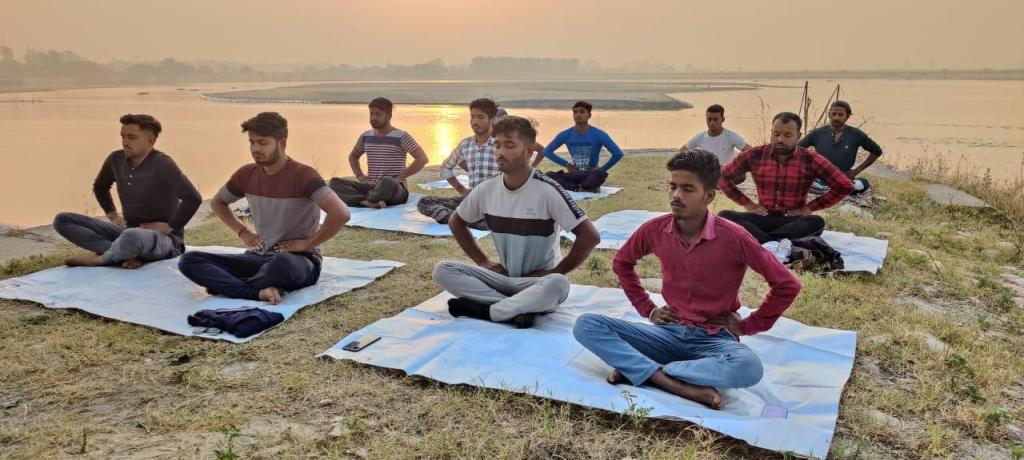
We would do meditation and pranayama in the wetland area. Then we started observing the birds. The youth were introduced to conservation organizations such as the Wildlife Institute of India (WII), WWF and BNHS. They regularly assist these organizations in research and other volunteer activities. They have worked on research related to Swamp Deers and the endangered Indian Skimmers. In fact, a few years back, they acted as ‘Nest Guardians’ for 10 Indian Skimmers. They stood guard 24×7 for three months, protecting the nests from stray dogs, agricultural activities, and other issues.

They have become expert guides and conservationists. Together, we have sensitized the villagers on the importance of the wetland and their long-term future. The Art of Living Foundation conducted 40 workshops in 40 villages. We also gave an educational tour of the wetland to 4,000 schoolchildren from Bijnor and Muzaffarnagar.
From engineering to conservation, the journey must have had many twists and turns.
Every journey is one of patience and will. I opted for this life because this is what resonates with me. It’s work in progress, but over the years, we have been instrumental in controlling poaching, ensuring best practices for farmers while keeping the wetland intact, sensitizing people, and spreading awareness about the importance of safeguarding our environment and ecology.
Sensitization also involved sharing bird sightings on eBird. I attended a conference in Lonavala on migratory birds, organized by BNHS. My aim was to spread awareness about this beautiful place.
Along the way, renowned birders and authors, Carol Inskipp and Tim Inskipp, came across my birding posts on X (formerly Twitter) and visited us in Bijnor. They presented their book (Birds of the Indian Subcontinent by Richard Grimmett, Carol Inskipp, and Tim Inskipp) to the young birders in our community.
We also gave a tour to actor and TV host Rajeev Khandelwal during the shooting of the travelogue series Rag Rag Mein Ganga, a production by Prasar Bharati for the National Mission for Clean Ganga (NMCG). We have been featured in the episode.
How has the young team responded to these turns?
The team remains enthusiastic and is working constantly. Initially, the girls were hesitant to be a part of these programmes, but over time, they gained confidence, motivated by the young men. The meeting with the Inskipps was a motivating factor as well. They enjoyed the shoot for the Rag Rag Mein Ganga episode.
How does the wetland look now?
The authorities are expanding on the ecotourism facilities to support the local economy. A fair amount of wildlife tourism makes it easy to spread awareness about safeguarding the environment. Besides the watchtower, new trails with viewing huts have been made. A small cafeteria has been introduced. Some residential luxury tents are coming up along with a toilet block.
There was a plan for a four-lane highway close to the wetland area. Does that cut through the wetland?
The government took due notice of the wetland regarding the highway. We had expressed our concerns to the National Highways Authority of India (NHAI). A new bridge has been constructed on the Ganga, but it bypasses the wetland area.
In the earlier plan, part of the highway was passing through a grassland area where Indian Grassbirds breed. We highlighted the need to preserve this breeding patch. So, NHAI realigned the route of the highway and shifted the bridge about 300 metres further downstream. This has also saved thousands of trees along the highway, almost a 4 km stretch, now.
What are your tips for a person who wants to start birdwatching?
A curious mind and sharp eyes, along with slow and steady steps. You can begin by watching birds near your home or in the neighbourhood park. Consistency is the key to discovering the feathered friends. You can visit the same place over and over again, and you will see how Nature surprises you.
Maintaining a journal about your observations is a good idea. You can start by looking for birds on trees, maybe common ones. Then listening to their calls, observing their flight patterns. You can also download apps to help you identify the birds.
I would highly recommend a guidebook, which is very helpful. It gives you more ideas about the kind of bird you saw, whether it was a tree bird or a waterbird. The guidebook helps you learn about the different body parts and how they are named.
Once you start liking something, I think it’s very natural to know everything about it. Then you can dive into it deeper, as much as you want. There’s no need to know all the bird names or be familiar with the birding lingo or have a checklist done. There should be no FOMO, only the joy of seeing birds.
You can just appreciate their beauty and connect with nature. We connect with birds for our individual reasons—some like the soothing bird calls, others become curious after seeing nests. Some birds nest in our backyard or garden, and children often become very protective of them. You can protect them from domesticated cats, dogs, and keep some water for them in the summer.
Nature lovers normally wear muted clothing. Is that an essential?
If you want to attract birds, then it helps to wear that kind of clothing. If you’re in a park or bird sanctuary and don’t want to disturb the birds or want them to fly away, then it helps to blend in your surroundings and make yourself as invisible as possible. Muted colours like greens, browns, and greys help you blend in with the natural environment. Bright colours can startle birds and make them wary.
What kind of binoculars do you recommend for a beginner?
I think 8×42 size binoculars are very good. It’s good for everybody, gives you a good magnification of birds with a good distance. The ‘field of view’ refers to the width of the area you can see through the binoculars. 8×42 binoculars have a wide field of view, making it easier to track moving birds, and they are easy on the eyes, weigh less, and are comfortable to carry.
It’s best to invest in decent binoculars, which start around INR 8,000. Very cheap ones are not good, as they strain the eyes, leading to headaches, and don’t have a long life.
What about a camera?
For many years, I used only binoculars to watch birds. But a camera has given me an extra pair of eyes. Sometimes you see birds for a fraction of a second and miss out on the details. A photograph helps you see the details and serves as a good way to help in conservation. Wildlife photography is also a good hobby. If you have a budget and are comfortable carrying more gear, then it’s highly recommended.
Any precautions while birding?
Consistency, patience, and stillness.
Savour your moments in Nature, rather than chasing lifers (when a birder sees a bird for the first time) or being obsessed about finding new species.
Be ethical in your approach. Do not make bird calls to attract them for a picture or glimpse. Sometimes you end up exposing those birds to predators—poachers and animals.
It’s best not to approach birds while they are nesting. Keep a safe distance. Unless you are part of a scientific project.
Be open-minded and take new people with you for birding. Introducing others to this practice actually elevates your hobby. When you teach someone or show somebody something that is totally new for them, it ignites a spark and adds to your own spark. It gives you a fresh approach and more joy.
Resources:
- Birdwatching Apps: Merlin, eBird, iNaturalist
- Bird Guidebooks: The Book of Indian Birds by Dr Salim Ali, Birds of the Indian Subcontinent by Richard Grimmett, Carol Inskipp, and Tim Inskipp, A Pictorial Field Guide to Birds of India by Bikram Grewal
- Free Online Ornithology Courses: ABC of Birdwatching by WWF, The Wonder of Birds by Early Bird, Basic Course in Ornithology by NPTEL/Swayam
- Where to study Ornithology: Salim Ali Centre for Ornithology and Natural History, and in universities offering Wildlife Biology programmes.
- Short-term courses are offered by WWF, BNHS
FAQs on Ornithology, Birdwatching and Conservation
What is the difference between ornithology and birdwatching?
Ornithology is the formal scientific study of birds. It requires a background in science, particularly zoology, to become a professional ornithologist. Birdwatching, on the other hand, is an activity that anyone can enjoy. You can even contribute to scientific research as a citizen scientist by sharing your observations with various organizations. Examples of citizen science include counting bird populations for organizations like eBird, or participating in seasonal bird counts.
Is it important to have a degree in social sciences to become a part of conservation movements?
If you aspire to work as a conservation expert, formal training is typically required. However, there are many roles within conservation programmes that require due diligence, a good understanding of the subject matter, and strong communication skills. The necessity of a degree depends on the specific role you are seeking. Many NGOs and governmental organizations have volunteer positions that do not require degrees.
Who is a naturalist?
A naturalist is someone who possesses a deep understanding of the natural world and can guide others in it. Indigenous communities often exhibit exceptional naturalist skills, developed through their close proximity and interaction with Nature. They may live in forests or other diverse geographical areas, and their knowledge is built on careful observation of natural phenomena.
I’m participating in #BlogchatterA2Z
You may like to read
Unleash Your Soul in Bijnor’s Whispering Forests & Soulful Wetlands
Noida Biodiversity: A Nature Lover’s Observations
Will Dhanauri Wetlands Become Noida’s Lost Eden?
A Deep Dive into Chilika Lake’s Unique Ecosystem and Conservation Efforts
Water Conservation is Crucial for Our Planet
Must-Watch Wildlife Docuseries on OTT
Exploring the Wonders of Wildlife: Tips for Aspiring Naturalists
India Environmental Movements: Voices for the Earth
Free Online Resources & Tools for Nature Lovers
This blog post is part of ‘Blogaberry Dazzle’ hosted by Cindy D’Silva and Noor Anand Chawla.

 Queen of Treasures
Thank you for introducing us to Ashish Loya and his remarkable work.
A single man’s effort, supported by the authorities and volunteers, in reviving a wetland and conserving numerous bird species is trily incredible!
The precautions he shared for birding are both insightful and noteworthy.
LikeLiked by 1 person
I hope more of us turn to save Nature. We so need that.
LikeLiked by 1 person
Such an insightful interview. Reminded me of The Residence, I recently watched on Netflix, where our detective is a birdwatcher! Thanks for sharing!
LikeLiked by 1 person
Thanks for letting me know about The Residence. Gonna watch it.
LikeLiked by 1 person
I’m genuinely inspired by Ashish Loya’s journey. His transition from a corporate life in New York to leading conservation efforts in Bijnor is truly remarkable. The story of how a childhood fascination with a Coppersmith Barbet evolved into a lifelong commitment to birdwatching and community engagement is heartwarming. It’s fascinating to see how his early experiences with The Book of Indian Birds and participation in the Asian Waterbird Census laid the foundation for his current work. His efforts at Haiderpur Wetland, especially in mobilizing youth and integrating meditation with nature conservation, showcase a holistic approach to environmental stewardship. The way he rediscovered his passion upon returning to India and turned it into a mission is truly motivating. Your portrayal of his story emphasizes the profound impact one individual can have on both nature and community. It’s a beautiful reminder of the interconnectedness of our lives with the natural world. Thank you for sharing such an inspiring narrative; it has deepened my appreciation for birdwatching and conservation efforts.
LikeLiked by 1 person
Glad to know you found it inspiring. 😊
LikeLiked by 1 person
Hats off to the efforts ! It takes unwavering zeal to build a new life after quitting New York & being rooted back in India. And thank you for such a detailed post on Ornithology and the passion required in conservation of natural resources.
LikeLiked by 1 person
It truly requires a mind shift to leave the west and come back to the roots. But I guess, each of us has their own journey, though his did sound like Swades to me.
LikeLiked by 1 person
True !
LikeLike
I really appreciated how you made birdwatching seem so accessible. By linking it with conservation tips, you convinced me that anyone, even someone just watching birds in their backyard, can play a part in protecting species!
#BlogaberryDazzle
LikeLike
Actually, it’s simple, the more you watch them, the more you will love them, then the more you will preserve them.
LikeLiked by 1 person
What an inspiring story! Loved reading about Ashish Loya’s journey. The way he’s involving local youth and protecting Haiderpur Wetland is truly amazing. Thanks for bringing his story to us!
LikeLiked by 1 person
This is an insightful and detailed interview of Mr Loya. I am leaving from this blog with a lot of new knowledge and interest in bird watching. I often find myself pausing on the way whenever I come across a new type of bird. This blog is the reminder to live those moments with stillness.
LikeLiked by 1 person
This was such a calming and insightful read. You really brought out the quiet joy of birdwatching while weaving in the urgency of conservation. Loved the way you balanced wonder with responsibility. Will definitely be more mindful next time I spot a birdie on my balcony!
LikeLiked by 1 person
What an inspiring journey, of Ashish. It’s amazing how a childhood curiosity turned into a full-blown mission to protect and educate. Loved reading how birdwatching became not just a personal passion but a way to bring the whole community closer to nature. Truly heartwarming. Thanks for introducing him with us.
LikeLiked by 1 person
I loved how you framed birdwatching not just as a hobby, but as a gateway to conservation awareness. The balance you strike between the thrill of sighting and the deeper ecological impact is spot‑on. Your writing inspires me to pick up my binoculars with a renewed sense of purpose!
LikeLiked by 1 person
It is truly inspiring to know about such a dedicated person, aiming for a better future through his journey of birdwatching and conservation. I personally love watching birds, and come to know so many new things from your posts.
LikeLiked by 1 person
I am glad you find the posts and educational experience.
LikeLike
It is thanks to people like Ashish that nature is being conserved and beauties like these birds are being talked about and seen. So glad you featured him.
LikeLiked by 1 person
If you ask me what is that species of nature that I love the most it will always be birds as I am not fond of animals and not at all a pet lover. So this conversation was pretty interesting and entertaining for me and difference between ornithology and birdwatching is something I learned new and thanks a ton to you for presenting such awesome session with the expert.
LikeLiked by 1 person
A very interesting post. Just this afternoon, as I was drying clothes in the balcony, I kept hearing the continuous call of a bird; I didn’t know which bird it was because I couldn’t see it. Birdwatchingcertainly seems like an interesting hobby. If one is able to make notes on the go, it’s amazing. Thanks for sharing the interview with Ashish Loya; you’ve asked just the right questions, the answers to which pique the curiosity to dive deeper into the subject.
LikeLiked by 1 person
You’ve beautifully connects the peaceful joy of birdwatching with meaningful conservation, Ambica. Your questions and their responses were a sweet reminder that every spotting moment counts toward protecting our feathered friends—very inspiring!
LikeLiked by 1 person
I ghave always loved bird watching. I grew up near an ecological park in Mathura Refinery and hence was close to a myriad of birds, before moving to Delhi.
LikeLiked by 1 person
That must have been a green childhood😊
LikeLike
I’m impressed with his work and the dedication put into it. Bird watching is quite interesting as I’ve heard from few friends of mine. Thanks for sharing info about his work. Will check out more.
LikeLiked by 1 person
I am no bird-watcher but people watcher! But then this was deeply interesting. I enjoyed Loya’s journey and his conservation work. More importantly came to know more about Art of Living’s work. I realized my knowledge on that too was sketchy. Good one Ambica
LikeLiked by 1 person
Very interesting and informative interview. Earlier we used to see so many birds around our houses. Now it is getting rare. Human beings contribute the least and damage the most.
LikeLiked by 1 person
Sad but true. Humans are the most dangerous species
LikeLike
Ashish Loya’s journey is truly inspiring. I love the detailed journey and also the mention of resources and FAQs which would help any budding ornithologists
LikeLiked by 1 person
I was never interested in bird watching, I confess. But when I got a camera for my food photography, I started taking nature photographs. But then I found some beautiful bulbuls in my garden and started photographing them. Slowly my interest grew and now I absolutely love and enjoy bird watching albeit in my garden or backyard. I am blessed to have an owl family, mynas, peacocks, peahens, parrots, kingfisher, woodpecker and a few more variety of birds here. Loved the interview!
LikeLiked by 1 person
Very well written, detailed and informative interview – great tips for bird watchers especially those starting the journey. Residence on Netflix has a detective who is sometimes more interested in birdwatching than solving mysteries!!
LikeLiked by 1 person
I enjoyed watching those beautiful creations of nature and listening to their lovely tunes. I don’t know why, I never felt the urge to know their names, if they are local or migrant, etc.
LikeLiked by 1 person
I love you blogs related to Birds and birdwatching
LikeLike
I loved reading this! As a busy mom, birdwatching feels like a peaceful way to reconnect with nature and find calm in the chaos. Ambica’s passion for conservation reminds me how small moments can inspire big changes—for us and the planet.
LikeLike
I enjoyed reading the interview. It was so thorough in every aspect!
LikeLiked by 1 person