
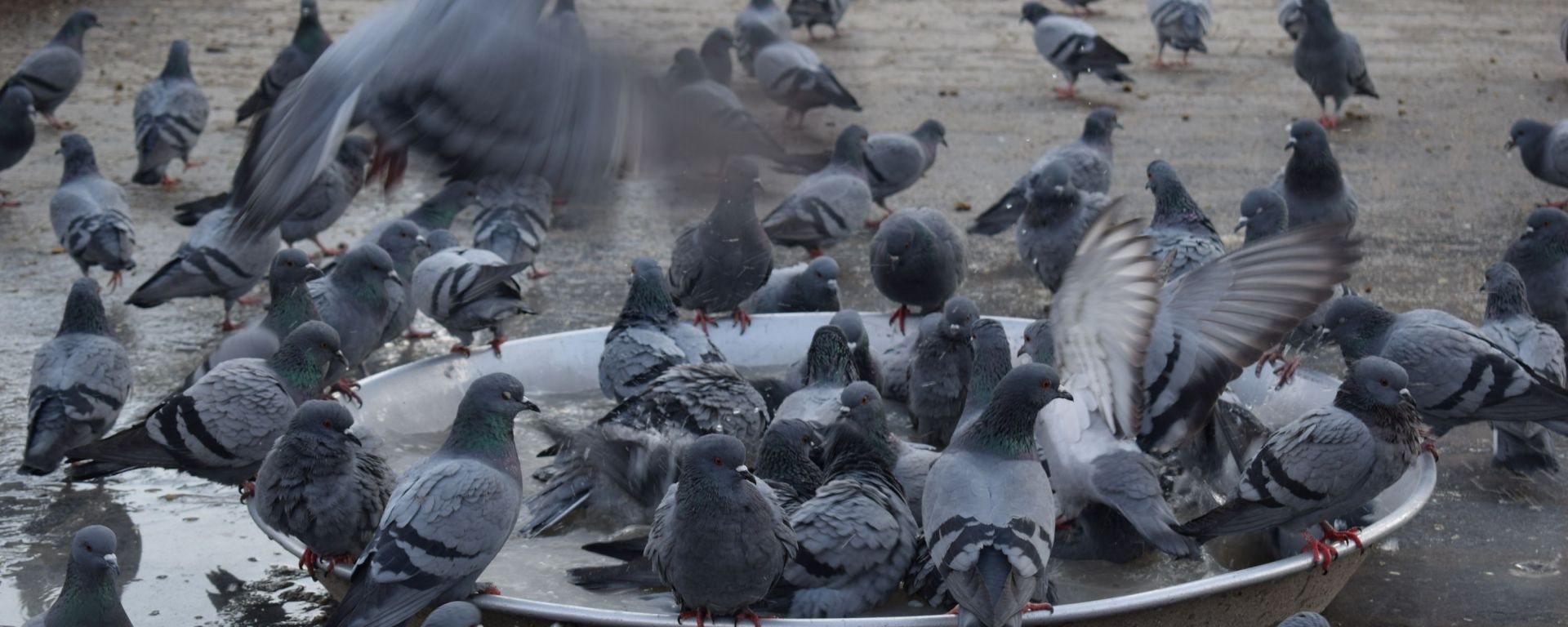
The seemingly harmless act of feeding pigeons in urban areas is creating a significant public health hazard, and an ecological problem.
- The Pigeon Loop
- Public Health Hazards
- Interview with avid birder, tourism professional Prasanna Gautam
- Tips on how to be safe
The Pigeon Loop
The benign rock pigeon was caught in a kite string in the densely populated Darya Ganj area of Delhi. I watched it being rescued by the Delhi Fire Service, and subsequently taken to the bird hospital in Chandni Chowk for treatment. This, seemingly, was a regular occurrence, as the roundabout at this spot was filled with Black Kites and Rock Pigeons feeding on seeds and the nearby garbage dump.
An old man was selling seeds for the passersby who wished to absolve themselves of sins or simply feed the birds out of kindness. Summers are particularly harsh, as the scorching sun dries up the water sources. The roundabout also serves as a water haven, with many samaritans leaving earthen bowls filled with water. The place is filled with bird droppings and feathers.
Grey, trusting and social, flying only short distances now, the humble pigeon has long been an emblem of peace and a messenger since the days of the kings. It was trained, fed and housed like a trusted royal member of the house. But eras have changed, habits have changed, habitats have changed, and pigeons have grown used to humans and the care they have been providing over the centuries.
I see hundreds flying in the morning near my house. More hundreds are found perched on electrical wires near many more feeding spots spread across Delhi-NCR or any other city I travel to. They live comfortably in the buildings and even nest there during the breeding season. I found two eggs on my broom in the balcony, two years back. The pigeon came to incubate it for a few days and then abandoned it, apparently the egg wasn’t going to hatch.
Their little feathers and poop are found all over the balcony, throughout the day. We just sweep the feathers and wash the poop, little realising what harmful pathogens lie in it.
Public Health Hazards
In 2016, a study by veterinary microbiologists from Karnataka Veterinary, Animal and Fisheries University (KVAFSU), revealed that the numerous pathogens in the bird droppings can cause almost 60 different types of diseases. Pigeon excreta favour the growth of fungi and faecal ammonia, leading to irritation and respiratory disorders, dysentery, typhoid, bacterial gastroenteritis and hepatitis. Extreme cases could range from minor influenza to high fever, blood abnormalities, and pneumonia. A worrisome affair. However, the feeding continued, so did the rise in pigeon population along with human population.
Doctors in cities like Delhi, Mumbai, Pune, Bengaluru, to name some, have been raising the alarm about pigeon hygiene and rising lung infections since long. In 2024, Pune Municipal Corporation (PMC) announced punitive action against individuals found feeding pigeons in open spaces across the city. The Municipal Corporation of Delhi has also considered a ban on pigeon-feeding spots across the city. More details on this proposal are expected.
Highlighting the health hazard emanating from pigeon droppings, Mumbai-based Bombay Natural History Society (BNHS) in association with JSW Foundation (the CSR arm of JSW Group) released a documentary titled ‘Mercy Feeding: Pigeon Menace in Urban Areas’ in March 2025.
Interview with avid birder, tourism professional Prasanna Gautam

Well, the grey loved messenger has a bigger impact than one ever thought of. To understand how to go forward with this, I chatted with wildlife enthusiast, avid birder and tourism professional, Prasanna Gautam. His years of observing urban wildlife, particularly bird behaviour, make him uniquely qualified to discuss this issue.
In a 35-year-long tourism career, he has had the opportunity to see, observe, and understand a varied range of habitats, cultural and religious practices. Besides his expertise in tourism, he has also participated in bird and wildlife censuses. He also coordinated the Snow Leopard conservation project at Hemis National Park in collaboration with Earthwatch India for three years during late 1990s. Excerpts:
Feeding pigeons is a common practice in India. However, their droppings present numerous health hazards. As an avid birder, what has been your experience?
The studies clearly show that humans are vulnerable to many kinds of diseases borne of pigeon droppings. Inhaling the fungal spores, such as Cryptococcus neoformans and Histoplasma capsulatum, leads to pulmonary diseases and other diseases such as fungal infections and immunodeficiency.
This menace is primarily associated with Rock Pigeons. What about the other pigeon species? Do they also prove to be as harmful?
Any bird species for that matter, if they are pests (like feral pigeons), can pose health hazards. We need to understand that birds and humans have different physiological make-up and different hygiene needs.
The pigeons are a constant part of city life. What would happen if people stopped feeding them totally?
That’s probably difficult to understand at this stage, as they have become habitual to the feed that humans provide. But I feel, if they are denied easy food, then they will slowly go back to their natural instinct of finding food.
People often leave seeds and other grains for other species of birds in parks and public spaces. Do you feel this should be avoided too?
Definitely yes, this should be avoided too. With this, they will inculcate the habit of easy food and forget their natural instincts and food. Then, they can become potential pests and pose health hazards such as flu, bacterial infections and maybe more diseases.
Every species has a specific kind of diet. My personal opinion is that feeding birds stems from our own greed. We do it for selfish reasons such as getting rid of our guilts (or sins). We install bird feeders for the greed of attracting birds to the balcony or gardens.
The birds should be left alone to find their food because they know how to do that.
Is installing bird feeders a good practice?
Personally, I am not in favour of bird feeders. However, bird baths during summers are fine and needed as water dries up in many places. Smaller birds find it difficult to find water sources.
Any tips to keep in mind when tempted to feed the avian species living in our neighbourhood…
Personally, this is very simple. When I get tempted to feed the birds, I ask myself this question, “If someone promises me good food and an easy life, then why would I work hard to earn them?” Giving things away without the need makes the bird lose the instinct of survival and foraging.
Finding a balance between compassion and public health is crucial. While feeding pigeons or other birds stems from good intentions, urban areas need to consider alternative methods of coexistence that prioritize both human and animal well-being.
Have you observed this pigeon feeding practice leading to public health decline in other countries as well?
Many countries and cities across the world have suffered serious health issues because of prolific feral pigeon populations, that is London, New York, Chicago, Barcelona, Berlin to name few. It is a common issue globally.
Pigeon droppings have high uric acid content. With long term exposures or accumulation, they cause structural damage and architectural defacements as well. The dirty roads become slippery during rains.
Beyond the human health hazards, the overpopulation of feral pigeons also poses significant ecological risks. These birds can displace native species, disrupting the natural balance of urban ecosystems. Their large numbers can overwhelm local resources, impacting the biodiversity of the area.
Tips on how to be safe
- Wear gloves when sweeping pigeon feathers and dropping.
- Wear a mask with filter particles as small as 0.3 microns.
- Wear protective covering over shoes.
- Put a little water over the droppings before cleaning to prevent the spores from becoming airborne.
- You can put a mesh around the balcony to prevent pigeons from residing and perching there.
- Some people put chimes and strings, but that hasn’t been 100 per cent successful (our wind chime never drove the pigeons away).
I’m participating in #BlogchatterA2Z
You may like to read
Must-Watch Wildlife Docuseries on OTT
Exploring the Wonders of Wildlife: Tips for Aspiring Naturalists
Wadaj Dam: Where Birdwatching Skills Fly High!
Will Dhanauri Wetlands Become Noida’s Lost Eden?
Exploring the mangroves of Bhittarkanika, Odisha
This blog post is part of ‘Blogaberry Dazzle’ hosted by Cindy D’Silva and Noor Anand Chawla in collaboration with Mister Tikku.

 Queen of Treasures
When you write about birds, all I can think about are the thousands of pigeons near my house. I’ve heard about the health hazards from their droppings, so thank you for shedding light on this topic.
While I’m often tempted to feed them, the hygiene concerns have always left me conflicted. Your post gave me much-needed clarity.
I’d like to share a line by Prasanna Gautam that really resonated with me: “The birds should be left alone to find their food because they know how to do that.”
LikeLiked by 1 person
I am glad that this resonated with you Pinki, the purpose of the post was to create a balance! be compassionate and sensible.
LikeLiked by 1 person
You captioned this post about pigeons very aptly – pigeons are an urban menace.Unlike crows they encroach and dwell very close to humans fearlessly and besides the constant fluttering, nesting , droppings the part where they actually carry serious risk of infections are well highlighted by you.
For me the worst part is when they nest and the young squabs invariably end up fallings or dying , that’s truly messy and disturbing.
LikeLiked by 1 person
Also, the pigeons aren’t in good health.. most who sit on my. Balcony are sick and limping .. it’s sad
LikeLike
What a thoughtful perspective on wildlife care! As someone who runs an educational platform, I really appreciate how this post highlights the importance of letting nature take its course. The quote from Prasanna Gautam perfectly captures the wisdom of non-interference. At Mondosol, we often discuss sustainable tourism and responsible interaction with local environments – this same principle applies beautifully there too. Would love to connect and share more thoughts on responsible tourism and environmental consciousness! 🌿
LikeLiked by 2 people
This post totally echoed everything I’ve been thinking but haven’t said out loud—those pigeons are honestly becoming a full-blown nuisance! I used to find them cute, but now I’m just dodging droppings and wondering if they’ve declared war on my balcony. I had no idea the health risks were this serious though, so your breakdown was super helpful. And yes, people feeding them like it’s a ritual isn’t helping! Loved how you balanced facts with a bit of sass—it made the read both informative and relatable.
LikeLiked by 1 person
I agree that pigeons are a big menace in urban areas, most of us are using balcony netting because of pigeons.It is important to strike a balance between compassion and public health as you rightly said, feeding pigeons or cattle can create health and safety hazards for all.
LikeLike
I am so glad you highlighted this issue, Ambica! I have been at the receiving end of it where the pigeon menace close to where I loved caused multiple health issues for me. It is a serious problem!
LikeLiked by 1 person
you should show them all the reports floated around by docs and health authorities!
LikeLike
Recently, I came across an article that stated that a common pigeon carries more threats than a rat or cockroaches. I am glad that finally this concern has been raised but steps have to be taken.
LikeLiked by 1 person
Pigeons are a menace for sure. Every time I think of getting rid of the pigeons on my daughter’s bathroom window sill, I see two eggs. I try to steel myself and get rid of them, but then I cannot. I have bought hooks to place them there, but every fortnight, the chicks fly, and if I miss a day, then there are two eggs again. How prolific is their breeding? Apartments are a great roosting nest for them. We just shifted from the apartment to a house, and I am left with the hooks and happily, no pigeons anymore.
LikeLiked by 1 person
Pegions cause lung disorders. You have mentioned effective preventive measures to avoid the problems.
LikeLiked by 1 person
Such an important topic. I know so many people who keep bird feeders in their gardens and balconies. Gotta warn them about why they need to stop doing that. I have myself been contemplating a bird bath and feeder in my backyard. Will stick to just the bath as suggested by Mr. Prasanna Gautam. I really liked how he said, “The birds should be left alone to find their food because they know how to do that.” and isn’t that how we all learn and adapt?
LikeLiked by 1 person
It’s very common to find piegon feathers and poops in the balcony no matter what you do to prevent them for coming. And before I read your blog I didn’t know it was hazardous, thank you so much for sharing this useful information
LikeLiked by 1 person
My mom had many sleepless nights trying to find a solution. We even tried multiple google answers but all in vain. I remember dad telling me it can cause health problems. I love how you covered it all so aptly.
LikeLiked by 1 person
This was such an eye-opener. I hadn’t fully considered how feeding pigeons could lead to real health and environmental issues.
Thanks for presenting the facts without alarmism, made the message land even stronger.
LikeLiked by 1 person
Ambica it is not just pigeon feeding causing hazards for the society at large so are equally the feeding of the monkeys and dogs. I am quite sure that you observed already or read the news of some of the dog and monkeys here in Delhi NCR regions which turned human life an absolute threat. It is good to be animal or bird lover but not at the cost of causing health hazards or life hazards. If you want to feed , then feed in a designated area which is safe and not cause any hazards to human or any living lives. Very serious topic you covered. Thank you
LikeLiked by 1 person
true, if you see the pigeons up close, you will realise that they aren’t healthy, at least the most I see around my home. Dogs, again the same issue, they are a menace and sick too. I don’t walk around early in the morning in the neighbourhood (roads) as the dogs jump anytime, so scary it is.
LikeLike
Totally relate to this. We’ve had pigeons nesting on our AC… feathers, droppings, and the constant cleaning. It might seem harmless, but the health risks are real. Glad this issue is getting more attention now.
LikeLiked by 1 person
Indeed a menace though I did not know in such details. Very imp that we don’t feed the pigeons and make them lose their ability to forage
LikeLiked by 1 person
Being an animal lover, my house is always full of birds and animals. Since childhood I’ve seen my parents and my sisters taking care of pigeons, and we have a huge water seep on the terrace. :) I guess now we are too immune to them…
LikeLiked by 1 person
This was such an eye-opening read! I never realized how serious the health risks from pigeon droppings could be. We often feed birds thinking we’re helping, but this post made me rethink that habit. Thank you for sharing such important insights.
LikeLiked by 1 person
Reading this, I feel a mix of compassion and concern. I’ve seen pigeons up close, their gentle presence comforting, yet I now realize the unseen risks they bring. It’s a reminder to care wisely—for both the birds and our health—with thoughtful balance.
LikeLike
Reading this, I feel a mix of compassion and concern. I’ve seen pigeons up close, their gentle presence comforting, yet I now realize the unseen risks they bring. It’s a reminder to care wisely—for both the birds and our health—with thoughtful balance.
LikeLike
Reading this, I feel a mix of compassion and concern. I’ve seen pigeons up close, their gentle presence comforting, yet I now realize the unseen risks they bring. It’s a reminder to care wisely—for both the birds and our health—with thoughtful balance.
LikeLike
Reading this, I feel a mix of compassion and concern. I’ve seen pigeons up close, their gentle presence comforting, yet I now realize the unseen risks they bring. It’s a reminder to care wisely—for both the birds and our health—with thoughtful balance.
LikeLike
Reading this, I feel a mix of compassion and concern. I’ve seen pigeons up close, their gentle presence comforting, yet I now realize the unseen risks they bring. It’s a reminder to care wisely—for both the birds and our health—with thoughtful balance.
LikeLiked by 1 person
This has prompted me to think of the care system that goes with them. while dropping has serious concerns for humans and people who clean them
LikeLiked by 1 person
Pigeons are a menace in urban areas and with people feeding them grains without realising the health risks it keeps getting worse. I’ve had to lock my balconies for days since they were taken over by these birds. We need to find a permanent solution for it.
LikeLiked by 1 person
Pigeons are a nuisance and then there are people who insist on feeding them. I will surely send your post to them so that they realize what a hazard this is.
LikeLiked by 1 person
Sadly, their softness is such a lure but so much human interference has created problems. We must not be ruled by superstitions and childishness. We must let them live like they are meant to live.
LikeLike
Feeding pigeons felt like kindness—until I learned the hidden cost. Now, every feather and dropping in my balcony reminds me: compassion must also be responsible, especially in crowded cities.
LikeLiked by 1 person
Good to see authorities taking action like Pune’s fines for feeding pigeons and BNHS’s new documentary ‘Mercy Feeding’. Awareness is key before we can expect real change.
LikeLiked by 1 person
Yes, the menace is real and it causes serious health issues to humans and pets alike upon long-term exposure.
LikeLiked by 1 person
I have an aversion towards pigeons..there are many on the top of the apartment sure they’re a health hazardm.i really hope they get back to their places
LikeLiked by 1 person
I try explaining this to my neighbors who feed pigeons. Seriously this has to stop.
LikeLiked by 1 person
Currently a religious angle has been added to this debate, which also makes it political. Sadly not many think of what’s best for the birds.
LikeLiked by 1 person