
A substantial and expansive exploration of the centuries-long relationship between India and the United States
Leonard A. Gordon’s Missions, Mantras, Migrants & Microchips: A History of the Indo-US Encounter, 1492 to Present is a long scholarly narrative that stretches from the age of exploration to the tech-driven present. A renowned academician and historian specializing in South Asian studies, Gordon has visited India many times for research since 1963.
This book, a slow, long read, is an account of the cultural, intellectual, political, and economic exchanges that have shaped the Indo-US connection.
He examines the early mercantile and missionary movements, tracing the spread of Indian religious and philosophical ideas, the allure of trade routes, and the establishment of early Indian communities in the US.
A Sweeping Historical Arc
Spanning over five centuries, the book is divided into four parts: The Age of Empires: Columbus to Amritsar, The Age of Gandhi: 1919 to 1948, New Nations in a Divided World: 1947 to Present and Cultural Explosion: South Asians in the Diaspora, 1947 to Present.
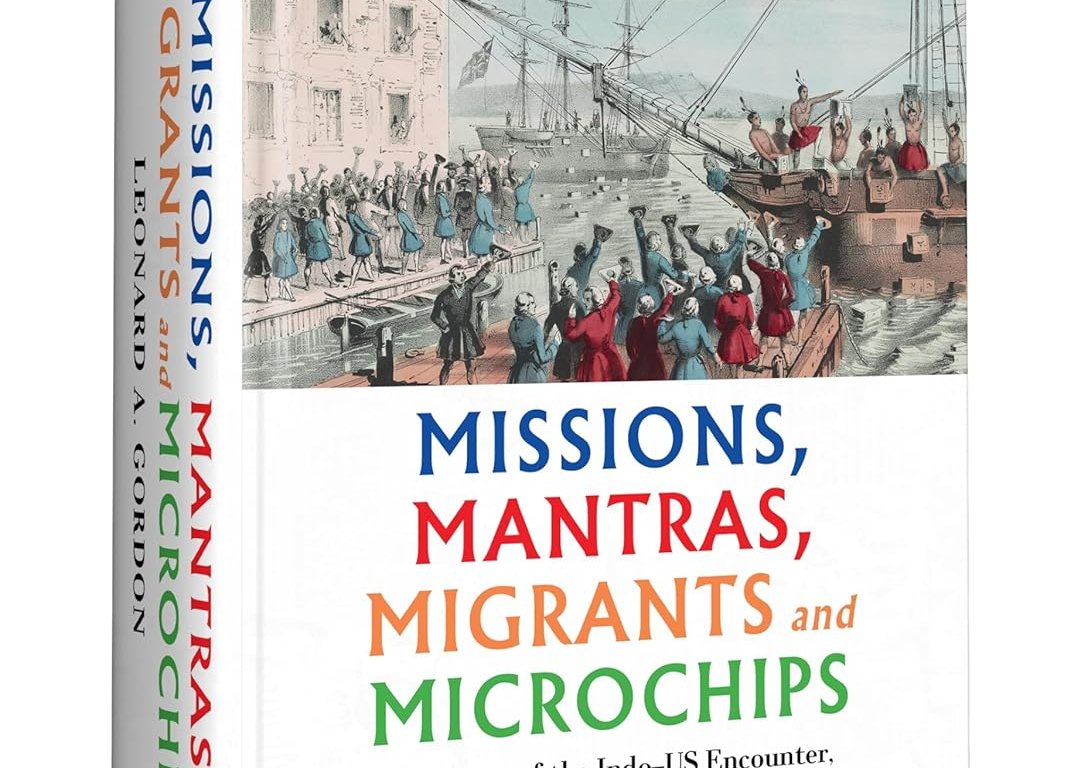
“The story of the relations between India and America begins to take form as the American colonists were starting to struggle for Independence. Starting just after dusk on 16 December 1773, Bostonian George Hewes described his ‘work’ thus: It was now evening and I immediately dressed myself in the costume of an Indian, equipped with a small hatchet…”, writes Gordon. He refers to the American Indian here, drawing symbolic parallels between the European ‘discovery’ of the Americas and the evolving Western fascination with India.
The narrative progresses through key historical moments: the arrival of American missionaries in colonial India, the intellectual exchanges between Indian philosophers and American transcendentalists, the complexities of Cold War diplomacy, and the modern era of technological and economic partnership. This chronological breadth is organized around the framework of ‘missions’, ‘mantras’, ‘migrants’ and ‘microchips. This makes it easier to understand the complex and expansive account of a 500-year-old relationship between the two diverse nations.
- Missions: This section explores the role of religious and reformist zeal, from American missionaries seeking to ‘civilize’ India to Indian spiritual leaders who influenced Western thought. Gordon highlights the two-way exchange of ideas, setting the stage for deeper cultural ties.
- Mantras: Here, the focus is on the philosophical and cultural allure of India, particularly how concepts like yoga, meditation, and Vedantic thought captivated American intellectuals and later mainstream culture.
- Migrants: Gordon chronicles the human stories of Indian immigrants, from early labourers to the post-1965 wave of skilled professionals who reshaped American cities and industries.
- Microchips: The book culminates in the contemporary era, where Indian talent has driven innovation in Silicon Valley and beyond, cementing India’s role in the global state and business landscape.
Strengths and Style
Drawing on a rich tapestry of archival sources, personal narratives, and historical analysis, Gordon’s scholarly narrative is extensive and complex. It takes time to process the historical background and the multitude of sources and the names.
Gordon writes with clarity and most of the times as an impassionate observer, weaving individual stories—missionaries, intellectuals, labourers, and business pioneers—into the broader historical narrative. Breaking away from the textbook style, he makes this a relatable narrative, taking the reader through the world of prominent and some not-so-well-known people from all fields of life.
The exploration of cultural exchange is compelling. Gordon illustrates how Indian ideas, from spirituality to cuisine, have permeated American life, while also showing how American opportunities and ideals have shaped India.
His discussion of identity—how Indian immigrants navigate their dual heritage—adds a layer of contemporary relevance, resonating with readers in an increasingly interconnected world.
Gordon has touched upon every facet of life that could be possibly studied such as steadfastness of the religious beliefs, the exchange of talent the growth of Indian businesses and their interactions with American counterparts (early trade and later collaborations of Indian businesses such as Tata Steel and Fab India), the cinematic exchange of actors such as Deepika Padukone, the growth of armchair Sanskrit scholars in US, writers and more.
Gordon examines the ‘brain drain’, the spiritual desert, the rich languages, the diversity, and the complexity, all woven together like a spider’s web.
He also takes into account the complexities of hybrid identities, the challenges of navigating multiple cultural affiliations, such as those between South Asian communities of India, Pakistan and Bangladesh.
Throughout the book, Gordon doesn’t shy away from the blips and the less-than-perfect moments.
Minor Critiques
Given its vast scope, the book occasionally sacrifices depth for breadth. Certain periods, such as the Age of Columbus, may feel less detailed compared to the richly explored modern era.
The thematic structure, while innovative, can make the timeline feel slightly fragmented for readers who prefer a strictly chronological approach. It takes time to process the innumerable influences.
Personally, I would have liked to read a lot more about Gordon’s experience in ‘The Personal Interlude’ chapter and also more about the economic reforms initiated by Dr Manmohan Singh, India’s first Sikh Prime Minister, who embraced globalisation. An addition of the role played by companies such as Infosys, Reliance, Adani group would have also given more understanding of the current times.
Why It’s Worth Reading
Missions, Mantras, Migrants & Microchips is a comprehensive read. Gordon’s ability to connect historical events with their modern echoes—such as the rise of yoga studios, South Asians taking centre stage in important state matters—makes this book both timeless and relevant.
It’s a must-read for historians, those interested in Indo-US history, students of South Asian studies, policymakers, and anyone curious about the human stories behind global cultural and economic ties.
Book Details
Publisher: Penguin India
Language: English
Hardcover: 688 pages
Price: INR 1299
Buy Here
YOU MAY LIKE TO READ
Negotiating India’s Landmark Agreements by A.S. Bhasin: Lessons in Statecraft
India Korea relations: The tree that ties
India-Korea relations: A new model for Asia
India-Korea relations: Indian connection
The Company of Violent Men: A South Asian Journalist’s Memoir
Finding colours of Ukraine & Poland in India
The Foresighted Ambedkar by Anurag Bhaskar: A Must-Read
Book Review: Perestroika by João Cerqueira
Book Review: The Shortest History of Economics by Andrew Leigh
BOOK REVIEW: THE SHORTEST HISTORY OF ISRAEL AND PALESTINE BY MICHAEL SCOTT-BAUMANN

 Queen of Treasures
5 thoughts on “Book Review: Missions, Mantras, Migrants & Microchips by Leonard A. Gordon”