
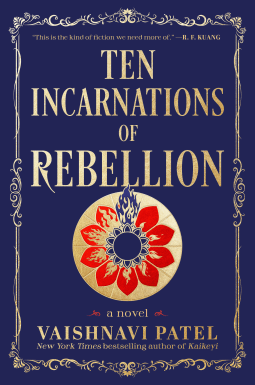
A speculative historical fiction novel, Ten Incarnations of Rebellion focuses on liberation from Imperial rule through the journey of young Kalki Divekar. Linked to the mythical 10 avatars of Vishnu, this is a novel attempt to reconcile karma with the path taken by the avatars of Vishnu.
It’s the 1960s and India is still under colonial rule. Against this backdrop revolves the story of young Kalki Divekar who is a native of an island city called Kingston, a version of Mumbai, weighed down by Imperial rule, and struggling for independence. Even as undivided India reels under the throes of a violent revolution, the rebellion in Kingston takes the form of slow, covert disruptions rather than the way of guns and bloodshed.
Born in an ordinary Hindu Maratha family, Kalki Divekar learns to mask the truth in early childhood. Trained by her gentle mother, she becomes skilled with words and body language as her revolutionary father vanishes in the darkness of the night, escaping the clutches of the British Army.
Taking a creative leap, author Vaishnavi Patel traces Kalki’s transformation from an innocent teenager to a determined revolutionary, somehow wearing the robes of the 10 avatars of Vishnu. Kalki is the 10th avatar of Vishnu, prophesied to appear on a white horse, wielding a fiery sword to destroy the wicked and restore dharma, bringing an end to Kaliyuga.
While this mythical thread is perhaps the weakest in the book, the story itself is thought provoking. The USP here is that the women take centrestage, the men remain in the shadows. The 10th avatar, mythically represented as a male figure, is a strong woman on the road to independence from oppression and slavery, perhaps a more subtle way of showing the divine feminine. Kalki’s life gains purpose and her character move through stages of rebellion or milestones that shape the outcome.
Amid all the privileges the British enjoy, which she gets to experience by studying in a good school and college and getting a job in the government, Kalki remains rooted to the cause of freedom. Think computers, Western clothing, English as the main language, loss of native customs and beliefs, the temple of goddess Mumba Devi in tangles of decay. Undeterred, she starts with a small rebellion–stealing and posting contraband music, and later creating a secret society. Her rise is slow and steady. Unlike her father, she doesn’t pick up arms, but gathers friends, fellow students, workers, and allies from all walks of life to infiltrate the colonial machinery, working covertly to dismantle it from within.
The Kingston society is a distinctly divided one—not just a divide between the British and the Indians, but also within the Indian society. Patel stresses upon inner prejudices of caste, creed, religion, sexism, racism. Then, there are collaborators–Indians who aim for profits, hand-in-glove with the British gaining their share of riches by exploiting their brethren.
The ten-chapter structure spans several years, and the narrative occasionally leans on summary rather than scene, which can make Kalki’s emotional evolution feel rushed. Her relationships, including a fraught lesbian friendship with the outspoken Fauzia, often feel like background noise to her larger political mission. Though, this relationship does become a major symbol of unconditional love of a Hindu girl for a Muslim girl, who sacrifices herself for the larger cause. As Fauzia notes, Kalki fights relentlessly for a future she struggles to even envision. Kalki’s character is a study in contradictions, unyielding in her beliefs, yet emotionally distant.
Patel does not idolise the Independence movement figures like Mahatma Gandhi. Through characters like Yashu, a Dalit woman who voices scepticism about what freedom will mean for marginalized communities, the novel tackles tensions within the resistance movement. Even certain colonizers and Anglo-Indian characters are written with nuance; their compassion and sacrifice break away from dictatorial British ways.
Patel’s narrative is a tale of depth that explores different dimensions. The 10 incarnations of rebellion are seen through the brave women, and they are messy, compromised, haunted by betrayal and sacrifice. A good read for people born in the millennium who seek to understand the beauty of India’s diversity and brotherhood, rather sisterhood.
Book Details
Publisher: Penguin Random House India
Language: English
Paperback: 320 pages
Price: INR 499
Buy Here
You may like to read
Feminine Power Unleashed: Must-Read Books by Indian Women Authors
Magical Lights
BOOK REVIEW: FLOWERS BLOOM BY DR KRISHNA SAKSENA
How Reading Challenges Expanded My Literary Horizons
Must-Read, Book Recommendations: Classics & Bestsellers
Book Review: Nandi’s Charge: The Battle of Vathapi Book 1 by Arun Krishnan
Varaha’s Vengeance by Arun Krishnan: A Review
Simha’s Roar by Arun Krishnan: Thrilling End to Vathapi Trilogy

 Queen of Treasures