
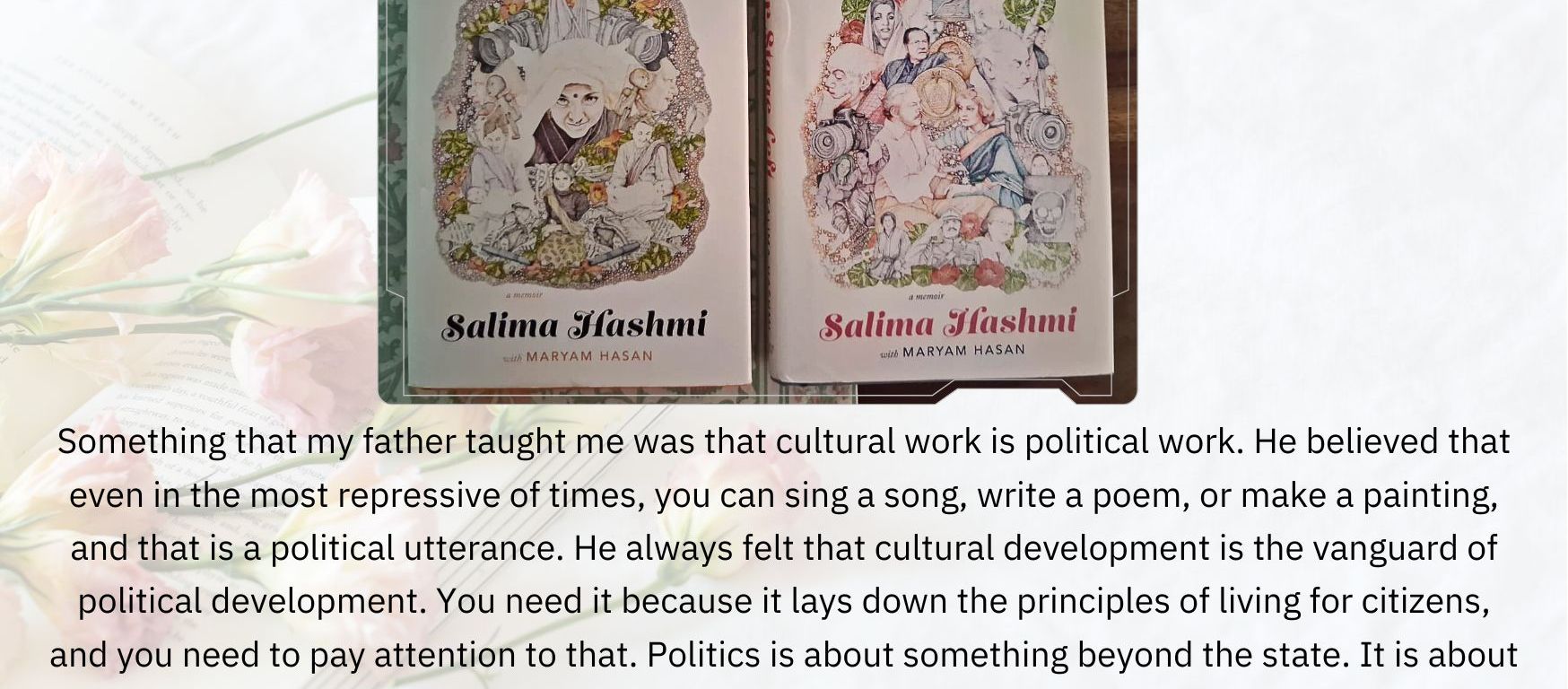
The daughter of celebrated urdu poet Faiz Ahmed Faiz, Salima Hashmi exemplifies how to carry a legendary inheritance without letting it become a cage. Her memoirs are rich with stories of art, activism, and resilience amid Pakistan’s political and social milieu.
Joie de vivre… a celebration of life and the joy of being on the planet. These were my first thoughts after finishing Salima Hashmi’s two-volume memoir, Waiting in the Wings and Enter Stage Left. Irrespective of which nation’s passport you hold, you are first an individual who can uphold values and spread cheer. This was my primary takeaway, and therefore I chose to share my learnings rather than an analytical review.
The elder daughter of celebrated poet Faiz Ahmed Faiz, Salima Hashmi chronicles the many colourful dimensions of her life in these unputdownable books. Her life isn’t just a shadow of her iconic poet father or her firebrand mother, but an intersection of passion, peace, and humane values set against the cultural and historical turbulence of Pakistan. The memoirs are rich with stories of a purpose-driven intellectual amid the brutal Partition, Faiz’s exile, censorship, and resistance.
These pages taught me more about South Asia, art, peace, humanity, and the burden and nostalgia of shared roots than any history lesson I’ve read earlier. Like her famous father, Hashmi creates magic with words. But words carry weight, and she learned this early at home. As a woman donning many hats, raised to be her own person, she has the skills to add colour, shape, and form to the ideas that take root in creative individuals.
About the Author
Salima Hashmi is a celebrated Pakistani painter, art educator, and human rights activist. As the daughter of Faiz Ahmed Faiz and Alys Faiz, she inherited a legacy steeped in poetry, politics, and cultural expression. Her mother co-founded the Human Rights Commission of Pakistan, while Hashmi herself co-founded the Women’s Action Forum. She has been at the forefront of innovative change in arts and gender issues in Pakistan.
Her career spans teaching at the National College of Arts (NCA) in Lahore, serving as its principal, curating exhibitions worldwide, and mentoring new generations of Pakistani artists. She was also the dean of Beaconhouse National University’s School of Visual Arts and Design.
The Memoirs in Context
Co-authored with Maryam Hasan, Waiting in the Wings and Enter Stage Left chronicle her family, art, and resilience amid Pakistan’s turbulent birth and growth.
- Waiting in the Wings focuses on her early life in the shadow of her iconic father, the revolutionary poet Faiz Ahmed Faiz. It portrays him not just as a legendary intellectual but as a devoted family man, and her mother, Alys Faiz, as a fiercely independent Englishwoman who became both a pillar of the family and a key figure in the country’s social landscape.
- Enter Stage Left continues the story, detailing Hashmi’s return to Pakistan in the 1970s and her immersion into cultural and political life as a wife, mother, and teacher. It chronicles her pioneering work in art education at NCA and her role as a vital link between generations of artists. The memoir also offers a sharp lens on the political clampdowns under General Zia-ul-Haq.
My Takeaways from Salima Hashmi’s Memoirs
1. Legacy is Inheritance, Not a Cage
Being Faiz’s daughter meant inheriting ideals of compassion and justice, but Hashmi shows how legacy can guide without confining. She built her own voice in art and education. She wasn’t a soldier on the battlefield but a warrior through mediums like television, advertising, art, photography, and words.
With a mother who fought for the underdog, she learned to take a stand in childhood. While her father stood for calm, her mother embodied courage; both taught her to walk through life with head held high. She also found a loving and supportive partner in Shoaib.
2. Borders Are Geographical Boundaries, Not Heartbeats
Born in pre-Partition Delhi, Hashmi’s memories are intertwined with India. Her memoirs remind us how nations change once borders are drawn, how regimes shackle hearts, but individuals still resist the hardliner stance.
Shared roots echo across the divide—common languages, homes, ancestry, even city names (Model Town in Lahore and Model Town in Delhi, Hyderabad in both India and Pakistan, Jhelum, Punjab). When people revisit their native lands, everything comes tumbling back.
Hashmi visited India many times—with her father, as a teacher, and later with her students. She came on peace tours, meeting Bollywood stars like the late Dilip Kumar, Saira Banu, Balraj Sahni, and Waheeda Rehman. She danced to their songs and carried back memories of cultural kinship.
The sweetest anecdotes lie in her father’s love story with Alys in Srinagar. Kashmir, the crown of India and the bone of contention between India and Pakistan, remains a beloved treasure.

3. Art Is Expression, Communication, Innovation & Perspective
Art is the soul of human life. It fosters creativity and imagination, gives birth to new ideas, and adds colour to existence. It can emote with terrifying acts of violence or regale us with tales of eras gone by.
Arts are witnesses to history, bridges of peace, and acts of defiance in times of repression. Under Zia-ul-Haq’s censorship, art became a silent yet powerful protest.
Hashmi’s life reflects how a nation without a clear cultural direction gradually forged one. She engaged in political satire on TV (Such Gup, Taal Matol), painted about Indo-Pak wars, curated art across South Asia, launched the Rohtas Gallery, created plays with her husband Shoaib, and embarked on photography tours to rural Pakistan.
4. Education Is Activism
Hashmi turned classrooms into spaces of questioning and resilience, where students could imagine freely despite restrictions.
Raised in a liberal, progressive household, she studied art in Bath, England. Those three years shaped her approach—teaching 45 five-year-olds in a rural school, clad in a sari! That ability to innovate and adapt later defined her work at NCA.
5. Culture & Travel Are Lifelines
For Hashmi, culture was not nostalgia—it was survival. Heritage, memory, and creativity became anchors of hope in despair.
In early years, she wore saris in Pakistan and England, even at protests and dances—until authoritarian regimes banned it as a “Hindu attire.” She learned Urdu, forged lifelong friendships worldwide, and became a living archive of 20th-century history.
She travelled by ship across continents, absorbed Moscow’s intellectual energy, enjoyed Bollywood, studied in America, and revisited India as an esteemed guest and teacher.
6. Resilience Is Quiet Power
Hashmi’s memoirs remind us that resilience doesn’t always roar. Sometimes it looks like persistence—continuing to paint, teach, and create despite repression.
Reading her life compelled me to search out her old TV dramas on YouTube. I marvelled at how far ahead she was of her times in Pakistan. Her memoirs are more than personal history: they are written with clarity, wit, calm, and humour. Even authoritarian regimes could not embitter her. Her life radiates hope and goodwill.

Why You Should Read These Memoirs
Waiting in the Wings and Enter Stage Left are not just Salima Hashmi’s stories—they are Pakistan’s. They echo universal lessons: artists who resist erasure, teachers who nurture courage, and individuals who carry forward legacy while creating their own path. If nothing else, then pick it up for the lovely covers created by Salima Hashmi’s student, Faiza Butt.
Book details
Waiting in the Wings by Salima Hashmi with Maryam Hasan (Volume 1)
Imprint: India Viking
Length: 256 Pages
Price: INR 699
Buy here
Enter Stage Left by Salima Hashmi with Maryam Hasan (Volume 2)
Imprint: India Viking
Length: 256 Pages
Price: INR 699
Buy here
You may also like to read
A Long Season of Ashes by Siddhartha Gigoo: A Haunting Memoir
Negotiating India’s Landmark Agreements by A.S. Bhasin: Lessons in Statecraft
Book Review: Society Girl by Saba Imtiaz & Tooba Masood-Khan
Desi Delicacies: Food Writing from Muslim South Asia
Book Review: Forgotten Foods: Memories and Recipes from Muslim South Asia
Expand Your Horizons Through Translated Literature

 Queen of Treasures
“Reading your review helped me discover a book worthy of great honour.”
LikeLiked by 1 person
very happy to know that you found something new to read.
LikeLike