
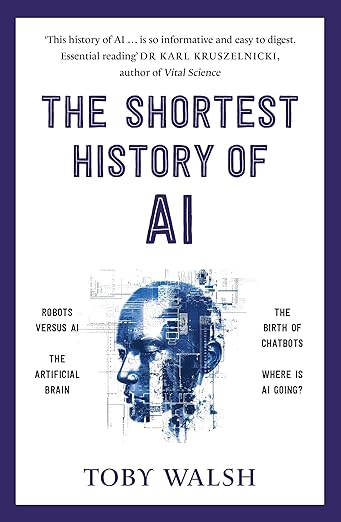
Artificial Intelligence (AI) was born on International Panic Day. Slightly weird, but then babies do cry when they come out of the womb. Whether that was an omen for today’s disruptive black sheep isn’t a question the book answers, but Toby Walsh certainly traces the path of the innovators, shapers, and shakers of AI.
Look, I’m old-world, and pardon my ignorance of all things tech. I’m not alienated from using digital stuff, I just don’t understand how it’s manufactured or the sheer amount of time and energy that goes into it. My primary concern with AI has always been its mammoth use of electricity, water, and all those natural metals needed for the huge servers and our devices. Given this, The Shortest History of AI by Toby Walsh, really woke me up to the perils of focusing on only one aspect.
The book opened a new perspective. I got to know a brilliant author, the many computer scientists, mathematicians, philosophers, authors, technocrats, companies, innovative countries funding AI, and impact of AI on a worldwide scale. Many passed away young, but their knowledge found takers.
The author, Toby Walsh, is a celebrated and award-winning British computer scientist. He is Scientia Professor of Artificial Intelligence at the University of New South Wales. The Australian media calls him a “rock star” of Australia’s digital revolution. He is a strong advocate for limits to ensure AI is used to improve our lives. Basically, he knows it all.
If you’re like me, not good in maths, physics or know nothing beyond pressing buttons, then this book is for you. The world of AI is about symbols and learning, and Walsh’s chatty style—using words like ‘Holy moly’, ‘be warned’, ‘bullshit’, and giving easy examples—makes it totally accessible for everyone. All the Ghibli or Nano Banana trends were centuries in the making, stemming from the old world to the new, thanks to countless forward thinkers.
I’m not writing a traditional book review, just sharing the superpowered stuff I learned from this short history of thinking machines.
1. The Literal Birth of AI
“Monday, 18 June 1956 was the first day of an eight-week-long workshop whose goal was to build intelligent machines.” (page 2)
The place was Dartmouth College, an Ivy League school in Hanover, New Hampshire. It was organized by John McCarthy, the assistant professor who coined the term “Artificial Intelligence.” He invited like-minded brainiacs from the US, Canada, and UK. Not surprisingly, an “all-male affair” and the gender imbalance exists even today.
2. Google’s Origin Story is a Misspelling
In 1996, an AI-powered search engine called BackRub came into existence. By 1997, it turned into our very own Google, which originated due to a total flub. The founders intended to search for the domain ‘googol’, a massive number that physicists love (1 followed by 100 zeros), but they misspelled it. Google was born!
3. Gaming AI and Pop Culture OGs
Walsh doesn’t just stick to the history books; he name-drops AI in movies, like my favourite Tom Cruise flick, Mission Impossible: Dead Reckoning, where he’s saving the world from a rogue AI ‘Entity’. I’ve watched both the parts of this movie. And I love the line: “This message will self-destruct in 5 seconds”.
Everything begins with play and so did the inventions. AI supercomputers defeated reigning champions in chess, Blackgammon, AlphaGo (which woke up the Chinese).
- The first superpower gaming computer was Nimatron, invented in 1940, and it played the Chinese game of Nim.
- The first AI chess program, Turochamp, was created by Alan Turing and David Champernowne in 1948.
Walsh also cites his favourite sci-fi books: 2001: A Space Odyssey by Arthur C. Clarke and The Hitchhikers’ Guide to the Galaxy by Douglas Adams.
4. India’s Ancient Brain Power
India has contributed brain power long before the Western world took over. Symbols are central for reasoning fed into a computer, and syllogisms, key to that reasoning, are traced back to the ancient Indian Sanskrit text, the Nyaya Sutras.
Then there’s the mind-blowing math:
- The Tower of Hanoi: A myth tied to the Kashi Vishwanath Temple says priests are moving 64 golden discs across three worn old posts. If they move one disc every second, it will take them 600 billion years to finish, which allegedly coincides with the end of the world.
- The Chess Fable: The inventor asked for a simple prize from the emperor of India: one grain of rice for the first square, two for the next, four for the next, and so on. The final result would be an insane 18,446,744,073,709,551,616 grains, enough to carpet the whole of India several feet deep! That’s exponential power.
5. AI’s Limits and Global Impact (The Cold Hard Numbers)
Going by the future Walsh writes about, it’s not all doom-and-gloom. But there are facts that we can’t overlook:
- “ChatGPT may be remarkably fluent in writing paragraphs of text, but it can’t do simple reasoning. It even struggles to add up.” (page 44)
- There are over 3 million robots in industrial units across the world. The robotics industry hit over US$37 billion in revenue globally in 2023 (page 83).
Robots are around as vacuum cleaners if you’ve seen all those advertisements. But they have done more than cleaning homes. Australian firm iRobot’s robots have explored the great pyramids of Giza, defused bombs in Iraq and Afghanistan, and gathered data at the Fukushima nuclear disaster site, even looked at underwater oil spills.
NASA has also sent robots on long, dangerous space missions.
But the UK House of Commons’ Science, Innovation, and Technology Committee (August 2023) identified huge challenges. Among these the most striking one for me was the existential threat. Humans landed on top of the food chain because they are the smartest species on Earth. But if the machine becomes smarter than humans, then what happens to humans? The scare does stem from books and movies that we see such as Dan Brown’s Origin or Mary Shelley’s Frankenstein.
Environmental costs, democratic challenges and many more pressing issues are also being contemplated daily. Like social media, AI could bring down trust levels, and harm mental health. Fake news and fake information could become the norm if AI is treated as a master rather than an aid.
Maybe the answer lies in slowing down, sitting back, and weighing the pros and cons instead of making this a race that no one seems to be winning.
“In one year from launching ChatGPT, Open AI went from no income to over US$1 billion per year, and a valuation of over US$100billion, though it still loses several billion dollars annually.” (page 176)
The good bit: India is part of the few countries investing in AI research.
Walsh’s book is a quick, essential ride through AI’s past, present, and future. It gives easy insight into the making of AI, including the game-changing computers like Watson and Menace. All you need is 6 hours and AI would be on your tips, because let’s face it: we have to know something before we opine on it.
Book Details
Publisher: Picador India (Pan Macmillan India)
Language: English
Price: INR 599 (Paperback)
Buy here
You may like to read
Book Review: The Shortest History of Migration by Ian Goldin
Book Review: The Shortest History of Japan by Lesley Downer
Book Review: The Shortest History of Economics by Andrew Leigh
BOOK REVIEW: THE SHORTEST HISTORY OF ISRAEL AND PALESTINE BY MICHAEL SCOTT-BAUMANN
Book Review: Missions, Mantras, Migrants & Microchips by Leonard A. Gordon
Takeaways from Salima Hashmi’s Memoirs: A Reflective Review
Treasure Hunt: Guardian of the Lost River

 Queen of Treasures
One thought on “Toby Walsh’s ‘The Shortest History of AI’: Your 6-Hour AI Guide”