
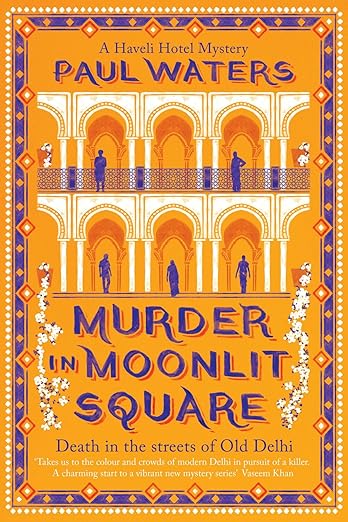
Discover how an Irish nun and a Delhi hotelier, bonded by a sneaky smoke break, team up to solve a murder, fight a “terror threat,” and save a historic haveli in the chaotic, colourful Chandni Chowk. A cozy mystery with a nostalgic resonance.
The best way to describe Paul Waters’ Murder in Moonlit Square is in one sentence: A multilayered emotional punch, sometimes shaken but mostly stirred. The story revolves around a brutal murder in the Delhi Haveli Hotel, a traditional haveli in the densely populated Chandni Chowk, and the subsequent disappearance of a Pakistani pilgrim who was a guest there.
The Plot and the ‘Perceived Terror Threat’
The brutal murder and the ‘perceived terror threat’ from neighbouring Pakistan have cast a shadow on the thriving haveli hotel. The hotelier, Avtar Mehta, is under the police scanner, and the business is just days away from being shut down. The charming hotelier is forced to team up with an elderly Irish nun, Sister Agatha Murphy, to save himself and the hotel. An unlikely ‘ad break’ brings the duo together in the dirty alley behind the hotel. This sneaky smoke encounter becomes their thinking cap as the story moves along.
A Cozy Mystery in Chandni Chowk
Given the magnitude of terrorism and the involvement of government intelligence and security agencies, one might expect a high-octane crime fiction that races through country borders with undercover spies, mafia, guns, and more murders. But Paul Waters takes a different approach, turning this into a cozy murder mystery.
He introduces the reader to two humanitarians, who believe in the goodness of life and people. They aren’t swayed by suspicious police officers; in fact, Mehta quickly gauges he would be made the scapegoat if the culprits aren’t brought to light, which Sister Agatha is forced to admit much later. Sister Agatha, just a kind-hearted nun experienced in running schools and teaching children, is determined to find the missing pilgrim. Both of them believe that the missing pilgrim is neither the killer nor a terrorist.
Delhi as a Character
Waters has paid a lot of attention while fleshing out his characters, giving the readers the minutest details about their clothing, behaviour, and emotions. But his USP is the way he has caught the ambience of old Delhi with its traditional mannerisms and the alleys where even sunshine doesn’t reach. For an Irishman to capture the nuances of Old Delhi like an insider isn’t an easy task. Of course, it helps that he’s an award-winning BBC journalist and married to an Indian.
The Chandni Chowk Waters describes is where labourers still carry goods on their heads, godowns are stuffed with wholesale goods, wires hang overhead, and in between are houses with lattice work and shouts of cycle rickshaw wallahs. If you take a walk around the walled city, you will see all that the book has captured.
Climbing to the roofs gives another view: it’s almost a drone-like experience where everything is ant-like, hordes crawling through a labyrinth without an opening and a closure. I’ve seen this fascinating scene from the roof of Khali Baori, the oldest spice market. I’ve even taken tonga rides during my childhood there.
Themes of Forgiveness and Displacement
The story is not just about the fight for survival or solving two crimes related to cross-border infiltration and sexual harassment; it’s also about forgiveness, a compassionate approach, taking intelligent paths to solve complex issues, and living in the NOW. It is interlaced with love, loyalty, and people anchored in the familiar. Sister Agatha brings to light many issues related to skills, divine gifts such as presence of mind, feminism, and the danger of young girls falling prey to evil male teachers.
The novel uses the central crime to explore deeper, societal ‘murders’. For me, this included the murder of the human heart, forced to migrate from his/her native land due to greedy politicians; the murder of young dreams by a teacher; the murder of livelihood by people who don’t abide by the law or fulfill their duty. There’s even a bigger murder—the murder of personal religious beliefs and trust between communities.
Mehta and Sister Agatha understand the pain of being displaced. India is her adopted country, but there’s no more work here, yet she doesn’t feel there’s anything left for her in Ireland. Mehta understands the pilgrim’s frame of mind, as his family too migrated to India during the Partition.
Nostalgia and Emotional Resonance
For a native like me, this book was time travel. It took me to my childhood home—a haveli, the dark basement or godown where my father kept his shop’s stuff, the food corners that delight tourists and natives, Jama Masjid and its adjacent Meena Bazaar. The description of the boys’ hostel/orphanage reminded me of my visit to the one run by Salaam Balak Trust at Paharganj. I’d even written a story on it for Patriot newpaper.
I feel if Mughal emperor Shahjahan’s daughter Jahanara (the creator of Chandni Chowk) saw the mayhem that exists today, she would faint. The beauty of the moonlit square has been swallowed by time.
Pick up the book for its beautiful cover designed by David Wardle. Read it for the emotional and hilarious moments, the Bollywood end with dance, music, festivities. Every chapter is about the Delhi that was and the Delhi that it has become, where the ancient, traditional and modern somehow intersect. And you’ll find a lot of quotable quotes to grace your Instagram feed with.


About the Author
Paul Waters is an Irishman married to an Indian. He grew up in Belfast during “the Troubles” and currently lives in Buckinghamshire. His first book, a thriller called Blackwatertown, is set in Ireland.
Paul has been a night club cook in New York, he made Pelé his dinner, smuggled a satellite dish into Cuba, was an award-winning BBC journalist. He has also covered elections in the USA, created an alternative G8 Summit in a South African township, gone undercover in Zimbabwe, conducted football crowds, reported from Swiss drug shooting-up rooms, overseen the World Service’s first live coverage of the 9/11 attacks on America.
Paul has taught in Poland, driven a cab in England, busked in Wales, designed computer systems in Dublin, presented podcasts for Germans & organised music festivals for beer drinkers.
He co-hosts the We’d Like A Word books and authors podcast, and is co-organiser of the Chiltern Kills crime festival and the Khushwant Singh LitFest London.
Book Details
Publisher: No Exit Press (Bedford Square Publishers)
Language: English
Paperback: 391 pages
Price: INR 550
Buy here

You may like to read
My Delhi Diary
Gripping Spine-Tingling Crime Thrillers
Book Review: Society Girl by Saba Imtiaz & Tooba Masood-Khan
Book Review: Unbroken by Indrani Mukerjea
I ended up binge watching these crime series
Meet Vish Dhamija: The British Indian Author Who Took Legal Crime Fiction to A New Level
The Green Lungs of Delhi-NCR
A Morning at Humayun’s Tomb, Delhi
Witnessing the Yamuna’s Revival at Asita East Park, Delhi

 Queen of Treasures
One thought on “Murder in Moonlit Square by Paul Waters: The Nun, the Hotelier, and the Delhi Haveli Mystery”