
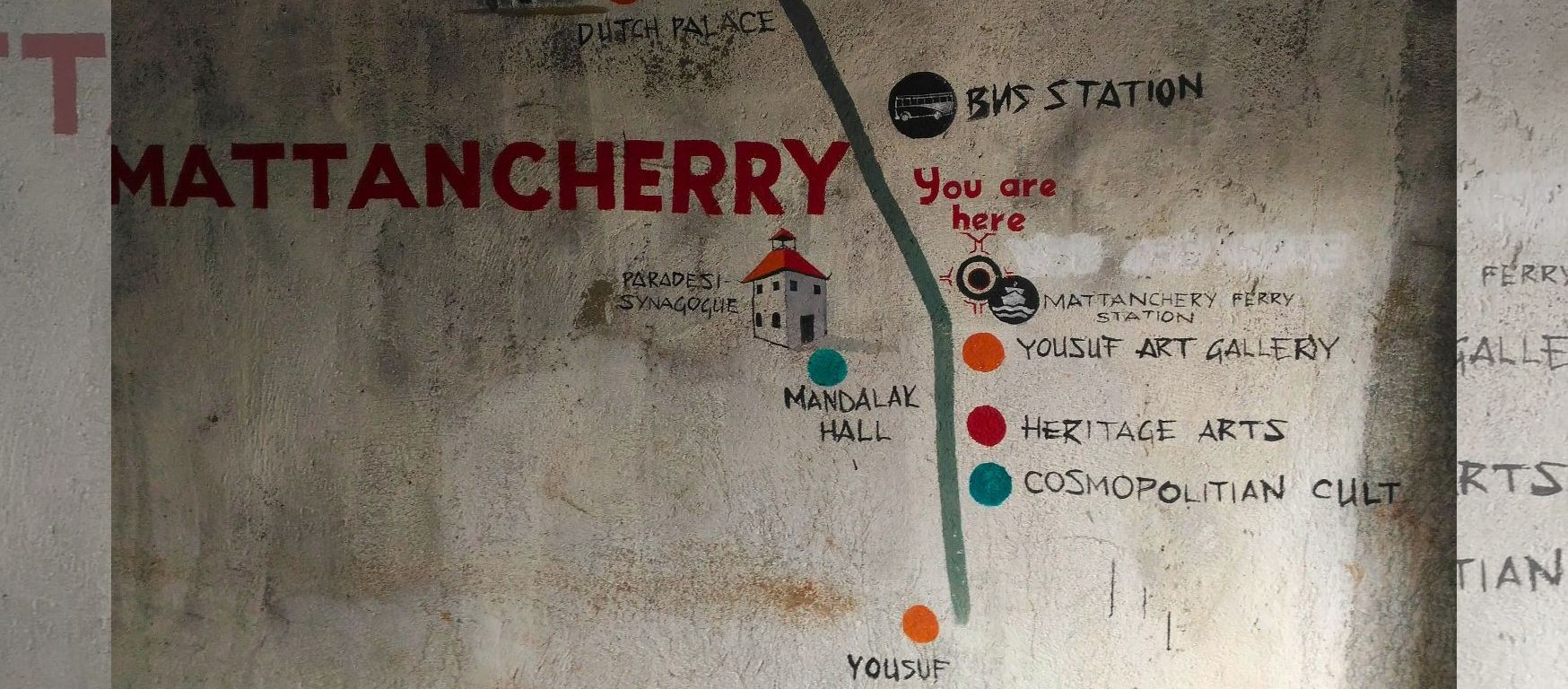
Discover Jew Town, Kochi’s rare blend of Jewish history, Kerala crafts, and enduring legacies that celebrate coexistence and craftsmanship.
- Kochi-Muziris Biennale: A Fusion of Time
- Muziris: Where Civilisations Met the Sea
- Jew Town: Where Sanskrit Met Hebrew
- The Paradesi Synagogue: Light and Legacy
- Little Queen Embroidery: Bruges Lace and Petit Point
- Sarah Cohen’s Embroidery Shop: The Last Jew of Kochi
- IRS Natural Incense and Perfume Oils: Make Your Own Perfume
- How to reach Kochi
- Where to stay in Kochi
I recently watched the movie Param Sundari on Amazon Prime. As it progressed, I thought to myself what a convulated experience of green, stunning Kerala. Even Siddharth Malhotra’s good looks couldn’t keep me glued. This was exactly the same feeling I had after my story on Kerala was published in 2016.
Every traveller has a dream; mine was Kerala. I was working with a travel magazine then, and thanks to the Kerala Tourism Board, I was sent for a preview of the preparations for the Kochi-Muziris Biennale in 2016. Somewhere between the salt air, the scent of spices, and a shack that scandalised locals when I downed five glasses of toddy with spicy fish, I realised that this trip wasn’t a “dream come true.” In my dreams, Kerala was a slow, cinematic, panoramic experience, not a 3-second silly reel hook (which is how Param Sundari portrays it). I think directors shouldn’t imitate jumping jack Instagram when making films, they are two different storytelling mediums.
My storytelling medium was the written word. I didn’t do justice to Kochi, to its historic Jew Town, or the ancient seaport of Muziris. As a journalist, you’re trained to smell out stories, but mine didn’t touch any of the five senses. My editor wasn’t on the same wavelength, time was short, the budget tight. I hadn’t bought a DSLR or trained my eye for photography. Years later, as I searched online, I found the stories I had glimpsed now told by other media houses. Still, I never forgot those stories and preserved my recordings. So here I am, penning them a decade late.
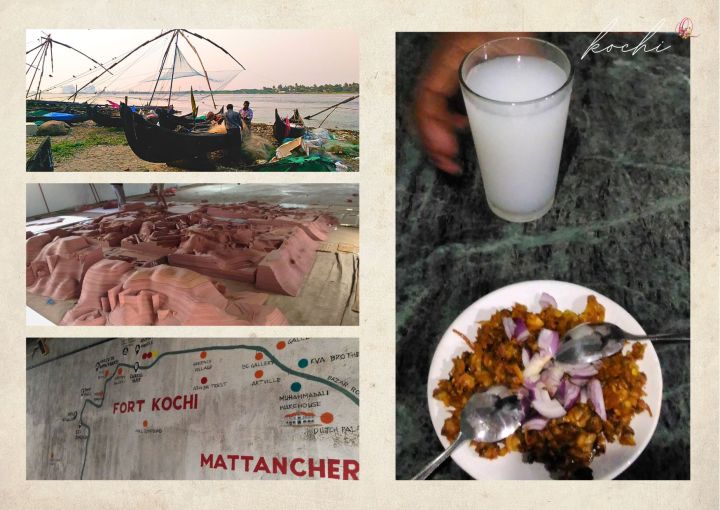
Kochi-Muziris Biennale: A Fusion of Time
The Kochi-Muziris Biennale (KMB) began on December 12, 2012, celebrating a blend of the ancient and the contemporary in public spaces. Indian and international artists converge here, showcasing works across mediums such as painting, sculpture, film, installation, performance art.
This unique art show is replete with seminars, musical performances, talks and more. But as I haven’t seen it, can’t say it.
During my trip, I just caught a glimpse, a few artworks in progress and even lesser artists at work. But what lingered: the stunning view of the Malabar Coast from Fort Kochi. The USP of KMB is that art isn’t confined to galleries, it breathes all around in courtyards, godowns, and sea-washed walls.
To know more, visit kochimuzirisbiennale.org.
Muziris: Where Civilisations Met the Sea
Located about 30 km from Kochi, Muziris was once a flourishing seaport and financial centre in the 1st century BCE, a vital link between the Indo-Roman and Indo-Greek trade routes. Legend says it vanished after the Periyar River flood of 1341 CE.
This ancient port is believed to have been home to India’s first church (Mar Thoma), first mosque (Cheraman Juma Masjid), and the oldest European monument — the Portuguese fort.
You can read more about it here: A Guide to Muziris Heritage Project, Kerala.
I had not wanted to place KMB (but had to) as the mainstay of the story, as it had been written about many times; my heart lay in Jew Town, an emblem of communal harmony and prosperous coexistence.
Jew Town: Where Sanskrit Met Hebrew
The historic enclave lies between the Mattancherry Palace and the old spice market. Its cobbled lanes are lined with antique shops, art galleries, and colonial-era buildings that whisper stories of another time. Jew Town’s origins date back to 1524, when the King of Kochi, Bhaskara Ravi Varma, granted land to Jewish refugees fleeing Kodungallur after conflicts with the Portuguese.
These settlers, the Paradesi (foreign) Jews, brought with them not only faith and resilience but also trade and artistry. For centuries, they thrived in Kochi’s spice trade, dealing in pepper, cardamom, and textiles. Here, Sanskrit met Hebrew, Malayalam mingled with Ladino (a language born of medieval Spanish and written in Hebrew script).
Though the Jewish population dwindled after the establishment of Israel in 1948, the echoes of their heritage still linger. Jew Town remains a living museum of Kerala’s layered past.

The Paradesi Synagogue: Light and Legacy
The highlight of my walk was the Paradesi Synagogue, the oldest active synagogue in the Commonwealth, established in 1568.
I was surprised that everyone walked in barefoot, just like a Hindu temple. It is a living synagogue, but we went in the afternoon, and there were only a couple of tourists.
Inside, I stood transfixed by hand-painted blue-and-white Chinese tiles, Belgian glass chandeliers, and a gold pulpit that shimmered in the afternoon light. I longed to attend a prayer session, but the silence too was sacred.
As we wore our shoes, stomachs grumbled. We didn’t have any recommendations for eating out. We just trusted our prayers and entered Sree Ganesh restaurant, close to the synagogue, to be rewarded with a yummy dosa for lunch.

Little Queen Embroidery: Bruges Lace and Petit Point
Satiated, we had a full market on either side. Uncertain about where to begin, what to see, who to talk to, we looked both ways and then in front. The quaint blue board with ‘Little Queen Embroidery’ helped me make a decision to cross the road.
It turned out to be a treat with handmade laces and embroidered home linen and clothing. It reminded me of all those royal balls I’d read about in historical romances by Barbara Cartland and Victoria Holt. After looking around, I realised the shop had been graced with the presence of King Charles (then Prince of Wales) in November 2013. I was on royal ground now.
The owner, Thomas P.E., was a delight to talk to, going into details about the craft of near extinct lace making and embroidery that is limited to a few craftswomen now. Lace making travelled to India with Franciscan and Carmelite nuns. The British loved lace, and the industry thrived during the British Raj.
Showing us the various pieces, he talked about the intricacies of Bruges Lace. This crochet technique, inspired by Belgian lace, is made from crocheted tapes or ribbons. While it is dying in India, lace making in Bruges, Belgium, is a huge draw.
With Thomas I learned about how to make a classical French knot, an intricate and delicate process. Then there was Venetian lace from the 18th century, which reached Cochin with Portuguese missionaries, Italian and Belgian nuns.
Lace is made with bobbins and each design needs a certain number, could be 28, 60, 80, even as high as 120. He had 268 women working on the products through his NGO.
Lace making is a slow process and each woman was able to make only 8 cm a day! Some lace makers still thrive in the convents. The centre at St. Elizabeth Convent in Kattiparambu has been around for over 100 years.
He lamented the loss of the beautiful craft to less earnings, more time consumption and need for strong attention to detail. A lace maker earnt around INR 1890 daily, while a city worker would earn much more.
Another beautiful embroidery was Petit Point. This is made with different sized needle points, probably the smallest point in the world. One pattern could have as many as 3,200 points. He had a heritage piece of 4,200 points with him! What made me gasp was that petit point crafts are also exhibited at the Louvre Museum, Paris (It’s true, I looked up the museum site). A good piece would probably take two months to make.
Introducing me to more embroidery, he showed me the beautiful Herringbone stitches. In this delicate work, the back and the front look exactly the same.
While Cross Stitch is common, but in the work done by the expert women, even the back is as clean as the front. Not a single knot was visible.
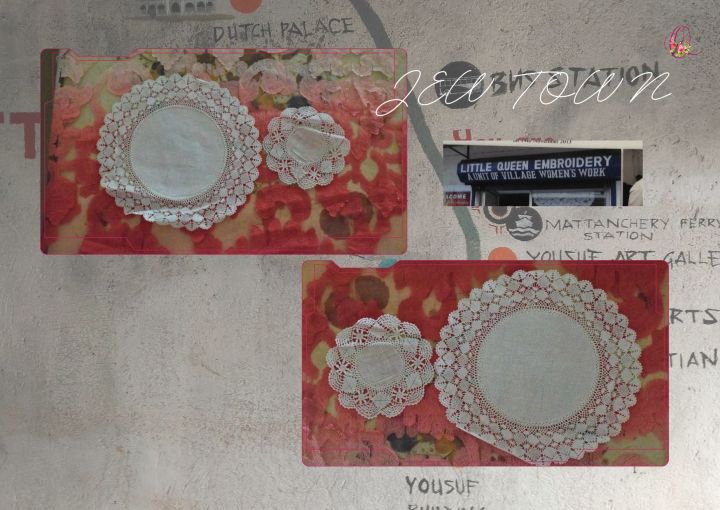
So, going by the hard work done by these women and the fact that this is going to get tougher to find, I am happy that bought two small cloth coasters.
You can read more about Bruges lace and embroidery in Kochi here: Once a hub of handmade Bruges lace, Kochi is now a centre of embroidery

Sarah Cohen’s Embroidery Shop: The Last Jew of Kochi
A few steps away stood another story — Sarah Cohen’s home and embroidery shop. It felt straight out of an Enid Blyton book, charming and intimate with cats, plants and colourful doors.
In 2016, Sarah Cohen, then 94, was the last living Jew in Kochi. I didn’t speak with her due to her memory and other age-related issues. However, her aide, Thaha Ibrahim, was very forthcoming about the shop, Sarah’s origins and his role. Sarah passed away in 2019, leaving her house and shop to him, a Muslim boy who had once sold postcards nearby. I learned this during my web search.
His story unfolded like a parable of kindness. Taken in by Sarah’s husband Jacob Elias Cohen in 1982, he grew into the family they never had. Fulfilling Jacob’s last wish, Thaha cared for Sarah until her passing. She now rests in the nearby Jewish Cemetery. It’s an unusual story that makes you believe in humanity; people are willing to take care of each other despite the religious differences. The Cohens didn’t migrate to Israel because they were rooted to India after settling here in 1942.
Adept at shadow embroidery, she taught the craft to many young girls in the neighbourhood. Her shadow embroidery, especially the Challah covers she created with Hebrew motifs, was exquisite. Each piece took four days and cost ₹1,000 back then. I’m glad to have a piece of embroidered history with me.
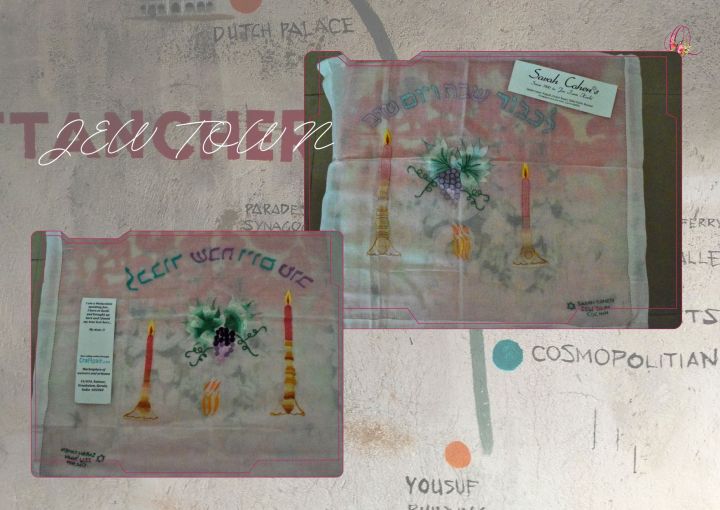
She had converted her living room into a shop. Her living quarters, a nice big room and kitchen, had a bed in the centre. Thaha and I sat by the window which overlooked the busy street. Thaha went onto to familiarise me with the history of Sephardic Jews and their passage to India from Spain via Turkey, Baghdad. Then, I learned about the importance of Challah, the braided bread that is offered at Shabbat meals.
Thaha Ibrahim runs the shop with the same old principles, going by the story I read on the web.
You can read more about Sarah Cohen and her shop here: Saving Sarah: The last Jewish embroidery shop in Kochi
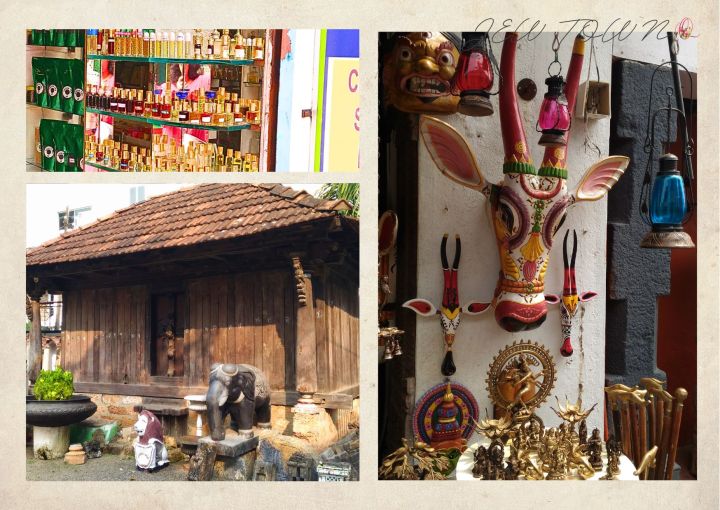
IRS Natural Incense and Perfume Oils: Make Your Own Perfume
I bought some incense sticks from IRS and even learned how to make them, thanks to the director Irfan Shariff. His wife, Sumaiya, decorated my hand with a flowery henna motif.
There were just shops and shops. But I can never forget the souvenir masks, cow masks at that. Come to think of it, I should’ve got stories around the making of those traditional cow masks.
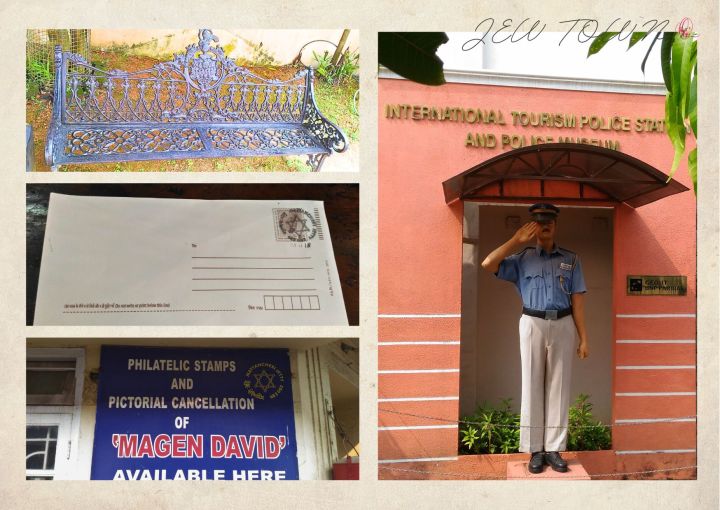
I also explored the International Tourism Police Museum where I was the lone tourist. In the old Jew Town post office, I bought a cancellation of the Magen David for INR 5!
Jew Town, Kochi reminded me that stories, like lace, are woven slowly, with patience and love. It’s the amalgamation of cultures that defines the passage of time. And stories are forever, they could be in the moment, in the past, in memories and in the making.
How to reach Kochi
The nearest international airport is at Nedumbassery, about an hour’s drive from Kochi.
Where to stay in Kochi
- Bolgatty Palace & Island Resort (KTDC)
- Cherai Beach Resorts
For those who prefer staying in the thick of the heritage circuit, Fort Kochi offers charming homestays and boutique hotels.
This post is a part of Blogchatter Half Marathon 2025.
You may like to read
BOOK REVIEW: THE SHORTEST HISTORY OF ISRAEL AND PALESTINE BY MICHAEL SCOTT-BAUMANN
Book Review: The Shortest History of Migration by Ian Goldin
Miraculous Rescue on Mt Annapurna: The Story of Anurag Maloo, Adam Bielecki & Mariusz Hatala
Finding colours of Ukraine & Poland in India
Bell Beauty Unveiled: A Stunning Photo Essay
Humayun’s Tomb Museum: The Bibliophile Mughal Emperor
Dharamshala, McLeodganj, Palampur, Andretta: Kangra Valley Treasures
This blog post is part of ‘Blogaberry Dazzle’ hosted by Cindy D’Silva and Noor Anand Chawla in collaboration with Ratna Prabha.

 Queen of Treasures
I wish I had read this article a few years back when we visited Kochi. So informative.
LikeLiked by 1 person
Same wish here, I wish I had penned it years back. :D
LikeLike
I could never manage to visit the Biennale. But I’m familiar with the Jew Street, the synagogue, etc because I studied in Kochi for 5 years. Your post has kindled some nostalgia in me.
LikeLiked by 1 person
It’s my nostalgic post as well! :P You can attend the Biennale this year, starts on December 12.
LikeLike
Other Than Vizag I am yet to touch any other parts of South India. Although the beauty of Kerala attracts me a lot but perhaps god has a different plan for me which is as of now restricting me to be there yet. Watched Param Sundari Yesterday only …. other than the hilly plantations while the duo were driving a bike, no where I felt it managed to capture Kerala rightfully. Kochi Reminds me as Rakhi’s Nest…. God knows when will I meet her face to face……
LikeLiked by 1 person
Oh, you haven’t met Rakhi ever! Kerala is beautiful and I haven’t seen it properly either. The boat race that you saw in the movie is on my list and the beautiful jungles. Vizag also on my list. I wish I could just pack my bags and just travel 😜
LikeLike
Der Aye par Durust aye! I am so glad that you penned this article even if after more than a decade , at least I learnt about the Jewish part of Kochi.The pictures brought alive your words.I hope most of it survives still.
LikeLiked by 1 person
Except for Sarah, I think they are all there
LikeLike
I havent watched, Param Sundari but you had my attention at 5 glasses of toddy, Ambica. Didn’t it give you a kick :) I would love to see the places you have mentioned. I am bookmarking this page for reference later
LikeLike
I hope you do get to visit Kerala! Toddy is fun…:P
LikeLike
Wow! There’s so much to Kochi that I didn’t know. Thanks for sharing, Ambica. I was in awe looking at the handicrafts, and the shadow embroidery is beautiful. So is the lace making– so perfect and delicate!
LikeLiked by 1 person
It’s pure art…that lace.
LikeLike
I went to Kerala few years back but I think I just visited the touristy places. However, through your post I can see Kerala through a completely different lens but true the place is truly magical. I wish the art of lace making revives in India, would hate to see such fine art extinct.
LikeLiked by 1 person
I hope so too. We should promote all crafts 😊
LikeLike
Your portrayal of Jew Town’s streets, filled with spice-scented lanes, lace-laden windows and stories of enduring faith, felt like a walk through history. The weaving together of heritage, craft and community in Kerala’s Jewish quarter was really good to read. I shared your piece with one of my friends who’s making a visit soon to Kochi and he has thanked you for so writing out so much of information.
LikeLiked by 1 person
Wow. That’s very sweet of you Romila. I hope your friend enjoys the trip.
LikeLiked by 1 person
Of all places I’ve gone to, Kerala still remains out of bounds. I’m not the Instagram reel-loving person and like to experience a place closely through its culture. What a beautiful post that recommends just about everything one must see in Kochi.
LikeLiked by 1 person
It’s best experienced with time on your hands. Allow yourself to be immersed in the experience. I hope I will get a chance to visit it someday, especially the backwaters where the world is awesome.
LikeLike
Hey, really enjoyed your deep dive into Jew Town, Kochi. You brought out the blend of faith, lace and legacy in a way that feels both respectful and alive.
LikeLiked by 1 person
I’ve read so many blogs but yours always has some different creative style, descriptive yet eye-catchy. Thank you for the written tour which is making me plan a trip soon.
LikeLiked by 1 person
Thank you for the appreciation. I hope you have a good trip, should you make the trip.
LikeLike
Bookmarked this. Yet to go to Kochi and your embroidery shop is on the top of my list !
LikeLiked by 1 person
Have a good trip, as and when you do go. 😊
LikeLike
That’s a wonderful review of Jew Town in Kochi — your writing brings its blend of faith, lace and legacy vividly to life ✨. The way you showcase its layered history and vibrant present resonates. We had visited way back in 2016!
LikeLiked by 1 person
Oh good to know, you saw this too 😜
LikeLike
So happy to read this! I live in Belgium and love the laces here. It is a dying art here as well since it is time consuming and neck breaking. Machine laces are mostly gaining popularity. I am an embroidery artist and it is so gratifying to read about Sarah Cohen. Thanks a lot !
LikeLiked by 1 person
It’s sad to know handmade laces are dying. They are real treasures. Since you are in Belgium, have you been to Bruges?
LikeLike
Hi, yes, of course. Bruges is a quaint little gem of a city. Did manage to buy a small piece of handmade lace and I have framed it :)
LikeLike
i remember visiting these places during my school and college trips. This really brought back lovely memories of the place.
LikeLiked by 1 person
It was good to know that the place has a nostalgic feel 🙂
LikeLike
I have visited Kochi twice, and your wonderfully detailed post took be back for the 3rd time! This is a must read guide for anyone visiting Kochi! Loved it!
LikeLiked by 1 person
I went to Kochi ages ago, when I was a kid. I hardly have any memories. Now I want to visit again during biennale. Maybe, I will head down there during this edition.
LikeLiked by 1 person
Let me know how you find it, if you do go to see the Biennale.
LikeLike
What a gorgeous article Ambica. I love how you mentioned you could smell a story. It’s amazing how this muscle gets flexed every time an idea hits.
LikeLiked by 1 person
yes, the interesting fact is that muscles store memories! and those memories become habits :P
LikeLiked by 1 person
I’m so keen to visit Kochi and the Biennale which is currently on, but nothing seems to be working out. I get your point about smelling out so many stories during travels but they often prove hard to place in publications – even though I’m a freelancer and not bound to one publication!
LikeLiked by 1 person
Try through Kerala Tourism.. they do take FAM trips.
LikeLiked by 1 person