

In a world obsessed with 3-second hooks, Bill Bryson reminds us that life is a slow, multi-billion-year shuffle that deserves our undivided attention.
Food for thought
We have built our life around the 3-second hook lie, the biggest lie in the digital age. Life is slow, shuffling, changing over billions of years to bring cells into forms and then forms into shapes that live, evolve, and die—sometimes, they go extinct.
In an infinitesimal world, I am nothing but a random tiny atom. The reinforcement sent my mind racing, all particles jumping up and down inside that small cranium at the thought that I am nothing, something philosophers and spiritualists have been propounding since the beginning of civilizations. I looked at the big fat book in my hand, the book which now sits on a throne in my bookshelf.
A Short History of Nearly Everything 2.0 is all facts, innovations, research, and man’s quest to unravel the mysteries of the universe. It’s a book that turns hard, grey scientific facts into a comprehensible, witty read, albeit a slow read that makes you sit with a pen and diary and make notes along the way. I have an aversion to highlighting the written word or adding scribbles along the margins. In any case, this book would end up being a coloured version of nearly everything! This book needs to be placed in a visible part of the home where the family reads it time and again.
This book introduced me to American-British author Bill Bryson, who is better known for his travel writing. His book A Walk in the Woods was also made into a movie (2015) which is on my high priority watch list now. Personally, he’s changed the things I want to write about and how I want to write them. A Short History of Nearly Everything 2.0 is an updated and revised version of the 2003 edition which won accolades and sold over 300,000 copies. It’s also given me a new travel bucket list.
Science made Witty (though Slow)
Coming back to the sciences again, the book explores the ‘whys’, ‘whens’, ‘hows’ of existence. From the Big Bang to ever-expanding galaxies and, amid them, our home, planet Earth—the universe is a dark gigantic space. And in this crazy, unending mystery, we seem to be the only living beings poking our nose into everything that exists or what we can understand. Doesn’t that sound like an upside-down, mind-boggling world? In 700 pages, divided into short chapters and five parts, the book touches upon major stuff from all the life sciences: chemistry, paleontology, astronomy, particle physics, evolution, geology. Basically… everything.
I am not reviewing the book as a scientist, as I only studied science through school, though now I regret that I didn’t tenaciously pursue it during graduation. What this means is that I might not have my facts in place with the latest findings and the changes that have happened over my existence. But even if you don’t have a keen interest in the sciences, you will enjoy reading this book. Bryson’s writing reminds me of the waves: going up and down, low tide and high tide, then sudden turns and twists, and eventually roars.
To give you a sample: “So at various periods over the last 3.8 billion years you have abhorred oxygen and then doted on it, grown fins and limbs and jaunty sails, laid eggs, flicked the air with a forked tongue, been sleek, been furry, lived underground, lived in trees, been as big as a deer and as small as a mouse, and a million things more. The tiniest of deviations from these evolutionary imperatives and you might now be licking algae from cave walls or lolling walrus-like on some stony shore or disgorging air through a blowhole in the top of your head before diving 60 feet for a mouthful of delicious sandworms.” (page 3)
My research showed that Bryson felt teachers often seemed as if they were actively trying to hide “the good stuff” by making it “soberly unfathomable.” So, he set out to write the book that makes science fascinating and accessible. Well, we are all happy that he accomplished this well.
Besides the facts, I couldn’t stop chuckling at the witty nuances on the ‘mad scientists,’ their eccentricities, and their squabbles. Their quirks and obsessions are hilarious.
What became the highlight was the fact that the timespan between thoughts, ideas, discoveries, explorations, and acceptance could be long, stretching across centuries. People have been the same through the passage of evolution: they fight for survival, they brush others aside, and they need acknowledgment and credit, even for work they haven’t done.
Notes by predecessors and stalwarts must be guarded, for in them lies precious knowledge. The love for the natural world doesn’t have to stem from formal studies; most information has been gathered by people who were passionate observers seeking knowledge for themselves.
Scientists and nature lovers have traveled far and wide, spent all their time in research and pursuing the unknown, braving natural calamities and ill health and lack of funds and resources.
Take the case of English mathematician Richard Norwood. The young man travelled to Bermuda with a diving bell to scoop pearls from the seabed. The experiment failed, but the experience and his love for trigonometry led to the masterwork on navigation, The Seaman’s Practice, in 1637. But his happy moment became a nightmare as he moved to Bermuda with his family. “In the 1650s the witchcraft trials came to Bermuda and Norwood spent his final years in severe unease that his papers on trigonometry, with their arcane symbols, would be taken as communications with the devil and that he would be treated to a dreadful execution.” (page 58)
To all those lost in the annals of time, their theories unrecognized, we owe a debt of gratitude; their pioneering work became a tiny desire for other generations to experiment, innovate, and discover.
While every page has a unique aspect of life forms on Earth, here I am sharing the timeline of existence, spanning billions of years, that Bryson walks us through:
- The Cosmos & the Atom: He speaks of the colossal size of the universe and the minuscule world of atoms and subatomic particles, reminding us that we are part of a 13.8-billion-year story. He delves into the subatomic, explaining that we are composed of atoms so small that “a million of them could fit into the period at the end of this sentence.”
- The Human Lineage: He traces the fragile thread of biology, from the first spark of life in a primordial sea to the very hands we, Homo sapiens, use to turn these pages.
- The Earth’s Temperament: He reminds us that we live on a restless, beautiful planet. Whether it’s the slumbering giant of Yellowstone National Park or the threat of a wandering meteor, he shows us that our existence is a miracle of timing and luck. Bryson covers major catastrophes, like the impact of meteorites, massive volcanic events (Krakatoa, Yellowstone), and the destructive power of earthquakes, tsunamis, and hurricanes.
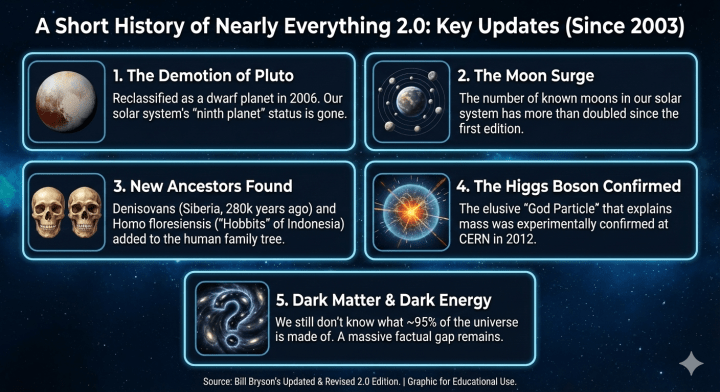
The new edition focusses on how much “busier” our solar system has become:
- The Demotion of Pluto: Bryson reconciles the heartbreak of Pluto losing its status as a planet.
- The Moon Surge: He notes with wry surprise that the number of known moons in our solar system has more than doubled.
- The Denisovans: Ancestors from Russia dating back 280,000 years.
- The “Hobbits”: Homo floresiensis, the tiny, archaic humans of Indonesia.
- The Higgs Boson: The “God Particle” that finally explains why things have mass.
- Dark Matter & Dark Energy: Bryson admits we still don’t know what most of the universe is made of, a factual gap that he treats with his signature sense of wonder.
Accolades
- The 2004 Aventis Prize: After winning, Bryson donated his £10,000 prize to the Great Ormond Street Hospital, proving that the study of “nearly everything” ultimately leads back to the value of a single human life.
- 2005: Won the EU Descartes Prize for science communication.
“We live in a universe that is at once magnificent and terrifying, and we have managed to understand a tiny, glorious fraction of it.”
Climate Matters
What I found particularly interesting was the fact that Lucy, possibly the first human to walk on Earth, was barely 3.5 feet tall. She emerged from the trees on land due to the Earth’s changing environment. Bryson has reinstated that human-induced extinction and the rapid use of natural resources is harmful, for the Earth replenishes and evolves over billions of years. There is no rapid action force or 10-minute delivery here.
In yet more inspiration, I’ve added natural history museums, Ashfall Fossil Beds State Historical Park, Yellowstone National Park, and meetings with museum curators to my travel bucket list.
Limitation
The book focuses largely on Western countries, primarily the USA and Europe and little bit of Australia; however, a book on science in the Eastern part of the world would also be interesting. It’s food for thought because science is constantly moving and we all live on the same planet in an interconnected web of life.
More Exploration
The book ends with a 100-page bibliography for those keen on exploring further. For a deeper look into the mind behind the book, you might enjoy the presentation by Bill Bryson at the Royal Society, where he discusses the challenge of trying to answer the oldest and biggest questions we have ever posed about ourselves.
About the Author
Bill Bryson was born in Des Moines, Iowa, in 1951. His bestselling books include The Road to Little Dribbling, Notes from a Small Island, A Walk in the Woods, One Summer and The Life and Times of the Thunderbolt Kid. In a national poll, Notes from a Small Island was voted the book that best represents Britain. The Body: A Guide for Occupants was shortlisted for the Royal Society Science Book Prize and is an international bestseller.
Bill Bryson was Chancellor of Durham University 2005-2011. He is an Honorary Fellow of the Royal Society.
Book Details
Publisher: Doubleday; Revised edition (21 October 2025); Penguin Random House Ireland Limited
Language: English
Paperback: 736 pages
Price: INR 1099
You may also like to read
Water Conservation is Crucial for Our Planet
Easy Eco-Friendly Hacks for a Greener Lifestyle
Navigating Eco-Anxiety & the Mental Impact of Environmental Loss
Treasure Hunt: Guardian of the Lost River
Zero Waste Movement: India’s Best Practices and Worldwide Initiatives
Free Online Resources & Tools for Nature Lovers
Ornithology: The Joy of Birdwatching & Conservation

 Queen of Treasures