
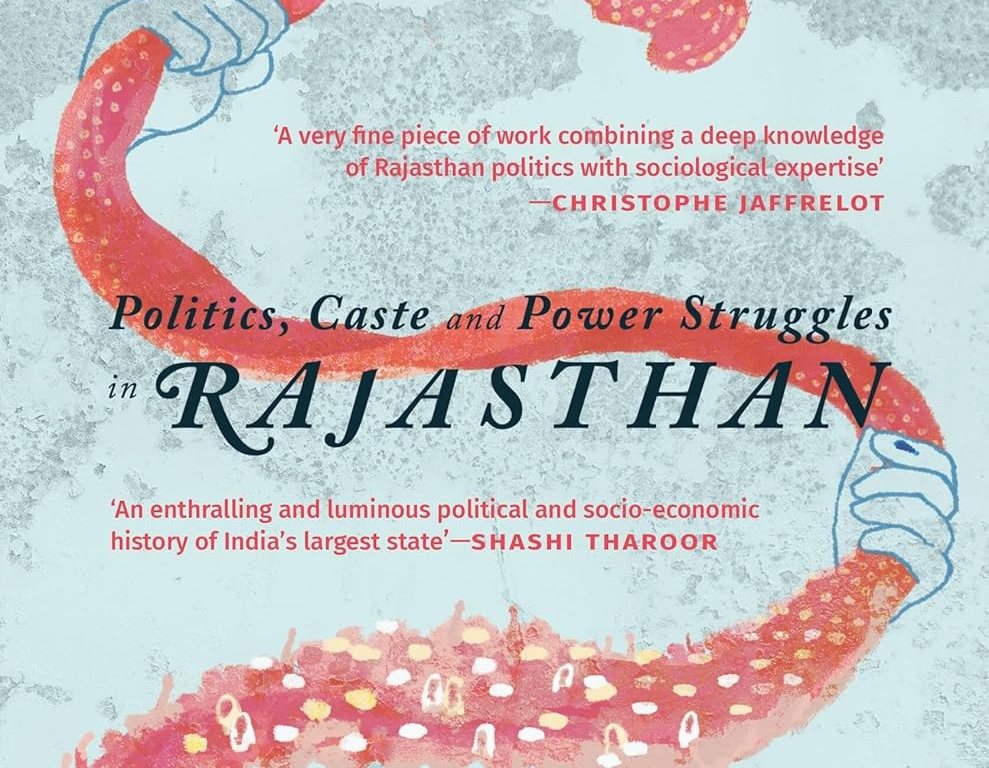
From the rise of the Kisan Sabhas to the internal rebellions of the modern day, this book is a lens to understanding not just Rajasthan, but the very core of Indian democracy.
- The Lingering Echoes of the Past
- Dynasties in Indian Politics: Royal Bloodlines and Electoral Power
- The Gritty Machinery of “Rajneeti”
- Faces of the Frontier: Shekhawat, Gehlot, Raje, and Pilot
- The 2025 Shift: New Challenges
- Why From Dynasties to Democracy Matters
- About the Authors
From grand palaces and stately forts to courtly manners and treasures untold, Rajasthan has worn the crown of royalty since centuries. But through the passage of time, thrones have given way to ballot boxes, durbar halls to legislative assemblies, and feudal jagirdari (land ownership) to constituencies where people clamour for civil liberties and dignity: good education, ample provisions for livelihood, and freedom to articulate cultural identities beyond caste, creed, or lineage. Above all, there is a burgeoning demand for the economic independence required to pursue modern dreams. From kisan sabhas to praja mandals, the fight for equality, justice, liberty has come a long way.
The Lingering Echoes of the Past
The transition from feudalism to the democratic principles of secularism, sovereignty compels the reader to ponder the on-ground reality:
- Has democracy really changed lives?
- Are dynasties passé?
- In nearly eight decades of independence, has the caste divide been buried?
And if so, why do reports of identity conflict, social exclusion, and human rights violations continue to surface? Take the case of Roop Kanwar, the 18-year-old who was burnt alive on her husband’s pyre, the last registered case of Sati in the country (1987). Or the gang rape of Bhanwari Devi (1992), a Dalit Saathin worker with the Department of Women and Child Development. Even, the lynching of Pehlu Khan, a Meo Muslim dairy farmer who purchased cow from a government-managed cattle market in Jaipur (April 2017). There are more such inequalities and brutalities cited in the book.
Given the complexity of India’s largest state (in geographical terms), there is perhaps no easy answer.
In From Dynasties to Democracy: Politics, Caste and Power Struggles in Rajasthan, journalists Deep Mukherjee and Tabeenah Anjum peel back the layers to highlight the adaptation and the uneasy coexistence of feudal legacies with democratic aspirations. While the former kingdoms merged into Independent India, it seems power simply changed costumes. “For Rajputs, the very thought of people with non-royal lineage and bureaucrats deciding their fate was revolting,” pen the authors (page 7).
Among the most formidable figures was Maharaja Hanwant Singh of Jodhpur, who resisted this shift fiercely, even holding discussions with Muhammad Ali Jinnah before eventually signing the Instrument of Accession. Ironically, his trajectory signalled to other royals that electoral politics could become the new route to influence.
Dynasties in Indian Politics: Royal Bloodlines and Electoral Power
The book revisits iconic figures such as Maharani Gayatri Devi of Jaipur, who chose the Swatantra Party over both the Congress and the BJP, advocating liberal governance. The party faded into political memory, but royal bloodlines did not exit public life.
Today, Diya Kumari, granddaughter of Man Singh II, the last Maharaja of Jaipur, is the Deputy Chief Minister under the BJP government. She was inducted into state politics by former Chief Minister Vasundhara Raje, herself descended from the Scindia royal family.
Royal lineage has not vanished. It recalibrated.
The Gritty Machinery of “Rajneeti”
This book is not a critique, but a narrative of the ground reality through personal reportage and research spanning decades. The authors bring forth the fact that the caste struggle is central to the criss-crossed power equation in the state; it is, quite literally, a political currency.
“The state’s vibrant political history, marked by dynasties, caste struggles and political rivalries, continues to be shaped not just by those who wield the scepter as part of party high command or as state-party officials, but by the aspirations of the millions of people who live in India’s largest state.” — Epilogue, page 238
The book unravels:
- The Caste Calculus: Deep dives into the Gurjar-Meena and Jat-Rajput rivalries.
- The Human Cost: Documenting incidents of hate crimes, cow lynching, mob violence, and the shifting perceptions regarding Adivasis and Dalits.
- The “Musical Chairs” of Power: The fierce rotation of power between the BJP and Congress.
Caste mobilisation has expanded participation. Yet it has also fragmented governance, sometimes reducing democracy to numbers rather than accountability. Representation has increased, but decision-making power remains tightly held. This duality is uncomfortable but necessary to confront.
Faces of the Frontier: Shekhawat, Gehlot, Raje, and Pilot
The authors have given insight into the regimes of prominent figures in Rajasthan’s power struggle: Bhairon Singh Shekhawat, Ashok Gehlot and Vasundhara Raje. The authors explore their unique equations as both rivals and impressive chief ministers.
Raje’s mass appeal lies in her ability to woo women and children, breaking through the patriarchal and caste divides. Though, both Raje and Shekhawat came from the Saffron fold, they “liked to function independently of the RSS on occasion – this at times resulted in some political decisions being contradictory to the policies of the BJP’s ideological parent”.
Gehlot’s appeal lies in his humility and no caste backing, as the Mali community, to which Gehlot belongs, is not singularly strong in the political arena.
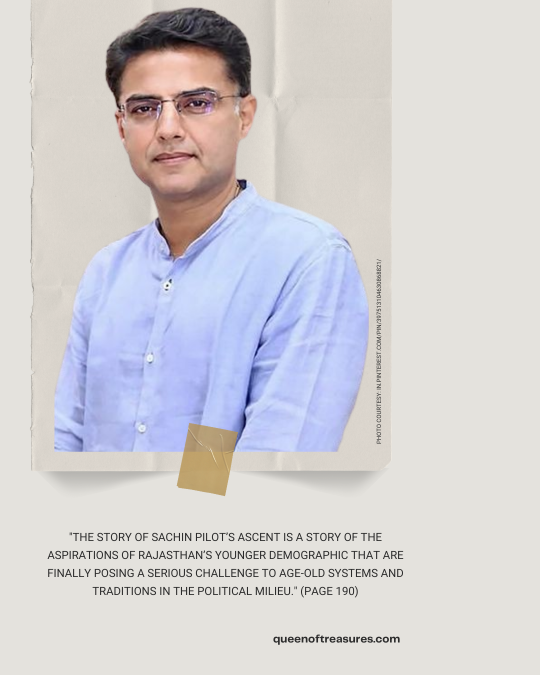

The narrative also shines a light on the rising star and rebel, Sachin Pilot—the politician who has won hearts on the ground, yet awaits his turn to take the throne of the Chief Minister. From in-party dynamics and ticket distribution to the full account of the Gehlot-Pilot rebellion saga, the book offers a “behind-the-curtain” look at political loyalty. “Throughout 2019 and 2020, Pilot criticized the government over atrocities against Dalits and its various policy decisions, repeatedly reminding them to make good on the promises made in the party’s election manifesto. With bad blood between the deputy chief minister and chief minister rising with each passing day, the hostilities were bound to come to a head,” say the authors (page 199).
The 2025 Shift: New Challenges
Coming to the current times, Mukherjee and Anjum take us through the BJP’s shift toward a “faceless” campaign focused on central leadership. Even as more third-front players emerge, the book notes a concerning increase in religious polarization as the leadership walks in the footsteps of parent RSS.
What does get dense though are the many names and people involved at various levels. While smaller parties haven’t succeeded in garnering the limelight, they play a significant role when it comes to electoral polls. Independent candidates hold sway over mindsets, as do caste leaders. Everybody matters in the shifting sands of democracy.
Why From Dynasties to Democracy Matters
For readers fatigued by headline-driven political commentary and loud TV anchors, this book lays out that democracy is a slow process, shaped by history.
The book’s USP lies in observation, clarity and context. For me, it was a gripping read as it positions the state as a lens through which Indian democracy itself can be understood. It takes the reader inside the complex matrix of social divide, even digital divide, to understand how democracy is enmeshed in a layered, traditional past, yet seeks a utopian present.
About the Authors
Assistant Editor with The Wire, Deep Mukherjee served as the Rajasthan correspondent for The Indian Express and has also worked with Hindustan Times and DNA. A UNICEF Development Journalism Fellowship awardee, Mukherjee has highlighted the plight of child labourers working in the lac bangle industry in Jaipur and stone quarries of Rajasthan. He covers issues pertaining to politics, human rights, gender, atrocities against marginalized communities, impact of government policies and schemes, labour and farmer suicides. He occasionally writes for literary journals and opinion pieces for news outlets and loves to travel.
Born and raised in Kashmir, Tabeenah Anjum is currently based in Rajasthan, where her journey in journalism began and inspired her non-fiction debut. With over 15 years of experience, she reports on politics, gender, human rights, migrant rights and issues impacting marginalized communities from Rajasthan and neighbouring states. Presently, she writes for Outlook magazine and contributes long-form reportage for The Quint, Article 14, Times of India Plus, The Gaon Connection, BBC, Countercurrents, Caravan and Telegraph. She was the bureau in-charge of Deccan Herald in Rajasthan until 2020 and continues to write opinion pieces for the newspaper.
A passionate photographer, she is the recipient of the National Award in Photography (2015) conferred by the Ministry of Information and Broadcasting, Government of India, and the Maharaja Sawai Ram Singh II Award (2017) for excellence in journalism and photography. Her photographs have been exhibited in India, Nepal and South Australia.
Book Details
Publisher: Pan Macmillan
Language: English
Pages: 278
Price: INR 599
You May Like to Read
We, The Citizens by Khyati Pathak, Anupam Manur, Pranay Kotasthane: A Review
A Long Season of Ashes by Siddhartha Gigoo: A Haunting Memoir
Nepal 2043 by Sujeev Shakya: A Futuristic Roadmap for Prosperity
The Company of Violent Men: A South Asian Journalist’s Memoir
Takeaways from Salima Hashmi’s Memoirs: A Reflective Review
The Foresighted Ambedkar by Anurag Bhaskar: A Must-Read
This post is part of the Bookish League blog hop hosted by Bohemian Bibliophile

 Queen of Treasures
Good one. Indeed change is happening across India.
LikeLiked by 1 person
I would love to read this book about Rajasthani royals and their accession. Politics and history has always interested me so this one looks like something that will shine a light on the dynasties of Rajasthan.Sachin Pilot is one politician with whom I had had high hopes being young and dynamic and also grounded but do not see him handling an important position.
LikeLiked by 1 person
I like sachin pilot as well. But they are keeping him on the backbench. Congress needs a total shift according to me.
LikeLike
Always a fan of your detailed and analytical book reviews. The way you write the book review with your critical analysis and depth, it shows how much effort you take to read and write the book’s feedback. Beautifully presented and thoroughly compiled. You are an inspiring figure for me, always. Take my love and gratitude, Ambica.
LikeLiked by 1 person
Thank you Swarnali. I feel the author’s world should be appreciated if the book is good.
LikeLiked by 1 person
Seems like an intense read, Ambica. Your detailed review (or should I say a fabulous analysis of the books) compels me to pick it up sooner than later. Undoubtedly into my TBR.
LikeLiked by 1 person
It is a deep read.
LikeLike
This was such a well-written, insightfully written review of a book that sounds quite an engrossing read. Having lived in rural Rajasthan, I know how backward it still is, despite the glamour and riches of the royals.
LikeLiked by 1 person
Most of India is in the same boat, the deeper you go, the more prominent the differences are.
LikeLike
This was an interesting review. With media being everywhere and the overdose of news, most of it unreliable, a book like this can help one understand the real politics of a state. There is too little reporting and too many opinions.
LikeLike
This book sounds like a fascinating look at how Rajasthan’s history and politics have shaped modern democracy. Although wary of this sub-genre I might just check out the title based on your review and the author’s background
LikeLike
Intriguing post. As someone who has been studying history and politics for more than a decade, I can say that change is definitely happening, albeit very slowly.
I should read more about the Rajputs now, after reading this article!
LikeLiked by 1 person
I found this review deeply engaging and thoughtfully layered. The way it traces Rajasthan’s political journey while questioning whether power truly changes hands made me pause and reflect. It feels less like a book about one state and more like a mirror held up to Indian democracy itself.
LikeLiked by 1 person
As always a fantastic review, Ambica. Always enjoy you in-depth analysis. The book seems a comprehensive one on Rajasthan. Always prefer a book written by journalists since they are more than opinions pieces. Already added the book to my TBR.
LikeLiked by 1 person
the complexity of current times, and the roots of old slavish societies, it’s all a knotted web and the book does manage to get there.
LikeLiked by 1 person