
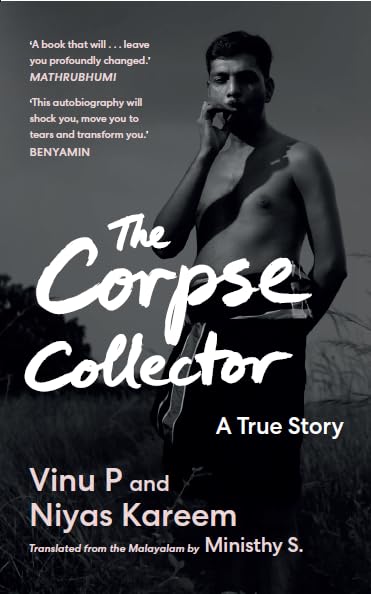
A man who touches what society refuses to. This True story forces us to ask where dignity ends and who carries it when institutions fall silent.
- Where Society Looks Away
- Born on the Margins
- A Profession Without Protection
- Learning the Language of Death
- Marriage, Loss, and Return
- What the Constitution Promised
“Someone who gathers corpses has no place here.”
“Even the relatives of those who died needed me only for collecting the corpses. I became a phariah after that. An abhorred man.”
“There goes the Shavamvari!”
Where Society Looks Away
Ostracised, humiliated Vinu P has been judged and sentenced for defying social norms. He collects what society abandons: bodies torn apart by trains; victims of suicide hanging in silence; lifeless forms pulled from rivers; road accident victims left unattended; murdered children; unclaimed dead whose names no one remembers.
Shunning the safer careers, Vinu P has chosen a profession most people refuse to acknowledge, let alone respect. Living with the label “corpse collector,” Vinu’s life has been chronicled in The Corpse Collector by journalist Niyas Kareem (translated from the Malayalam by Ministhy S.; Malayalam edition, Maranakkoottu: Oru Savamvariyude Athmakatha, was published in 2024). This moving true story revolves around life choices, isolation, and stubborn purpose. Vinu’s work sends out a message that the dead need the same compassion as the living.
Born on the Margins
Born in Kerala’s Aluva district, Vinu grew up on the margins. His parents were outcasts for marrying outside their castes. His father washed and ironed clothes; his mother sold fish. They sent him to school hoping education would offer escape.
It didn’t.
Vinu didn’t pass his tenth standard, but he passed a threshold far more difficult: the decision to give dignity to the unclaimed. He believed a body remains sacred, no matter its condition. But no one agreed with him. Villages shunned him. Tea shops turned him away. His father even bought him an auto-rickshaw repeatedly, hoping he would choose a “safer” life. But Vinu’s heart lay elsewhere. His journey began in heartbreak; the first body he ever collected was that of his childhood friend, Mithun.
A Profession Without Protection
He learned from men on society’s fringes—undertakers who drank and lived in the shadows. They knew a truth few accept: life is inseparable from death.
Acceptance came not from neighbours, but from the Kerala Police. They understood his importance, often paying him from their own pockets and protecting him from goons and many more perilous situations. Yet, the work remains a gauntlet of hazards, financial, biological and mental.
A corpse collector is exposed to tuberculosis, blood-borne pathogens, infections, toxic gases methane/hydrogen sulfide) in confined spaces. There are chances of physical injuries from bone fragments or dangerous terrains like cliffs.
Vinu has undergone mental trauma from handling victims of violence and social isolation, corroding his confidence, yet not diminishing his passion to serve the dead. He buried his youthful dreams all too soon and lives on the fringes of society.
Learning the Language of Death
Over time, Vinu developed an unsettling intimacy with mortality. While daylight burns his spirit, night brings him solace. He talks to the dead; the graveyard is his sanctuary.
He possesses a heightened sense of smell—he can tell how long a person has been dead, or if a body was dumped in water after death. He has crawled into gas pipelines and handled corpses riddled with maggots. For us, these are nightmares. For him, this is routine. He remains meticulous, helping with forensics and keeping records for every inquest.
This corpse collector has recovered over 3,000 bodies in his 25 years of work. He has personally buried about 2,500 people, mostly at his own expense, as relatives and known ones refused to claim the dead. He has seen their disgust, greed, ingratitude and emotional paucity.
Marriage, Loss, and Return
After the collapse of a first marriage built on lies, Vinu found Bincy, a nurse who understands the sanctity of the body. Together with their son, Varshit, and support from an elderly “Amma” in Canada, his life has softened.
His police friends continue to support him, rewarding him, appreciating him, and even helping with spreading the word through media about his deathly work.
His dream is now simple: a graveyard of his own, where the forgotten can rest in peace.
What the Constitution Promised
Vinu P’s work lays bare many contradictions that live in the heart of our society. In India, an unnatural death turns a body into a stigma. The book forces us to ask:
- If Article 21 guarantees the right to life with dignity, does that dignity not extend to death?
- If equality is promised, why is this labour rendered invisible?
- If untouchability is abolished, why does the corpse still carry its shadow?
Reading about Vinu’s life is like moving in a labyrinth. It raises more questions, yet leaves you in awe of the man who has chosen the forsaken path.
Book Details
Publisher: Juggernaut
Hardcover: 256 pages
Price: INR 699
- You may also like to read
- Book Review: Society Girl by Saba Imtiaz & Tooba Masood-Khan
- R.A.W. Hitman: The Real Story of Agent Lima by S. Hussain Zaidi
- Book Review: The Extraordinary Life of Rifleman Aurangzeb by Damini Punia
- World’s Most Famous Heists
- Healing Your Shadow: A Guide to Better Mental Health and Well-being
- COP30, Delhi-NCR Pollution, Aravallis, Article 21: India’s Fight for Green Life
This post is part of the Bookish League blog hop hosted by Bohemian Bibliophile.

 Queen of Treasures
Wow! This must be some ‘profession.’ Vinu has taken the path less travelled and hats off to him for the same.
It’s good that he enjoys support for his work. His profession is unholy, like that of the hangman in prison.
Your review is a pleasure to read.
LikeLiked by 1 person
The sad part is that the end is same for every living being, yet we choose to ignore those who do this work. They need more protection for health concerns, financial support and inclusion.
LikeLike
Uff.. this is such a morbid profession and yet it’s a task that’s necessary. Kudos to the author for picking Vinu’s life to write about.
LikeLiked by 1 person
To tell you the truth, I am wordless as to how do I express my views. I mean Vinu’s profession is necessary, and yet the emotional toll on him must be massive. Nor do I think the book would have been easy to write ( and for you to read).
The sad part of life is that one needs to see the good, bad and the ugly, for Vinu, I think it is the ugly part that dominates, for the simple reason that others do not respect it.
LikeLiked by 1 person
It’s a difficult read but its even more difficult to live this, yet find your purpose.
LikeLike
Vinu’s story shook me to the core. He has been doing a job that none would agree to, which only goes to show how we fail to accept death as a part of our life.
I am too stunned reading how his work has affected his health, and yet he continues doing it out of respect for the dead.
Thank you for writing about this book, Ambica. The story of Vinu needs to be shared with the world.
LikeLiked by 1 person
So true. We never see the face or the feelings behind this task, only the surface which alone is horrifying.
LikeLiked by 1 person
Unsettling is definitely the word for this, Ambica. Its amazing how callous we have become, unwittingly or otherwise. Books like this, and your equally unsettling but impactful review too, act as a much-needed mirror that should ideally compel us to return to dignity instead of lying in ignorance.
Will definitely check out this book, even if I know I’m going to be unsettled.
LikeLiked by 1 person
It’s quite pacy, even though it is unsettling. It leaves you with a weird feeling.
LikeLike
That’s a tough job. Writing about that would be tougher. I’m not sure, however, I’d like to read the book.
LikeLiked by 1 person
It’s a jolting book. But it’s well written and am sure a lot has been trimmed.
LikeLike