
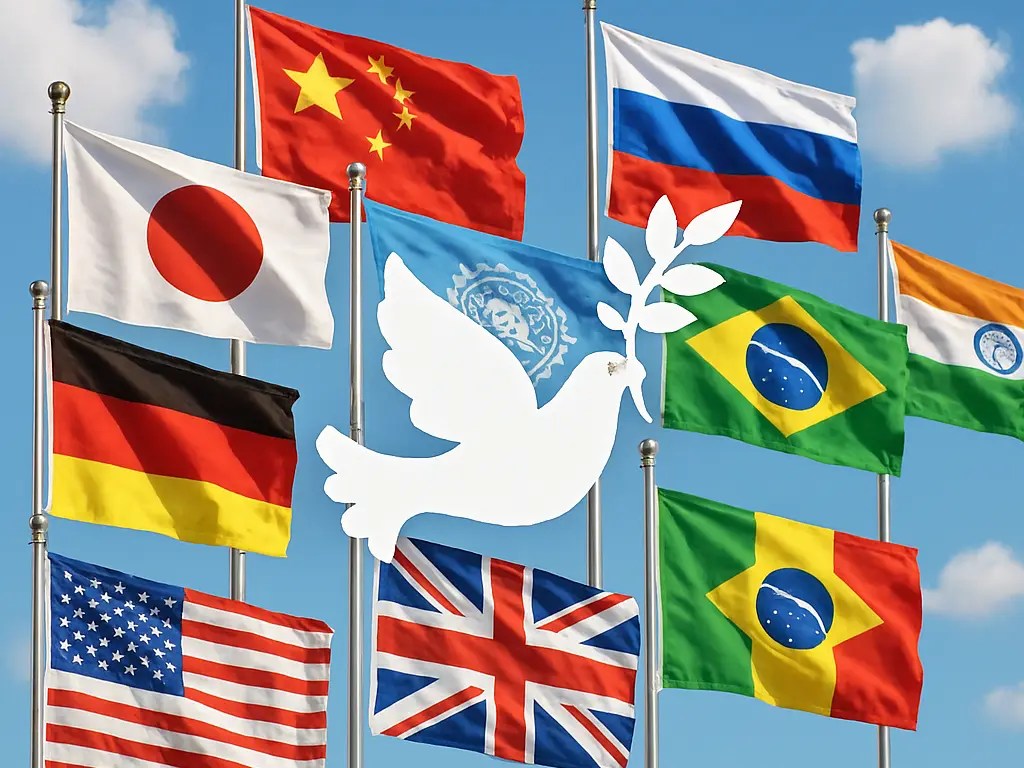
A personal essay on power, peace, and the performance of global order. A board, a charter, and a price tag form an uneasy echo through today’s geopolitics. Is peace still a shared principle, or has it become a carefully managed spectacle?
“A Piece of Peace.”
That was the headline I once gave an article on a resort I had covered for Discover India, sometime in another lifetime. Both the resort and the magazine have since slipped into oblivion. Change, after all, is the only constant on Earth’s timeline.
So when the phrase resurfaced at the World Economic Forum in Davos, Switzerland, it caught my attention. A viral clip of Elon Musk mocking US President Donald Trump’s proposed Board of Peace made me pause. Musk joked about whether it meant peace or piece, as in a slice of Greenland here, a bit of Venezuela there.
The joke was greeted with chuckles, largely because Trump is not the most popular president in the world at present. His foreign policy has ruffled allies and adversaries alike. He began 2026 with provocative threats, from talk of taking over Greenland to the reported capture of Venezuela’s President Nicolás Maduro Moros and his wife in the middle of the night. The international community described this as a violation of international law, challenging the sovereignty of a state.
Musk, like most people, does not know my old headline. But for me, it triggered something larger. It took me back to another symbolic place: Panchshila Park in Delhi, where I spent 11 years of an innocent childhood.
In India, peace has long been articulated through Panchsheel. The Five Principles of Peaceful Coexistence, defined in the 1954 Sino-Indian Agreement, align closely with international law:
- Mutual respect for each other’s territorial integrity and sovereignty
- Mutual non-aggression
- Mutual non-interference in internal affairs
- Equality and cooperation for mutual benefit
- Peaceful coexistence
Seen against this backdrop, I began to wonder: is the Board of Peace merely a piece of power dressed up as principle, or a genuine offering to a world that seems permanently on the brink?
When the World Chose Peace
It was the devastation of the Second World War that gave birth to an institution meant to symbolise safety, security, and justice for the globe. The United Nations was born in 1945, shepherded by then US President Franklin D. Roosevelt, to replace the ineffective League of Nations. Power, however, rested with the “Big Four”: the United States, the Soviet Union, the United Kingdom, and China. Roosevelt believed these superpowers would arbitrate global conflict through the Security Council. Peace, at last, had gatekeepers.
For nearly 80 years, the world invested in this global peace architecture. Economic growth, humanitarian interventions, cultural diplomacy, peacekeeping missions. Yet violence persisted. Skirmishes erupted, governments fell, ideologies shifted, alliances fractured, and nuclear weapons loomed large.
Perhaps the last moment of genuine global cooperation was during the COVID-19 pandemic, when vaccines crossed borders with relative ease. Since then, the world has splintered again.
Russia’s invasion of Ukraine in February 2022 shattered the illusion of post-war Europe. The Hamas attack on Israel on 7 October 2023, followed by Gaza’s devastation in Israel’s response, produced images that were unbearable and inescapable.
Once again, the United States stepped in, both as broker and as architect of something new.
Enter the Board of Peace
The Board of Peace, announced under United Nations Security Council Resolution 2803, is US President Donald Trump’s response to the Gaza crisis. Proposed in late 2025 and formally unveiled on the sidelines of the World Economic Forum in January 2026, it presents itself as an international governance body that will oversee demilitarisation, governance reform, and large-scale reconstruction in Gaza.
On paper, the language is noble: accountability, reconstruction, stability.
In structure, it is more troubling.
Trump is designated chairman for life. All decision-making powers rest with him. He alone can invite countries, nominate successors, amend the charter, or dissolve the board itself. His chairmanship, the charter clarifies, is independent of his presidency.
Permanent membership reportedly comes with a price tag of one billion US dollars. Sub-Saharan Africa, notably, was not invited.
The board includes heads of state, former prime ministers, billionaires, diplomats, and business leaders. Gaza, meanwhile, is administered through an executive structure led by a High Representative appointed by the United States.
Peace, in this formulation, is not bound by elections.
The World Reacts, Uneasily
The response has been anything but unanimous.
Some countries joined. Others declined. Many are still weighing their options. India, notably, did not attend the signing ceremony in Davos, choosing caution over spectacle.
Western allies expressed discomfort, not only with the board’s structure but also with its symbolism. Critics described it as a vanity project, a pay-to-play club, a Mar-a-Lago version of global governance. The logo itself was mocked as a derivative of the UN emblem, gilded in Trumpian gold.
More troubling was the fear that the Board of Peace seeks to bypass, or even supplant, the United Nations, a multilateral institution. Peacekeeping, traditionally multilateral and imperfectly democratic, now appeared personalised and centralised.
Trump’s recent geopolitical posturing, from Greenland to confrontations with world leaders, did little to reassure sceptics.
Peace, Reimagined or Repackaged?
For all its failures and lacunae, the United Nations is anchored in shared principles. Sustainable Development Goal 16 speaks of justice, inclusivity, accountability, and institutions that protect people from fear.
The Vision of Humanity outlines eight pillars of peace:
- Low levels of corruption
- Well-functioning government
- A sound business environment
- Equitable distribution of resources
- Acceptance of the rights of others
- Good relations with neighbours
- Free flow of information
- High levels of human capital
Measured against these ideals, the Board of Peace raises uncomfortable questions.
- Can peace be enforced top-down?
- Can it be monetised?
- Can it survive when accountability flows in only one direction?
Or are we witnessing a shift in the very idea of global order, where multilateralism gives way to managed consensus, and peace becomes a project rather than a process?
A Piece, After All
I return to that old headline: A Piece of Peace.
Back then, it described a quiet place, a retreat from noise. In today’s geopolitical arena, peace appears fragmented, sliced into negotiations, boards, charters, and executive committees. Everyone wants a piece. Few seem willing to hold the whole.
The UN’s Sustainable Development Goal 16 and the Vision of Humanity remind us that lasting peace demands more than a billion-dollar entry fee.
The Board of Peace may yet evolve into something meaningful. Or it may fade, like an old magazine, into footnotes and archives.
But the question it forces us to confront remains urgent.
Is peace still a universal principle, or has it become just another asset class in a fractured world?
Ambica Gulati wears many hats: independent journalist, editor, multimedia storyteller, and author. Her work explores global affairs, conscious travel, the environment, culture, and the intuitive arts. Beyond the laptop, she nourishes her creative practice through meditation, birding, reading, journaling, oracle cards, and yoga.
Continue this journey
If this essay sparked a reflection on order and peace, you may enjoy these archives:


Interesting viewpoint. I think its money and hunger for power and fame rules the world. Written rules are broken for these.
LikeLiked by 1 person
The world has gone crazy! I think they don’t have an inkling of where they are and why the best points of the old-world order need to be kept intact.
LikeLiked by 1 person
True
LikeLiked by 1 person
Interesting view point.
LikeLiked by 1 person
Trump championing for peace -but a price and putting his megalomaniac self at a place of permanent power just goes on to show this is meaningless manoeuvre and the world is right to react uneasily.
LikeLiked by 1 person
so much of all this currently prevailing across the world!
LikeLike
Yesterday a man in a vegetable shop intentionally pushed me and said sorry. Peace has actually become like this.
LikeLiked by 1 person
My first instinct on reading this was: push him back. But my more sensible reaction, stay back, no point of wasting energy, though in foreign affairs, this step back has to be calculated as well.
LikeLike
Power corrupts man; absolute power corrupts man absolutely. That’s the only line that comes to my mind.
LikeLiked by 1 person
As we see in the world around us now.
LikeLike
Ambica, such a well-thought out piece ( forgive my pun). I loved the way you laid out the past, the present and the worries about what the whole board of peace entails.
LikeLiked by 1 person
Glad it made sense.
LikeLike
Great piece (hopefully, some peace will come in the world, after all hope is still powerful), Ambica. One thing I’ve realised after reading a bit of history. Anything that is institutionalized, no matter how noble the beginnings, end up getting rotten, a few really good ones in the long run, and most quite early on.
Yet, humans cannot do without institutions. They “guide” the lesser mortals (read the common man on the street) to “better things”. Without them, we are like sheep without a shepherd, right? As long as the common man on the street looks up at these institutions, they will keep coming. Hopefully (there, hope comes again), some of the good ones will sustain for the good of humanity.
And one day, some day, the common man will become so intelligent, he/she/they will find their own guiding light.
LikeLiked by 1 person
Institutions made with honor do tend to honor at least some parts of it. Unscrupulous leaders will lead to more disasters, though time does test everything.
LikeLike
I found this post interesting and informative. It showcases a variety of linked content from different blogs, which makes it a fun way to explore other voices and ideas. It felt like browsing a thoughtful collection of topics rather than a single story, and I appreciated the mix of perspectives.
LikeLike
What a thought-provoking read this was, Ambica. You’ve spoken for a lot of us who are confused as to who and what is right. World peace has become a fancy thing to garner points at beauty pageants while in reality hardly anyone is taking concrete steps towards it. Power has the capacity to corrupt and when resting with one person, not gentle or understanding in this case, can make one commit grave mistakes. We’ll have to wait and watch what happens!
LikeLiked by 1 person
The world has become greedy, now leaders want more than approval–they want natural resources and close down borders, use talent and skills for personal gains, 80 years of joy has turned them complacent. If you don’t learn from history, you are bound to repeat it. Sad truths!
LikeLike
Trump and Peace are words that don’t compliment each other. I like the views you have put across so simply and clearly, Ambica. Interesting read.
LikeLiked by 1 person
With leaders as we have in countries like America and India peace is not an easy pick for sure.
LikeLiked by 1 person
Most of the world is skewed in current times. They don’t value the sacrifices of yesteryears.
LikeLike
Ambica, this is so clear and sharp post. Indeed these days peace is being sold like a produc. Loved how you made us question what real peace even means.
LikeLiked by 1 person
United Nations is walking on the path which was led by League of Nations, This Board of Peace will take similar course I suppose, maybe after another 4-5 dacades…. Meanwhile, some other geopilitical groupings would emerge. i just hope it doesn’t lead towards the next great war.
LikeLiked by 1 person
Well, since most countries don’t want in at the moment, I feel it could lead to war and now the weapons are deadly.
LikeLiked by 1 person
The way you braided memory, history, and present-day unease felt deeply thoughtful. You didn’t preach; you invited reflection. It left me unsettled in the best way, asking questions that linger long after the last line.
LikeLiked by 1 person
Very thought-provoking! You’ve unpacked the complexities around Trump and the concept of peace with clarity and nuance. This kind of balanced analysis helps readers go beyond headlines and really think about what ‘peace’ means in today’s world.
LikeLike
this is the sad state of reallity we live in. But this should really ring a bell to many
LikeLiked by 1 person
I understand money, I understand power but I dont understand politics which I have always seen misusing the power of money and power so badly. I literally hate politics. I am least bothered which party is coming to power or which one is going as I know end of the day all the same and equally corrupted. Politics is a subject which i never like and discuss about.
LikeLiked by 1 person
Really thought-provoking read on the complexities of peace power and principle in today’s world. Your reflection on the Board of Peace and the meaning of genuine cooperation made me pause and think deeply about what peace truly demands from nations and people.
LikeLiked by 1 person
Interesting essay. You are right to bring up whether the word ‘peace’ even holds any validity today, i feel it has become another jargon to be used in speeches and statements without holding its spirit.
LikeLiked by 1 person
“Peace is not bound by elections.” That line hit hard. It captures so much of today’s global discomfort.
LikeLiked by 1 person
This came to me as well researched article that has enlightened me about something I was naive about. It’s crazy. But it is happening and we should be aware of it. Thank you 😊
LikeLiked by 1 person
Imagine Trump clamouring for the Nobel Peace Prize. It’s like Putin or Xi Jinping demanding that prize. Like our very own Modi claiming to be Viswaguru. Like Netanyahu inviting Muslims for a peace summit. Or vice-versa.
What has happened to our world? What sins did we commit to get such leaders?
Fragmented world! you’re right, that’s what we have created.
LikeLiked by 1 person
a difficult world! Yet, we go through our daily motions. We are getting used to complacency.
LikeLike
A sharp and reflective piece that questions whether modern peace is a shared human ideal or a carefully packaged instrument of power!
LikeLiked by 1 person
That was quite informative. Board of Peace sounds ridiculous among many other decisions of Trump. The geopolitics is shifting alarmingly fast yet it becomes newsworthy for a few days and then we collectively move on. We seem to be living on a fragile edge between peace and war. Despite institutions like the UN and various peace keeping forces, nothing truly feels secure when the power is concentrated in the hands of a few and now greed has taken over that’s driving global decisions.
LikeLiked by 1 person
Power and money have become more important than peace in the modern time. Mistakes of the past are being repeated at a grander level by those who are craving more power.
LikeLiked by 1 person
I’m rereading this post and it’s wonderful that I again found it enlightening in many ways. In a perfect world Panchsheel would be practiced and there would be no wars. Alas, reality is different and world leaders find new ways to dominate. Will this ever stop?
LikeLiked by 1 person
I doubt! We have totally heartless people running the world because they weren’t a witness to the wars. Let’s hope for the best.
LikeLiked by 1 person
At a time like this your piece forces us to ponder. Yet, I recently read that cosmonauts in outer space realise how fragile ‘Earth’ is and its existence, sustenance is far more important than political boundaries or economics. So, high time peace descended in all corners.
LikeLiked by 1 person
I really wish peace in every part of the world. That is the only piece of comfort for all the living beings who share the planet with us.
LikeLiked by 1 person
Well-written, Ambica. In light of the ongoing war, the board of peace is a mockery. Peace doesn’t come from guns and tanks. It’s just ego, money, and power at play. Praying and hoping that someday, good sense will prevail, and no more wars will be fought, and the needless loss of innocent life will cease.
LikeLiked by 1 person
I really worry for the state of the world. You really nailed it.
LikeLiked by 1 person
I also worry about the kind of world we have created. Too much innovation is also harmful.
LikeLiked by 1 person