
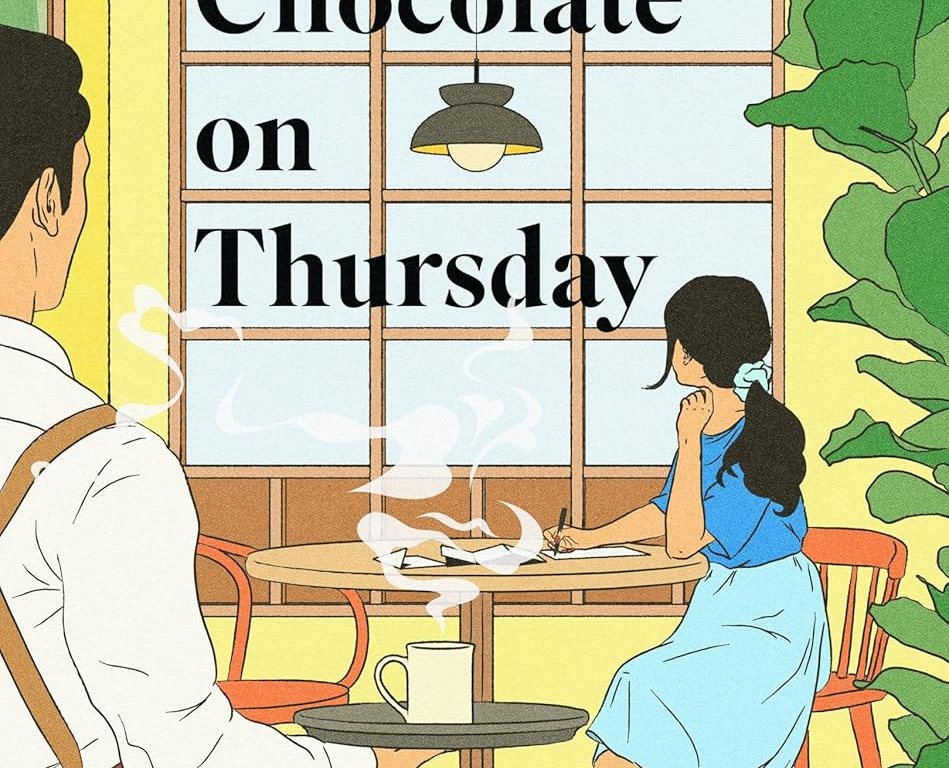
A circular train of interconnected vignettes—moving from Tokyo to Sydney and back—where identity matters less than atmosphere.
I like chocolate—a warm cup that settles the nerves, invites sweet dreams, and, as they say, leads to good skin. Perhaps it was the chocolate that first attracted me to this book. Or maybe it was the quiet buzz surrounding Japanese “healing fiction” and the fame Michiko Aoyama earned with What You Are Looking For Is In The Library.
Or, quite simply, maybe I was just tired of the weight of loaded crime stories.
Hot Chocolate on Thursday carried a promise: a stillness that seeps in slowly, filling the body with an etheric peace. It lived up to that promise of a “comfort read,” but it went further. It became a restorative process.
The book was originally published in Japanese in 2017. This 2026 edition, titled Hot Chocolate on Thursday, has been translated by E. Madison Shimoda.
What the Story Is About (No Spoilers)
The novel opens in a quiet corner of the Marble Café in Tokyo, where a server watches the world through the steam rising from porcelain cups. From this unassuming threshold, Aoyama introduces a series of interconnected lives. We move gently from Tokyo’s streets to a zoo in Sydney and back again, following people who appear ordinary, almost anonymous.
There is no single protagonist. Instead, the book unfolds through linked vignettes, each story brushing lightly against the next. A small action, a forgotten object, a brief encounter—these moments ripple outward, subtly altering lives that may never consciously meet.
Overseeing this quiet choreography is a presence referred to as “The Master.” He is not a controller, but a giver of space. Space for art. Space for ideas. Space for growth.
The Architecture of Healing
Aoyama’s prose moves like a train where passengers get on and off, interlinked through their passage yet divergent in their unique situations. What makes this “healing” is not a process, but a series of realizations:
- Ordinary Magic: Nothing supernatural happens, yet everything feels faintly enchanted. Aoyama shows how everyday gestures carry weight—leaving behind a bottle of nail polish or cooking an omelette “just right.” These are not mere symbols; they are life itself, doing its quiet work.
- Interconnectedness: Lives intersect without announcement. A choice made without thought finds its way into another person’s day. It suggests that nothing is ever entirely isolated, even when it feels that way.
- Healing Without Preaching: This is not a book about “fixing” oneself. There is no urgency to change. Healing happens as a form of noticing—as presence, as allowing.
A World of Softness and Alignment
The characters span generations, from kindergarten teachers to a couple celebrating their 50th wedding anniversary. In a world that values monopolies and profit, the Marble Café becomes a sanctuary where everything is allowed to be nurtured.
I found myself deeply moved by the cultural anchors Aoyama uses: the tea ceremonies, the cherry blossoms, and the tactile grace of old-world letter writing with a fountain pen. At times, I found myself momentarily losing track of names, but identity here is less important than atmosphere. The characters arrive as moods, colours, and fragments. They stay just long enough to leave an impression.
Aoyama celebrates the soft professions: the server, the literary translator, the artist, the gentle teacher, the happy-to-manage home husband, the career woman who strives to cook the perfect omelette for her son, the entrepreneur who values tea ceremonies. She inculcates a complete zen experience, turning the ordinary into extraordinary.
The kanji letters, the illustration of the pot and cup in the top right corner and the hot chocolate cup as strategic breaks, a touch of art and words, lend the stories a beautiful touch of reality. Coupled with the pick-me-up cover design by Yannick Scott, this book fills the heart with joy.
The Personal Resonance: From Sydney to Mumbai
With this book, I saw the jacarandas in Sydney and felt an immediate affinity with the Royal Botanic Garden there. It reminded me of my own walks in Horniman Circle in Mumbai, with its ancient trees and green grass.
The flowery trees in the book made me head out to enjoy the orange and red splashes of palash and semal near my home. I ended up driving past bougainvilleas in red, pink, and white, suddenly more attentive to the “inner weather” of my surroundings.
Aoyama’s art of weaving culture, nature, and life into a soft, cushiony narrative is admirable. She cherishes the old, accepts the new, and creates a delicate balance. There are no cliffhangers or adrenaline chasers here—just oxytocin, a quiet reassurance that we are part of a Master’s gentle fold.
My Takeaway
Hot Chocolate on Thursday works slowly, almost invisibly, reminding us that every small thing matters. It honors emotional maturity and understands that peace is not found by adding more, but by noticing what is already present.
If you are no longer chasing noise, if you understand that meaning often arrives sideways, then this is the book for you.
About Michiko Aoyama
Michiko Aoyama was born in 1970 in Aichi Prefecture, Honshu, Japan. After university, she became a reporter for a Japanese newspaper based in Sydney before moving back to Tokyo to work as a magazine editor. What You Are Looking For Is in the Library was short-listed for the Japan Booksellers’ Award and became a Japanese bestseller. It is being translated into more than fifteen languages. Michiko Aoyama lives in Yokohama, Japan.
Book Details
- Publisher: Doubleday (Penguin Random House India)
- Language: English
- Hardcover: 208 pages
- Price: INR 799
—Ambica Gulati is a journalist and editor writing on travel, culture, world affairs and the unseen.
From the Archives
If you enjoyed reading this, you may like to continue the journey:
- Noida Biodiversity: A Nature Lover’s Observations
- Meeting Prakriti: Nature’s Muse or Mysterious Enigma?
- Beyond Cocoa: Unveiling Nature’s Palette of Chocolate Colours
This blog post is part of ‘Blogaberry Dazzle’ hosted by Cindy D’Silva and Noor Anand Chawla.

 Queen of Treasures
Goes straight into my TBR. While I still love my crime, thriller stories, I also enjoy these slow-paced tales meandering through the ordinariness of life while exposing the hidden extraordinariness.
This book somehow gives me the vibe of “The Easy Life in Kamusari” which I thoroughly enjoyed. Great review, as comfortingly meandering as the book!
LikeLike
Your reply has given me a new TBR :P I am going to read The Easy Life in Kamusari.
LikeLike
I loved how you’ve reviewed the book and added how it personally impacted you. I’m sure it must be read. I somehow like Japanese stories, calm and comforting. Thanks for the review.
LikeLiked by 1 person
It’s such a comforting read and brilliantly mapped.
LikeLike
Sounds like Hot Chocolate on Thursday by Michiko Aoyamay is like a comfort read.I like to read books that are not sad or even thrillers.Your review has evoked my curiosity and I wish to learn more.
LikeLiked by 1 person
It’s a very happy book and called healing fiction.
LikeLike
After reading too many crime thrillers this book seems like the perfect way to go slow and enjoy reading that heals. Loved your review. Whatever Japanese fiction I’ve read till now has been amazing, deep and rooted in their culture. Will check this one out.
LikeLiked by 1 person
This was my first Japanese fiction. I thoroughly enjoyed it. It’s called healing fiction for the right reasons.
LikeLike
I loved this! Michiko Aoyama’s hot chocolate as comfort and ritual resonated with me! I crave those simple, cozy pauses in my busy days.
LikeLike
Beautifully written review – a compelling read. Liked how you wrote about how the book resonated with you personally.
LikeLiked by 1 person
Your description of the jacarandas in the Royal Botanical garden just took me back to Sydney. Oh the vibrant purple colour, it’s unforgettable!
This book sounds interesting indeed. Would love to pick it up.
LikeLiked by 1 person
You’ve been to Sydney..👍
LikeLike
Hot Chocolate is something attracts me a lot and having these words on the title is making it more tempting for me. The review also gave me reasons why I should read this book and so thank you for the recommendation.
LikeLiked by 1 person
Sounds interesting though I am going to keep this away from my present TBR. Not because your review failed to intrigue me but I am trying to be stronger!
LikeLiked by 1 person
Ha ha.. it’s a pacy read and engrossing. You might find it actually pushing you to read the long TBR list faster.
LikeLike
The title would have caught my eye right away. Your review has maanged to convey that I should pick this book and read it soon.
LikeLiked by 1 person
A lot of Japanese books have this slow buildup and old-world narrative charm about them.
LikeLiked by 1 person
This was one a delight to read and really cost.
LikeLiked by 1 person