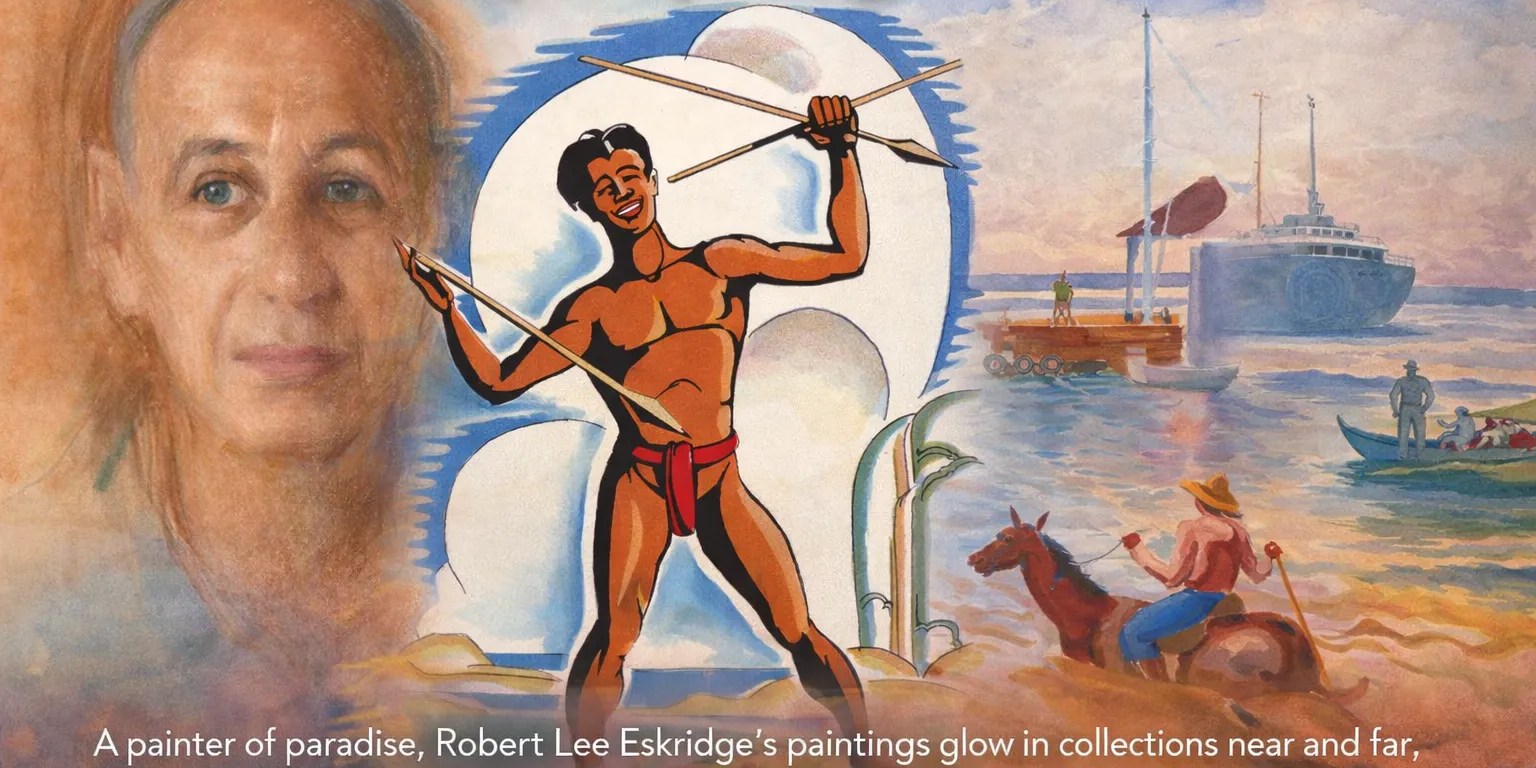
A reflective journey into the life of Robert Lee Eskridge: Affable Artist, Author, and Adventurer in Tahiti, Hawaii, Brazil, and Beyond, featuring insights from author C. J. Cook on art, travel, and vanishing worlds.
Do you remember your first drawing class, when pencils transformed simple fruits and vegetables into masterpieces on paper? Like many of us, my canvas usually featured a little hut by a river, trees shielding it from the afternoon sun, and clouds drifting above a landscape untouched by urgency.
Perhaps something in those early brushes and canvas never really ended; that longing to paint lingered through my 20s. In 2005, I enrolled in a children’s book illustration course at Shankar’s Academy of Art and Book Publishing in Delhi. It introduced me to outdoor painting, sketching from life, and the variation of different mediums. While I lacked the artist’s free-flowing strokes, I fell deeply in love with watercolours and nature. This is precisely why the work of Robert Lee Eskridge (1891-1975) tugged at my heart.
Worldview and Slow Travel
Eskridge loved travel, like me. Slight in build, formidable in resolve, he travelled to understand people and places. Long before commercial air travel compressed the world into pacy itineraries, he crossed the United States by rail, studied in France, and journeyed through the Mediterranean landscapes of northern Africa and Europe. Eventually, he found his artistic centre in the South Pacific aboard slow-moving steamships, with Tahiti and Hawai‘i profoundly shaping both his art and worldview. Later came Brazil and Portugal, further widening his visual and cultural vocabulary.
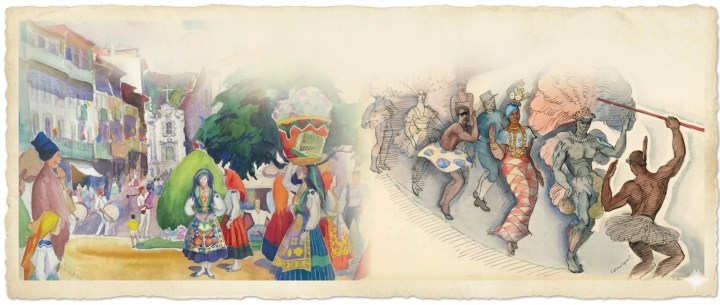
His work evolved alongside these journeys: from engravings and sketches to drawings, then luminous watercolours and oils. The watercolours, especially, carry movement and immediacy. Again and again, he returned to island life—fishing communities, labour, rituals, ceremonies, and families—observed not with exotic fascination, but with attentiveness and respect. Companionship mattered deeply to him, and camaraderie often framed both his travels and the people who appeared on his canvases.
His range was expansive. He crafted public arts, murals, advertisements, cartoons, books, was an academician, took on private commissions, and just about everything art.
Art Inspired by a Life Lived Deeply
Unlike canvases shaped purely by imagination, Eskridge’s works emerged from lived experience. The American artist drew inspiration from the lives of native islanders in Hawai‘i and Tahiti, as well as the Latin cultures of Brazil and Portugal. He travelled slowly, observed closely, and immersed himself in worlds that were untouched by mass tourism and digital overexposure.
Eskridge lived on his own terms, blending art with storytelling while documenting folklore, rituals, labour, landscapes, and island life now increasingly vulnerable to climate change and the algorithm of “tech noise.” In many ways, he belonged to the generation of artists who encountered remote cultures before globalisation flattened nuance into familiarity.
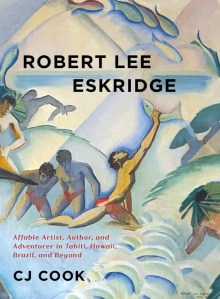
In Robert Lee Eskridge: Affable Artist, Author, and Adventurer in Tahiti, Hawaii, Brazil, and Beyond, author, historian, and manuscript collector C. J. Cook brings this remarkable life vividly alive through a richly illustrated 344-page volume containing over 509 images, including more than 200 works by Eskridge himself. The result is a comprehensive account of an artist who chased colours rather than currency.
Cook’ s extensive research and vivid descriptions give a heavenly life to the panoramas of Hawaii and Tahiti. It’s almost like entering a portal to paradisiacal worlds where Nature is gentle and the sun more friendly.
Cook’s writing traverses Eskridge’s extraordinary journey, from unexplored islands to the front lines of World War II, through friendships in influential circles, island communities, artistic discovery, and recurring financial turmoil. It captures the entirety of a man whose life often seemed guided by instinct, serendipity, and an insatiable curiosity about the world.
The Wanderer’s Spirit
Eskridge remains something of an enigma for the 21st century generation, yet his wanderer spirit deserves admiration. His paintings carry rhythm, observation, and emotional texture. There is a deep attentiveness to ordinary life within them: fishermen at work, ceremonial gatherings, changing skies, villages breathing quietly beside the sea.
One fascinating episode from his life involves his search for the grave of a cannibal king, a journey that eventually led him to donate rare relics to a museum. Whether through chance or destiny, Eskridge always seemed to encounter the right people at the right moment.
Far from being consumed by the glamour of his elite patrons, he carried himself with a grace and ease that makes today’s influencer culture feel strangely hollow. His travels were not about “content” or “reels”; they were about finding the heartbeat of a destination.
Manga Reva and the Art of Slow Observation
What makes Eskridge especially fascinating is that he was not merely painting islands; he was archiving vanishing worlds. His art blended with writing enhanced the legacy of chronicling cultures and geographies.
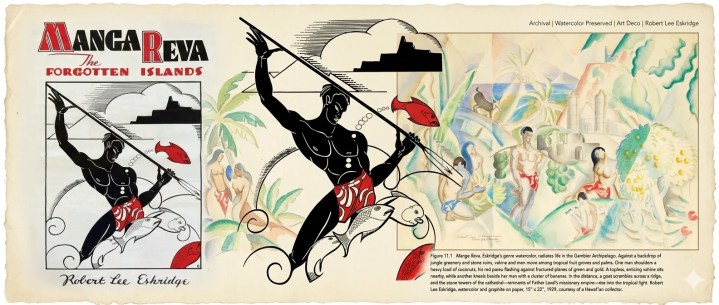
His rare illustrated travel memoir, Manga Reva, now almost impossible to find except at staggering collector prices, captures this spirit vividly.
Part travelogue, part ethnographic observation, part artistic meditation, the book chronicles Eskridge’s encounters across the South Pacific with remarkable sensitivity. There are descriptions of island rituals, folklore, tattooing traditions, village life, ceremonial practices, and landscapes rendered through the eyes of someone who genuinely lived among the communities he painted.
Unlike contemporary travel media engineered for scrolling and algorithmic consumption, Manga Reva moves slowly. It notices textures: the rhythm of fishing villages, the geometry of canoes, the emotional climate of islands standing quietly at the edge of modernity. Its pages feel less like tourism and more like a painter carrying a journal through disappearing worlds.
Perhaps that is why second-hand editions now command astonishing prices online—INR 40,000+ on Amazon! This kind of travel writing and artistic witnessing is endangered.
In Conversation with C. J. Cook
What do you personally feel about Robert Lee Eskridge’s approach to the Pacific?
Eskridge did not portray the Pacific as an exotic stage set. Instead, he observed the region closely, lived among its people, and documented their work, beliefs, and customs with respect.
Through these efforts, he participated in a wider artistic discourse concerning place, identity, and transformation. In his work, the Pacific is not merely a backdrop but a dynamic world shaped by labor, faith, endurance, and imagination.
How would you classify him among his contemporary watercolour artists?
He was one of the best watercolourists of his time. My favourite painting is Stone Fishing, which appears on the cover of the book. I have explained this in detail in Chapter 8.
One of Eskridge’s most memorable paintings from his time in Bora Bora was Stone Fishing—a water color that captured a rare and dramatic communal ritual…Eskridge described the event in vivid detail in Manga Reva. Stone fishing was no everyday practice. It was a ceremonial act steeped in ancestral memory. The ritual echoed commands once given by Polynesian kings. A respected elder would issue the call, and the islanders responded with practiced urgency. For three days, men and women worked together…
How is his work viewed today?
Sadly, his work remains underappreciated. I hope this biography encourages people to reassess his work. His watercolours are typically valued around $1,000–2,500, while large oil paintings can range from $50,000 to $150,000.
I noticed that Manga Reva (second-hand) is priced at over INR 40,000. What was your experience reading it?
I have read all his books, which is why the biography contains so much detail. Chapters 9 to 11 especially draw from Manga Reva.
What from his life stayed with you most?
I love exploring the cultures and islands of the South Pacific. We are kindred spirits in that regard. We both love Hawai‘i and Tahiti.
About C. J. Cook

C. J. Cook is an award-winning author and historian whose work focuses on the art, artists, and cultural history of the South Pacific. His first book, Tyree: Artist of the South Pacific, received two Gold Awards from the Independent Book Publishers Association in 2018 for Best Cover and Best Biography.
His second biography, Leeteg: Babes, Bars, Beaches, and Black Velvet Art, earned the IBPA Gold Medal for Best Biography in 2022.
In 2023, Cook published Beauty in the Beast: The Flora, Fauna, and Endangered Species of Artist Ralph Burke Tyree, followed by Edithe Beutler: Beautifying Hawaii with Color, the first full biography of the pioneering colourist and entrepreneur whose hand-painted photographs helped shape Hawai‘i’s early visual identity.
My Recommendation
More than an artist biography, Cook’s account of Eskridge is an extraordinary meditation on travel itself: on what it means to truly observe a place before photographing, packaging, and consuming it.
Almost a 100 years have passed since he painted life on the islands, so much has been lost, yet so much remains. Reading about Eskridge inspired me to revisit my own journeys with greater patience. In a world run on cold, monotonous listicles, snappy filters and staged travel clips, this book is best experienced as an old-world hardbound edition, cherished and observed carefully.
It is a reminder that somewhere between the watercolours, the islands, and the fading steamship routes, the world needs slower eyes and deep hearts honouring Nature’s rhythms.
Book Details
Publisher: South Pacific Dreams Publishing
Release Date: August 11, 2026
Ambica Gulati is a journalist and editor whose work explores global affairs, travel, environment, and the intuitive arts. From short stories to wellness mantras, she focuses on meaningful experiences in a complex world. She has authored books for children, a series of six books on Monuments of the World published by Om Books International.
From the Archives
If you enjoyed reading this, you may like to continue the journey


2 thoughts on “Who Was Robert Lee Eskridge? Artist, Adventurer, Chronicler of a Vanishing World”