

The philosophy of Sri Aurobindo is neither about Christianity, Hinduism or any other religion, nor about existing philosophy. People from all religious backgrounds who came to his ashram, dropped their past convictions and identities as they began to understand Integral Yoga. And together, he and the Mother, envisaged a future in which the world had moved beyond religion, hopefully to a new universality.
Sri Aurobindo: The Life and Teachings of a Revolutionary Philosopher by Roshen Dalal, page 276
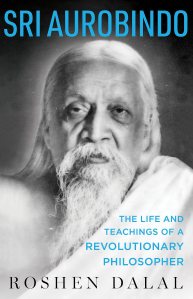
Even though, I had never read anything about Sri Aurobindo earlier, I think for long my life has been influenced by his luminescence. I visited Puducherry and Auroville in 2001. With absolutely no interest in philosophy, I did not do any background search on the man who has left behind the renowned Utopian town of Auroville. I was simply a tourist who liked the ambience, the greenery and of course, the golden exterior of Matri Mandir, which was then under construction. It was a short group tour and I don’t think I registered the ideology of this idyllic place. But in the current times when polarisation is gaining momentum, this book is special. It talks about communal harmony and integration, about the role of Muslims and other communities in the fabric of society.
During my 30s, I discovered the fragrances prepared by Aurobindo Ashram in a small shop on Janpath, Delhi, the small aromatic perfumes that were more about healing than simply smelling good. Prone to headaches and pain in other parts of the body, I would often use the lavender roll-on and the instant relief was fabulous. It became a part of my first aid kit. I liked the handmade products from Auroville as well.
It is only decades later that I have been introduced to Sri Aurodindo’s life and philosophy through historian Roshen Dalal’s book, commemorating his 151st birth anniversary. He was born on August 15, 1872. Reading about his knowledge of language and literature ranging across continents, his education in the UK and political views, it is hard to believe that all this happened a century ago. Even in the 21st century, when travel and education are just a click away, not many would transition from a European education and a good career to an austere sadhak giving shape to the dream of oneness in Auroville.
Born in Calcutta, he was the third child of doctor Krishnadhan Ghose and Swarnalata and named Aravinda Acroyd Ghose. The book explores his life and times, evolution from a freedom fighter to a spiritual seeker and eventually a philosopher and guide who came to be revered as Sri Aurobindo. The book is the result of over 30 years of research. Each chapter is focussed on a different aspect—beginning from his childhood, family, education in UK, marriage, political ideology and eventually the deep exploration of the cosmos and the scriptures, and the formation of the ashram in Pondicherry.
It was fascinating to read about his father’s views, from endorsing British habits and customs to finally moving away from them. The book is filled with references to an era when India was undergoing political turmoil and under many European regimes, primarily the British, and different ideologies related to Hinduism were being propagated.
Sri Aurobindo was fluent in Latin, French, English, Sanskrit and later Bengali. He read global literature and philosophy, wrote many essays related to freedom and was even arrested in the Alipore Bomb Case. This stay in the jail changed his life. After his acquittal, he escaped to Pondicherry which was then a French colony and far from Calcutta where British regime was suppressing India.
His life took a different turn from there. His family life slipped away, slowly and steadily. He would never be able meet his wife again, and his relationship with his brothers changed. He began delving deeper into the meaning of life, started doing pranayamas, and then rigorous sadhana. The cross-cultural stream of consciousness is evident in the passage that his life took from here, exposed to British and French influences.
In Pondicherry, he met Paul Richards and Mirra Alfassa, who later became the Mother. She was the epitome of Shakti, the woman who understood his vision and carried it forward. She became the pillar on which the ashram’s activities ran. Dalal explains this passage of his life beautifully. Nothing is ever built in a day, so while Sri Aurobindo meditated for days, the Mother ran the ashram clockwork. She translated his vision into practical execution.
He went onto explore different scriptures such as Gita, Vedas, Upanishads, and Dalal has explained his philosophy in nuggets in the book, which is helpful for novices like me. Reading the book makes you realise why Sri Aurobindo ashram in Delhi has a mass communication school and also the Mirambika school. The Pondicherry ashram also offers courses in aromatherapy. I regret that I have never taken the time to visit the ashram in Delhi, despite being a native to the city.
He was a creative man, who propagated finding the creator in arts. He connected the hymns of the Vedas to the spirit—unlike most who limit them to physical rituals. He believed that the spiritual was supreme and would take one to a more harmonious life. In fact, Dalal explains that his most famous work, Savitri, is the spiritual dialogue between life and death, and it was constantly rewritten as he progressed in his sadhana. With this revelation, Savitri takes on a new meaning for any reader, at least for me.
The book is a slow read, something that ignites the desire to read Sri Aurobindo’s complete works and understand the man who explored the divine beyond idols and ritualistic practices. His vision of heaven on Earth can perhaps be best explored at Auroville, where people live a life in tune with Mother Earth. Hopefully, I will get a chance to visit Puducherry again with more time on my hands this time, till then I carry the learnings in my heart. And Roshen Dalal’s book holds a special place on my bookshelf.
Book Details
Language: English
Hardcover: 352 pages
Publisher: Pan Macmillan India
Price: Rs 699 (Kindle edition available)
This review is part of the blogger outreach programme by Pan Macmillan India. The views expressed are my own.

 Queen of Treasures
Good one. One thing I leaned recently is that there are many less known spiritual gurus in India. They don’t want to be famous for some reason.
I visited Auroville few years back and had bought 2 books. Yet to read them. :)
LikeLiked by 1 person
Certainly worth reading. I would also like to visit Auroville and Puducherry again, I didn’t understand the significance until now.
LikeLiked by 1 person
Tried many but nothing works for my body but I’m glad you have found what works for you. Natural remedies are the best.
LikeLike