
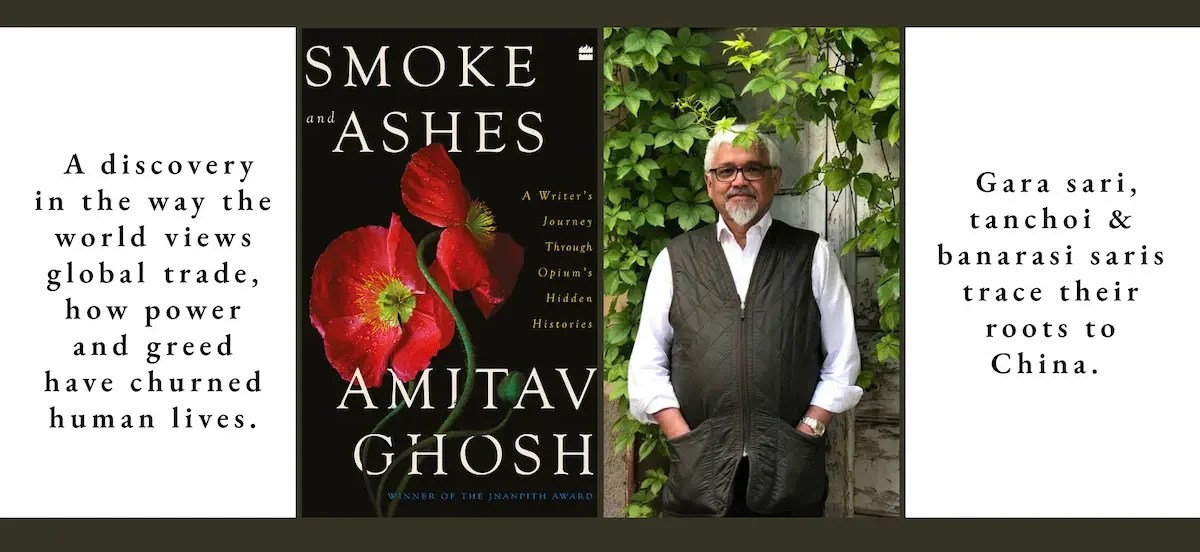
Among the most renowned global thinkers, award-winning author Amitav Ghosh takes us through the fascinating and devastating world of opium, used by the British Raj to reshape China and India.
I must begin with the confession that this is the first time I am reading a book by Amitav Ghosh. Though, I had attended an interactive session on The Great Derangement: Climate Change and the Unthinkable (2016) at the India Habitat Centre, Delhi.
Smoke and Ashes: A Writer’s Journey through Opium’s Hidden Histories is ‘a memoir, travelogue and excursion into history, both economic and cultural’.
Well, as a generalist aka journalist or creator, sometimes I take liberties and go beyond the usual ways of looking at stories.*
So, I am not exactly reviewing the book as it has been reviewed across media outlets. After reading the book, I also researched on Ghosh’s style, views and writing, watching interactions on YouTube.
From this entire search, my focus shifted from an ubiquitous review to takeaways.
The Research on Opium
During the research for the Ibis trilogy, the author discovered that lives of sailors, soldiers and the people of China and India were greatly impacted by a flower called Opium Poppy. This research began in the early 2000s, that is almost 20 years ago, and the author travelled to China.
All real life experiences are eye openers, and the same was with him. He also discovered that his grandfather, who lived in Chapra, Bihar, probably did work related to this addictive plant.
Along with Ghosh, like deep sea divers, we reach the ocean bed where the deepest secrets of this dark trade lie. He sheds lights on man’s loss of his humane self in pursuit of infinite wealth and power. He then ends with a sense of despondency that the poppy might raise its ugly head again, engulfing humanity until humanity learns that Nature is slow but not silent.
Everything rebounds unless greed is controlled. Hard core capitalism is not the way forward, balance of materialistic life is.
In between, there is a beautiful tapestry of life, as cultures melt into each other.
Dark & Suspicious
The book is a time traveller’s paradise, taking the reader to the unknown parts of the18th and 19th centuries. However, it is not a light journey, the deep dark past, full of plunder and horror, reveals the plight of poor farmers in Bihar and the gentle people of China.
This book has actually changed my perception of China, made it more human and the colonisers more demonic. To quote the author, I conquered the ‘Himalaya of the mind’.
Much like the author, most of us in India view our neighbouring countries with deep suspicion and a certain blankness. In the north, we skew our noses at Pakistan, and in the east, China is a recoiling entity.
We almost never dream of visiting these nations, except for religious reasons such as pilgrimage to Gurdwara Sri Kartarpur Sahib and Kailash Mansarovar.
Blood money!
Plants have inhabited the planet far longer than humans, and their power is manifold, as we see with the opium poppy. Its ability to cure and narcotic properties ignited the fire to earn vast revenues in the British regime.
The book cites the impoverished state of the farmers in Bihar, bent under the draconian rules of the Opium State. They were ill-treated, low-paid and lived under fear and surveillance of the new lords of India.
The British coffers kept filling, so much so that the British Empire created new markets for the Americans as well. The author gives a heartfelt description of life there and the gruesome wide gap between the whites and the browns.
A ghostly trade, wrapped in secret chests, the opium market flourished for over a century and a half, creating generations of addicted Chinese, Indians, Java Islanders.
The British, not only tortured the farmers in India, they ensured that the opium reached Chinese shores and got them the revenue they needed to add to their already mighty empire.
Citing the case of free markets, the Britishers used military power to ensure that China allowed opium trade to flourish. The two Opium Wars are a testimony to this.
The then Qing Emperor had strict laws about the country and kept trying to eradicate this smuggling operation.
The narrative is an intense journey into the intricate web that the underground trade had built and how it gave birth to criminals and corruption within all ranks of society.
Ghosh reveals how during the famines also, the farmers in Bihar couldn’t grow any other crop, except the white poppy. He has also stated in his many interviews that even today the social parameters of this region indicate the impact left by the colonials. The people in this region have trust issues. The Chinese, too, view the westerners with suspicion and have been aggressive in their approach to keep themselves safe, despite the centuries gone by.
The British regime also forced countries such as Singapore to enter into treaties. Hong Kong became a major hub for them.
Arts, Flowers & Mistresses
However, nothing ever happens in isolation. Ghosh writes about the flourishing arts in India and China, western tourists coming to see two major opium factories, one in Patna and the other in Ghazipur. These artworks, and some other references, have been depicted in the book.
In matters of art, China fared better than India, as the designated Canton area in Guangzhou had a foreign enclave. The merchants stayed there in the 13 factories, where they could not bring their families. The merchants paid the artists for portraits and other natural world pictorials that they carried back home. Of course, some merchants kept Chinese mistresses and their children got high positions in the businesses they later built in their native lands.
We also learn how the famous gara sari, tanchoi and banarasi saris have their roots in China. It was interesting to know how the famous JJ School of Art came into existence.
We see a whole new world developing from blood money. There is mention of new boats being made in America, which sailed faster than the merchant ships. We hear of prominent names such as Forbes, Roosevelt, Low, Sackler having made their fortunes via opium trade.
The white foreigners invested their profits from opium trade in building the economies of their native land. They also brought back cultural motifs such as paintings, flowers, décor, furniture, architectural styles, clothing, and more. Today, over 30 towns in the US have the name Canton, Ghosh says in an interview.
Psychoactives & Karma Rebound
Ghosh also cites the difference between the development in the eastern and western parts of India. While Purobiya was under the British hold, the Malwa region managed to keep their foothold strong. They only paid the taxes and ran opium operations as they willed. Colourful poppy plants grew here. The result was that ‘Mumbai got the economy and Calcutta got the economists,’ he says.
Ghosh introduces us to the world of psychoactives, and their impact on the global population over time. He also talks about the recurrent cycles and gives the example of OxyContin and Purdue Pharma and the opioid epidemic. What happened to China in the 19th century, now plagues the western world, especially the US.
He talks about the power of the citizen movements, the power to stand your ground, as the international activists did in the early part of the 20th century to end this saga of cruetly and torture. He makes us think about the despondency of the quiet Asian countries, their gentle, deep civilisational roots lying in the natural world that are trampled upon by so called progressive empires.
Following the Tracks
What the British did to China and India, the Dutch did to Java and other islands.
Ghosh does not shy away from telling us that most of the bigwig families, especially in politics, and famous corporations made their fortunes through the opium trade of yesteryears. Even the Hong Kong and Shanghai Bank’s roots are traced to this opium trade.
As I came close to the end of this horrifying account of misuse of natural resources and purposeful destruction of human lives, I reached the part about Ghosh’s dilemma and giving back the advances at one stage, as he couldn’t proceed with the horrifying aspects that he discovered during this passage. Eventually, he has penned it, perhaps as a lesson for us and the future generations. Maybe, this historical account will help us prevent further damage to the planet and the species that live here.
Will Nature reclaim?
Reading Smoke and Ashes has been a discovery in the way the world views global trade, how power and greed have been the bane of human species since the beginning of time. Military force over gentle civilisations may have made the Western world rich, but Nature will always find a way.
The misuse of natural resources is beginning to tell. There is no right or wrong way, just a balance of knowledge that lies deep in the recesses of the Earth. If only, we would slow down and listen to it to prevent more mishaps, and be compassionate at all times.
To conclude this, here is a small para from the book: ‘In thinking about the opium poppy’s role in history it is hard to ignore the feeling of an intelligence at work. The single most important indication of this is the poppy’s ability to create cycles of repetition, which manifest themselves in similar phenomena over time. What the opium poppy does is clearly not random; it builds symmetries that rhyme with each other.
It is important to recognize that these cycles will go on repeating, because the opium poppy is not going away anytime soon. In Mexico, for instance, despite intensive eradication efforts the acreage under poppy cultivation has continued to increase. Indeed, there is more opium being produced in the world today than at any time in the past.
Only by recognizing the power and intelligence of the opium poppy can we even begin to make peace with it.’
(*Many years ago, one of my editors in jest said, journalists are generalists, they can cover anything and everything. Over my long career, that actually turned out to be true. I still live by the principal of flexibility and adaptability, and the best way of framing a story.)
Book Details
Publisher: Harper Collins Fourth Estate India
Language: English
Hardcover: 408 pages
Price: Rs 699 (Kindle edition available)
This review is powered by Blogchatter Book Review Program
Ambica Gulati is an independent journalist, editor, multimedia storyteller and author whose work explores global affairs, culture, travel, the environment and the human stories behind larger events.
She is available for reported features, interviews, analysis, profiles and multimedia stories on international affairs, India and beyond.
From the Archives
If this story stayed with you, there’s more to explore in the archives.


A good review. Welcome to my review. I loved the book for reasons similar to yours.
LikeLike