

Kashmir is the land of many ‘must-do’ things, including a culinary diversity that rocks your senses. I explored Srinagar with a native and got a taste of the traditional palate, besides the better-known dishes. All these are in the ‘must-eat in Kashmir’ list, for you can’t be in Kashmir and not do what the Kashmiris do.
A coveted crown, Kashmir has wooed, shocked and hit the headlines for everything that doesn’t spell my touristy version of the beautiful Himalayan region. The Kashmir of yesteryears, pre-1990s, has a permanent place in my heart. But for my stomach, the Kashmir of 2019 comes to the fore.
I only expected meaty dishes and curd curry or a kahwa, as those are most well-known dishes. I was surprised to discover fresh from the tandoor breads that Kashmiris relish with noon chai, a special salty pink tea. This is Kashmir’s answer to the European croissant and coffee. I liked Kashmiri chai and bread better—fresher and healthier with lesser calories.

This round bread comes straight out of the tandoor. The round crisp baqerkhani bread is topped with sesame seeds and priced at INR 5 and INR 10 respectively. There are small bun-like round breads, tsot and tsochvoru, topped with poppy and sesame seeds. Add some butter to this, dip in your noon chai and whoa! You have a sumptuous breakfast.
Noon chai is also known as gulabi chai and sheer chai. To gunpowder tea are added salt and baking soda, which make the tea pink in colour.
For the main meals, the accompanying breads are round, big ones much like the rotis of north India, albeit more variety. These are slightly sweet ones sheermal, lavas, kulcha and girdas. Most people prefer to eat rice with their veggies or fish.
Sheermal goes best with kahwa—the famous green tea mixed with saffron, almonds and spices. You get over 20 different kinds of kahwa across Kashmir. Sometimes at weddings, milk is added to kahwa. The sweetener is normally honey, sometimes gulkand is also used.

Traditionally, kahwa is made and served in a samovar, a handcrafted copper teapot that costs a bomb. Kashmiris do like eating in copper utensils, which cost the earth.
On the streets are snacky treats such as masala tikki, which has dried vegetables and fish as accompaniments.
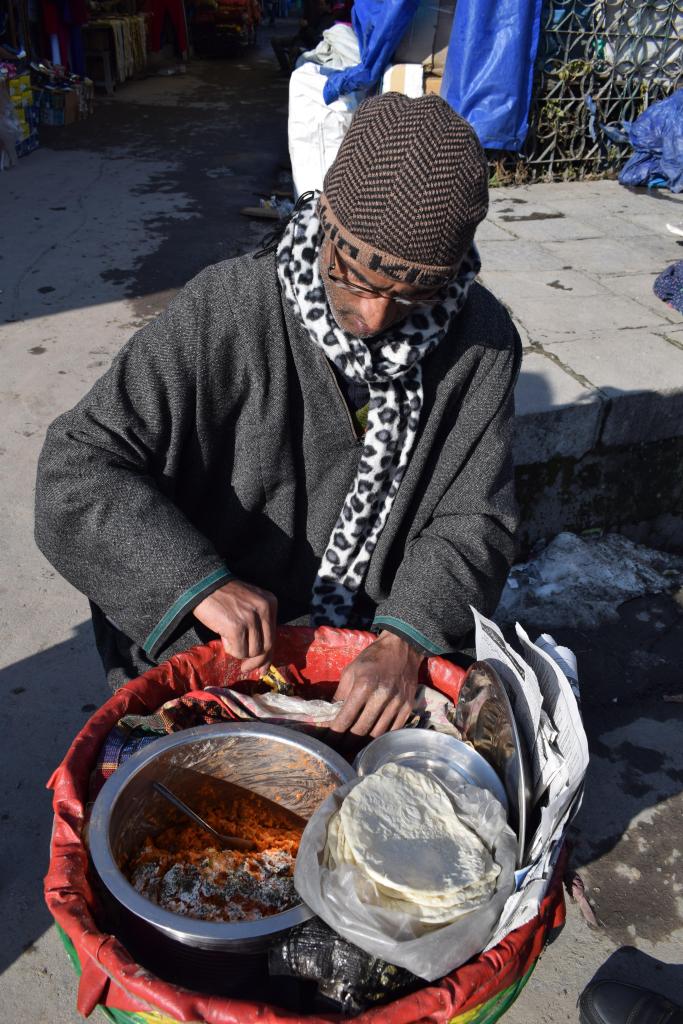
I also got to taste Kruhun Masale, that is boiled chana rolled in a thin white flour roti and dipped in tomato chutney. It’s normally served on a newspaper!

Another newspaper delight is Masale Tzhot. Delhi peeps can connect this with dal moth. The Kashmiri version is darker in colour due to more spices.
The Valley’s best-known spices are saffron from Pampore, shahi zeera, Koshur Marchwagan or Kashmiri lal mirch and Zereshk or mild, tangy berries. Dried ginger or sonth, and baedyn or dry roasted and ground fennel seeds, are well used to prepare most dishes.
Contrary to expectation, Wazwan is not your daily meal. It’s a traditional meal comprising 36 dishes (number keeps varying) for celebrations, primarily weddings. It is prepared by special cooks known as Wazas, which is a hereditary, respected profession; people outside the bloodline don’t enjoy the privilege of being taught this.
Eating Wazwan is a ritual. A tash-t-nari (jug and basin) is passed around for the guests to wash their hands. The centrepiece is a large dish filled with rice, laden with four seekh kababs, four pieces of meth maaz, two tabak maaz, sides of barbecued ribs, one safed kokur, and one zafrani kokur. Then, there are more dishes, and accompaniments such as yogurt garnished with saffron, salads, pickles and dips.


While the Valley is primarily meat eating, Nadru Yakhni (lotus stem cooked in flavoursome yogurt curry) is popular. The Kashmiri Pulao loaded with nuts is a must-eat too. Then, there are dates and cherries. All these are my favourites, including the round bread for breakfast.
I’m participating in #BlogchatterA2Z
Read previous posts: A, B, C, D, E, F, G, H, I, J, K, L

 Queen of Treasures
kashmir has so much to offer.. unfortuantely, it always comes in wrong news
LikeLiked by 1 person
Well ..it’s upto us to change the news then! 😊
LikeLiked by 1 person
sheermal is my all time favourite bread! And Kashmiri wazwan is just awesome 💯
LikeLiked by 1 person
Sheernal is truly a treat as is nadru yakhni.
LikeLike
Hi, I left a comment on your post about Megong flowers, not sure if it went through, as it gave some ‘not acceptable error’.
LikeLike
Such a writing enriched with not only with names, but also the description of the food items. I haven’t tasted any except the kashmiri naans/rotis/pulao. thanks for introducing other items.
LikeLiked by 1 person