

Have you ever dreamed of exploring the diverse landscapes of India without creating a significant dent in your pocket? Train travel in India is a cultural potpourri
- Vande Bharat Express
- My First Chair Car Experience
- Fairytale Ride in Himalayan Queen
- Through Rural Rajasthan in a Local Train
- Delhi to Kolkata in 23 Hours
- Double Decker Bonanza
- The Last Metro
When I went to Jordan and Sharjah, I was surprised to know they didn’t have rail networks! In India, it’s difficult to imagine travel without trains.
Let’s take the tracks to the 1970s. Train travel wasn’t a click away. There were agents and long queues for booking tickets. These bookings had to be done months in advance. Mobiles, internet, and computers were in stages of invention in the West. We, the easterners of the world, never thought they would invade our lives in a manner that we would forget human intervention.
Travelling meant carrying half your home with you, in addition to the luggage. We would carry our large canvas bistarbands (holdalls) stuffed with quilts, blankets, sheets, pillows; meals comprising parathas, aloo sabzi, aam ka aachar; surahi or water pot; cutlery (the steel one, no plastic or single use stuff); towels; soaps.
Of course, over decades like everything else, trains evolved as well. From cardboard tickets to digital tickets, platforms announcements to SMS and WhatsApp notifications, coolies, conveyor belts and lifts, air-conditioned waiting halls and slightly cleaner toilets, readily available food packets and delivery systems, trains are no less than mini joyrides.
What hasn’t changed though are family members wishing to sit with each other, even for short journeys. So, switching seats, berths, and accommodating others is the norm in India. The ticket checker also gives a hearty nod on this one.
With the 21st century promoting consumerism and comfort, the railways now provide sheets, blankets, pillows, food, at least in the good trains and upper-class compartments.
There are different kinds of trains in India, such as the fast Vande Bharat Express, Shatabdi, Rajdhani, Tejas Express, Vistadome, luxury, mail, local trains, heritage toy trains and more. Then, there are cargo trains.
Read about my luxury train experience. I also travelled in the monorail and bullet train in South Korea, as well as Walt Disney Metro in Hong Kong.
Vande Bharat Express
Let me begin with my most evolved train journey, a boring work trip. In 2022, I travelled from Delhi to Varanasi via executive class of Vande Bharat Express. This is a medium-distance superfast express, a ‘Make in India’ initiative started in 2018. It connects cities less than 800 km apart or take less than 10 hours to travel with existing services. My destination, approx. 760km, took 8 hours. While I liked the speed, a foodie would have loved it more. You are served till you can barely move. We brought home all the dry and snacky stuff such as chips, bhujia, juices, biscuits, even kachoris.

Did you know the first passenger train in India ran between Bombay (now Mumbai) and Thane on April 16, 1853? This 34-kilometre journey was pulled by three steam locomotives named Sahib, Sultan, and Sindh.
My First Chair Car Experience
Let’s step back to 1988, my first solo train travel at the age of 18. Like most Indian girls, I had not travelled alone. But now, I was going to live in a hostel, as I enrolled for a professional course after school.
Trains are disciplined beings. They start on time and they end on time, well most of the time. We stood in the long queue, checking out many trains in which the journey could be done during daylight hours.
I discovered that Delhi is Old Delhi, New Delhi, Delhi Cantt, Nizamuddin and Sarai Rohilla. Mind boggling, I didn’t know my city! We narrowed our booking to Shan-e-Punjab, Ludhiana to New Delhi, enquiring about the different coaches. It was all chair car, new for me, as I had only experienced the sleeper coaches and car trips. We consulted people who had travelled in a chair car—all sit and travel, no berth and all of 4.30 hours. Easy peasy.
Though I had a walkman and a radio, it didn’t seem to be the ideal way to spend the hours. Radio wouldn’t catch the signals, and big headphones were impossible to manage. So, four books for each hour, 30 minutes rest and then Delhi. My mother had packed 10 parathas with sabzi for me, hoping I would be 10kg fatter by the time I arrived in Delhi. But I didn’t go by the book.
I had never eaten food served in a train. With my newly discovered freedom, I bought a flask of tea and a breakfast packet. I also needed adventure, so got off at Ambala station to have the famous kullad wali chai. Whew! What a marvel, I even made it back to my seat on time. A lot can be done in 3 minutes.
Needless to say, I didn’t even read one book. Getting off, I was bewildered about the novelty of traveling solo and being an adult. What was the big deal? I would learn about that ‘big deal’ much later in life, around my 50s, when books and music overcame my practical senses while travelling in the Delhi metro.
Fairytale Ride in Himalayan Queen
Between hostel and home, I got used to the chair car and train food. Sometimes, I would take sandwiches, parathas were out of favour as I grew up. But I still lacked exposure to the world.
It was 1989, and one of hostel mate’s father fell sick. Like a Samaritan, I offered to hop along to Shimla with her. It was midst of December, chilling cold, climate change hadn’t set in till then. I almost got frostbite in Shimla.
I avoid buses like plague. Tell you about those bloopers in another post. So, even though locals in Shimla avoid the snail-paced toy train, I insisted we take that on the onward journey from Kalka. It used to take thrice the time of a bus ride.
This was a fairytale ride, I felt like little Noddy in his toy train. My companion had no such thoughts.
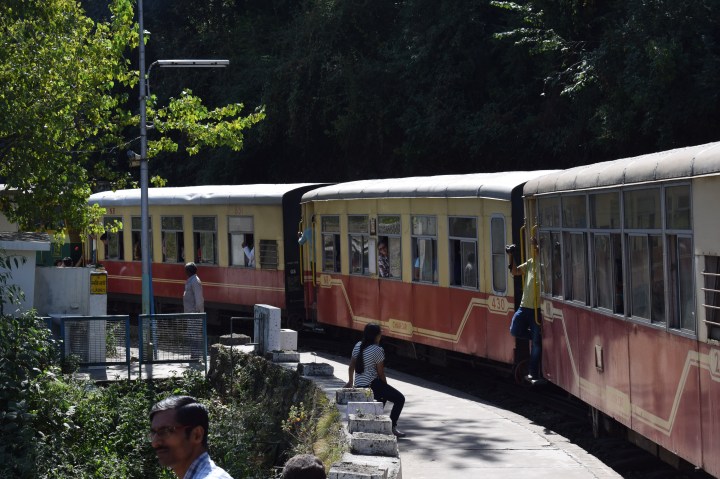
Kalka to Shimla, slowly through tunnels, past clean small stations, people boarding and deboarding with ease, sitting in the narrow’s doors with a dizzy view of the valley below. As the train climbed up, the mountain air became headier. I gorged on our packed food; head stuck out of the window. She sat on the steps of the door, totally badass about the curves and dark tunnels.
Built on 2 ft (610 mm) narrow gauge tracks in 1898 by the Delhi-Ambala-Kalka Railway Company, it opened for the public on November 9, 1903. It was inaugurated by the Viceroy of India Lord Curzon. The little train was declared part of the World Heritage Site Mountain Railways of India on July 8, 2008.

There’s also a sad story about the tunnels. Around 107 tunnels were built, but only 102 were used. The longest tunnel was at Barog. The then engineer Colonel Barog dug the tunnel from both ends but could not connect them. He was fined Rs 1 and ashamed of this, he committed suicide inside the tunnel. Shocking! After that Chief Engineer H.S. Herlington completed it with help of a local sadhu called Bhalku.
As the train chugged on, I watched the slow world of Himalayas. The longest halt was at Solan.
In 2018, I took the train again from Shimla to Kalka, completing the two-way journey of the Himalayan Queen in 30 years! This time, it was to avoid the drive through the jammed roads of Shimla.
According to the European Environment Agency, rail travel accounts for 14 grams of CO2 emissions per passenger mile, which is dwarfed by the 285 grams generated by air travel, and the 158 grams per passenger miles from journeys in cars. This makes train travel a more eco-friendly option.
Through Rural Rajasthan in a Local Train
It’s 1999, am 29 years old now. I have travelled alone, lived alone, experienced life now. But this journey made me realize that I wasn’t prepared for contingencies, lacked discipline and commonsense.
This was perhaps my wildest trip, going into the interiors of Rajasthan, in the middle of summer, without reservations or clear plan on how to reach Salasar’s most famous Hanuman temple, Balaji Mandir, home to obstacle removing red monkey god. Only good part, the temple is so famous that we didn’t get lost or harmed on the way.
We expected it to be a day’s trip. My younger sister, all of 20, and me, carried just one handbag. Thankfully.
Someone had suggested that we visit the temple of Balaji in Salasar to find a resolution to the problems that plagued the family. So, it was a hush hush trip, and I didn’t get any clear idea of the route. Our budget was tight, and we were women, so no private vehicles at any stage.
Less brains and more enthusiasm, I booked the Pink City Express from Delhi to Jaipur. All pink and good seats, well begun is half done. Not in this case.
Reaching Jaipur at 9pm, we inquired about the connecting train to Sikar. Nothing! There was a local train at 4 am though. That didn’t seem like an impossible situation, so we stayed put at the waiting room for ladies, just about bearable. We ate at the station restaurant and bought water and biscuits.
Going by the information, we should start at 4am and reach Sikar by 7am. Not bad, but then no one told us that this was narrow gauge and the train’s speed was slower than a snail’s or that it could stop in the middle of nowhere without a warning.
No cushioned seats and no reservation criteria, we dried up in the heat as the day progressed and the train got fuller, almost bursting to the seams with people travelling between villages.
The wooden planks got more and more uncomfortable with the passing hours; we couldn’t move from the coveted window seats to the shady aisle ones.
The good part: We saw the interiors of Rajasthan in all their rawness, camels, desert, heat, colorful turbans, beautifully bejeweled men and women, amazing tattoos, ethnic clothing and a village station after every 15 minutes. The tattooed elders peeked, speaking about the memsahibs in hushed tones.
It was a black and white movie era: people rolled their cloth bundle under their armpit, slept with their heads on it, carried steel trunks, packed potlis of roti–sabzi and plastic water bottles. No vendors in this train and the three hours had long gone. With just the last drops of water left, we hoped Sikar station would be visible soon.
It did come, but after a halt in the middle of nowhere that lasted 45 minutes. With a difference in dialect, the villagers couldn’t explain the reason. Eventually, we deciphered that the big train from Bikaner had to pass first on this single track.
We reached Sikar at 10am, tired, unclean, waterless and foodless. There, we discovered that there was a direct overnight train from Delhi to Sikar! We did take that on the return journey.
The trial didn’t end at Sikar. It took massive effort to get into the stuffed tuk tuk with at least 30 people, some sitting on the roof, to complete the next 45 minutes to the famous temple in Salasar.
I think the monkey god did cleanse our sins and turned us into more adept planners as the years passed.
Delhi to Kolkata in 23 Hours
It’s 2000. I’ve experienced AC sleeper, Chair Car, Local Trains, Toy Train. But there’s more to this snaky ride in India. Train journeys can be such nice lessons in learning good behavior and community welfare.
This journey jolted me out of my comfort zone. I belong to the category of travellers who like their space and hang on tenaciously to their seats.
I desired to see the Dakshin Kali temple in Kolkata and a friend was going home for his cousin’s wedding. I tagged along. He booked us into the normal sleeper coach, no AC. As it would take me a full day to reach Kolkata, my berth was my home.
My friend, a native of Kolkata, was maturer and genteel, open to sharing and caring. As the day progressed, the train stopped at almost every station, and a new passenger squeezed in on my already full berth. I was horrified and recoiled from contact. My friend assured me that I would get my berth back at night. I didn’t believe this.
He distracted my snobby self with stories about his hometown and family. My neighbours conversed in Bengali and were shocked at friends of different genders undertaking the journey. But my unfazed friend smiled and translated their conversations in his Bengali-Hindi. Juxtaposed against my English-Hindi, this was a comic show and the compartment became congenial.
Here, I learned that married women wear red and white bangles in West Bengal. A sweet family shared their lunch of rotis, aloo sabzi, achar, with us. Crossing Bihar at night was a scene straight out of dacoit tale—windows tightly shut, handbag under my head and mind on alert.
There were some heart-in-the-mouth moments when my friend jumped out at a small station to fill water and then for an early morning cup of tea. I thought he had missed the train and the tickets were with him. I didn’t even have his home address! Luckily, it all ended well, and we reached Howrah station in one piece, taking the ferry across the river.
Indian Railways is one of the largest railway networks in the world, operating over 70,000 kilometers of track and serving billions of passengers annually.
Double Decker Bonanza
Coming to 2014. By now, I was used to travelling alone, anywhere, anytime, packing my bags and waiting for dry snacks on the train. I stayed away from all the fried stuff served on the platforms. I often travelled for work, especially well-organized media trips.
Maybe the novelty had worn off, or so I thought, until I got to see this double decker at Jaipur station. It looked like a normal train, except that the top and bottom seemed cramped. I was imagining a seat on the top part, head hitting the roof, but we were booked on the lower part. Enough head and leg space.
It was a fun trip. My neighbour, a young lady in ethnic Rajasthani wear, was travelling with her five pieces of luggage and three children. She was sweet and had never travelled alone with the children. As the train rolled, we began to chatter.
Her first question: “Are you married? Is that your daughter with you?” My young media companions stifled their giggles as I looked intently at the woman.
In a very serious tone, I replied: “If God had been kind to me, I would have been married and had children. But no one wanted to marry me. I am a spinster trying to find happiness in the company of young girls.”
That stupefied her traditional upbringing. “Don’t pull my leg,” she said. “You are so pretty, anyone would marry you.”
Suitably chastised by her innocent expression, I responded gently: “Men don’t think like that about me. I have white hair that needs colouring. I am not compatible with children.” Her eyes almost popped out.
Her husband, an army man, met her in Delhi and from there the family would be going to the other part of the country—Guwahati. We waved her a cordial goodbye.
The Last Metro
Adventures are born when we let our brain sleep. But they begin when the brain wakes up! Must have been 2018 or 2019, I was taking the late-night Delhi metro home from Rajiv Chowk, Connaught Place, to Noida City Centre. It must have been around 9.50 pm.
In the practically empty train compartment, I wasn’t worried. I took out my book and plugged in some music, lost to the world. Somehow, after what seemed like a few minutes, I glanced up, finding an unfamiliar station. Then I saw the sign, Anand Vihar. I had taken the metro to Vaishali! I jumped.
Lady luck was on my side. It was around 10.30 pm and I hung onto my bag. The night seemed darker with just six or seven people on the platform.
To my relief, the last train to Noida was around 11.20 pm. I caught that at Yamuna Bank, making it home in one piece.
God forbid that I am lured by books and music during a short distance ride ever again.
There have been many more journeys, more adventures, more hits and misses, but now, I enjoy the slow trips. Leave early, wait on the platform, watch the world go by, eat train food and bring back some leftover snacks, and be happy!
This post is a part of Blogchatter Half Marathon 2024. Read more:
- Aspiring Writer’s Guide: Mastering the Art of Content Creation
- Kaziranga: A One-Horned Rhino Sanctuary in Assam
- Khajuraho’s Temples: The Erotic & The Divine
- Humayun’s Tomb Museum: The Bibliophile Mughal Emperor
- Dharamshala, McLeodganj, Palampur, Andretta: Kangra Valley Treasures
- Book Review: A Murder is Fixed by Madhav Nayak
- Jaipur: Pink City Through My Lens
- The Company of Violent Men: A South Asian Journalist’s Memoir
- Rewire Your Brain: Heal Your Mind and Body

 Queen of Treasures
You have such a vivid memory of decades ago, Ambica. I really admire the way you make me nostalgic, the bistar band, food, matka, soap and so on. I started flying only when I turned 50. Before that there were three short flights in my life. I enjoyed train journeys and always looked out of the changing topography. I remember writing a poem too which I have not saved. Planning to go for the Vistadome but my health is just not permitting me to move out from home leave alone travel.
LikeLiked by 2 people
I wanna do vistadome too and the heritage in Darjeeling and Niligiri.. bullet also of it comes while we are alive 😁
LikeLike
Ah! You made me nostalgic with this post, Ambica. I remember the cardboard tickets, the big giant station bell as an arrival indicator and the bistar band. Paper soaps, aloo-puri-achar combination and ‘koi kuch de toh khana nahi’ advise by every elder. Love those days, yes the railways have evolved a lot, but certain things about train journey is like an emotion, it never changes.
LikeLiked by 1 person
I still enjoy train journeys.. 😊
LikeLike
I’m a bit jealous of your memory, Ambica;)
Train travels was a thing back in the day. I don’t remember much from my long train travels. Ah, there used to be a fight with my brother for occupying window seat😄
LikeLiked by 1 person
Yeah..window fights and lower berth fights! Writing keeps my brain cells in place else my memory has become very foggy.. 😁
LikeLiked by 1 person
Ambica, your post reminds me my childhood journey. I also had a long train journey and I love train journey till. Mr. Hubby tease me that I don’t like to travel by air but prefer to travel by train. Train journey is really beautiful and you explained it very well. That loud Bhonga (we called it in marathi) getting down at station to eat for 10 minutes, watching nature by sitting near the window and many more memories are there.
LikeLiked by 1 person
yeah, platform has vibes, so relatable
LikeLike
My mom loves train journeys . So do I ! Your post has brought back so many memories.
LikeLiked by 1 person
It was so refreshing to read about train journeys. It took me back to my train journeys. Reading your post gives me the feeling that you have travelled a lot and have been an adventurous person. You must be adventurous now also. I think I too share the same feeling like you.
LikeLiked by 1 person
Thanks, I haven’t travelled as much as I would like to, and adventure is more like a safe place now :P
LikeLike