
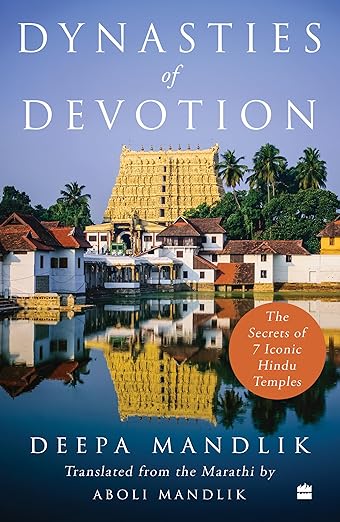

Dynasties of Devotion by Deepa Mandlik is a richly woven journey through seven iconic temples, blending history, art, and spiritual reflection into a compelling travelogue.
In India, temples are more than sacred monuments; they are dynamic centres of devotion, identity, and continuity. Through generations, they have shaped traditions, influenced social values, and nurtured collective memory. They are a living heritage.
The book, Dynasties of Devotion, can be called a pilgrimage in prose. Like a time traveller, Deepa Mandlik explores seven iconic Hindu temples—six in South India and one in Cambodia. Her narrative goes beyond architecture, delving into the historical, political and cultural milieu of the eras gone by.
Unlike most scholarly books on the ancient temples, this one meanders from the academic style of writing. Mandlik’s first-person narrative is like a traveller in wonder of the era gone by rather than a detached researcher or a mere tourist. Her husband accompanied her on these journeys, collecting photographs and her daughter Aboli Mandlik has translated the book, which was originally written in Marathi, titled Parakrami Hindu Rajanchi Adwitiya Mandire. It received the ‘Best Reference Book of the Year Award’ by Akhil Bhartiya Marathi Prakashak Sangh as well as the ‘Best Book of the Year Award’ by the oldest literature society of Maharashtra, Granthottejak Sanstha, Pune.
The book covers seven famous temples: Kailasa Temple in Ellora, Brihadeeswara Temple in Thanjavur, Brihadeeswara Temple in Gangaikondacholapuram, Angkor Wat in Cambodia, Chennakeshva Temple in Belur, and Sree Padmanabhaswamy Temple in Thiruvananthapuram.
Most visitors get a fleeting glimpse of temples as attractions, enjoying the picturesque views and few moments of reverence, but Mandlik has spent time keenly observing the breathtaking sculptures, the arts that flourished in the ancient India and the test of the time that the temples have withstood.
Each chapter covers a different dynasty and the temple it built. It takes us into that dynastic era, introducing us to the socio-political milieu and the world of kings and wars. At times, the sheer magnitude of these works brings goosebumps, as thousands of people worked on creating these wonders that can never be replicated.
Archaeologists and historians have gathered information about the times through excavations and inscriptions, highlighting the prominent people of those eras. But the many thousands who carved these sculptures, year after year, are lost in time, only their marvellous creation remains a wonder, surviving the tides of time. Some temples took 100 years to build, others 20, yet one was done in only six years.
The narrative makes you realise that within the temples, there was a living cosmos, a harmony of elements and the daily life of humans centred around this. They were centres of art, trade, economy and spiritual evolution.
On the good side, Mandlik has addressed the concerns arising from flimsy social media posts, which seemed more like click baits to me. I browsed through to understand the points she addresses—a viral claim that the Kailasa Temple was built by alien beings. She effectively dismantles this theory with grounded research.
Overall, the book is a good read and a good guide if you plan to visit the temples. It prepares you for the visit which would probably be now longer than a momentary shoot or a bow in reverence. However, the multiple descriptions do take time to process. One can get lost in the sheer description of the many sculptures, adapted from various mythological stories related to the gods.
While her research is meticulous, the density of the prose might require focused attention. Personally, the narrative would have gained more strength had the format been that of a picture book, rather than a book with a handful of photographs laced in.
In sum, Dynasties of Devotion is an insightful, evocative book which would appeal to history and architecture lovers, artists, explorers and time travellers in search of peace and wonder.
Book Details
Publisher: Harper Collins India
Pages: 208
Price: INR 399
Buy here
This review is powered by Blogchatter Book Review Program.
This post is part of the Bookish League blog hop hosted by Bohemian Bibliophile
YOU MAY LIKE TO READ
Khajuraho’s Temples: The Erotic & The Divine
Chambal Valley: Outlaws, Temples & Tales of the Ravines
Visiting The Temple City, BHUBANESWAR
Tirupati to Srikalahasti: A Tale of Two Pilgrimages
Nashik’s Sacred Sites: Trimbakeshwar, Panchavati & Ganga Aarti

 Queen of Treasures
Happy to know about this book precisely because temples have always fascinated me with the mystique they exude. Would certainly love to read this.
LikeLiked by 1 person
I love how you have brought out that the author used the historical context of temples to explain the life around it. It’s fascinating that temples apart from being a religious place are also spaces of community and culture.
LikeLiked by 1 person
Sounds like the perfect book for history buffs and travellers. I love the idea of looking at temples as microcosms within themselves, which they used to be.
LikeLiked by 1 person
Yes, all sacred spaces tend to have that feeling, some more than the others.
LikeLike
Reading about 7 iconic Hindu Temples would be such a treat! I think I once read a coffee table book on Konark but nothing otherwise, so surely looking up for this title.
LikeLiked by 1 person
Not one I’d pick at first glance or even after reading the blurb. but your review makes it sound like a captivating dive into love, legacy, and drama. Your take on the character arcs has me intrigued. Might just give it a try
LikeLiked by 1 person
This sounds like a facinating book. I always maintained that our temples were the social and economic focal points of a region. From your review this book, kind of corroborates my POV.
I really like the fact that it moves beyond the religious angle and looks at Temples in totality
LikeLiked by 1 person
I am thrilled that “Dynasties of Devotion” is not just about Gods and temples but takes a step further and also talks about the ruling Dynasties that built the temples. That is a very holistic approach to temples in general.
LikeLiked by 1 person
It’s a lot of architecture and some picture format would have been good.
LikeLike
True pictures make it so much simpler to understand and easier to admire.
LikeLiked by 1 person
As a kid all our family trips turned into religious tour of different temples and my dad loves temples, carvings and this book perfectly captures the essence. Loved your review. Reading this book soon!
LikeLiked by 1 person
The fact that this took 100 years to build some of these temples while others were completed in just six years absolutely gives me goosebumps thinking about the dedication and craftsmanship involved.
LikeLiked by 1 person
quite fascinating to go back and research about the architecture of the temples.glad you enjoyed the book
LikeLiked by 1 person
Sounds interesting. Don’t think I would have heard of this book if I hadn’t come across your review – so thanks!
LikeLiked by 1 person
Sounds like a well researched book that goes beyond just describing the temples. Definitely adding it to my TBR although I do understand it needs time to absorb. Thanks for sharing the review, Ambica.
LikeLiked by 2 people