
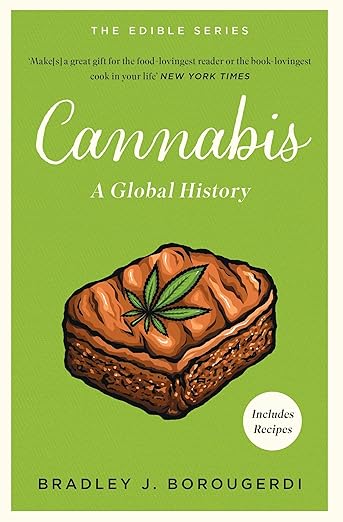
A visually rich and culturally comprehensive study that traces the journey of cannabis from its ancient roots in the East—where it is revered as the elixir of Shiva—to its complex legal and culinary status in the modern Western world. Borougerdi balances hard science with art, photography, and social history.
A plant much maligned and viewed with suspicion, cannabis has always been a wonder to me. In India, its most famous and socially accepted form is bhang, the elixir of Lord Shiva. But cannabis is far more than just an intoxicant; its healing and medicinal properties have long been integrated into holistic practices and alternative medicine.
What I found particularly compelling about the book Cannabis: A Global History by Bradley J. Borougerdi is its ability to present the plant in its totality—examining its inherent properties alongside the human struggle to control it. It also carries a “Parental Discretion Advised” disclaimer, acknowledging that cannabis derivatives—charas, marijuana, majoun, hashish, and bhang—can be addictive substances.
Borougerdi explores the botanical, medicinal, and recreational uses of the plant globally, with a specific focus on the Western world. Unlike most paperbacks, this book is interlaced with vibrant photographs that encompass a wide range of subjects: botanical illustrations, vintage posters, traveler tales, miniatures, and paintings. Divided into six chapters, the book concludes with an extensive bibliography and recipes from both the old and new worlds.
If botany isn’t your forte, the book simplifies the science: the cannabis plant has distinct genders, male and female. It isn’t a typical plant where reproductive power resides within a single organism. Furthermore, the specific concentration of molecular substances determines whether it serves as an intoxicant or a medicine. Its capacity to alleviate pain is widely recognized and used extensively in herbal medicine.
While the plant has always been revered in India through rituals related to Lord Shiva, Borougerdi tracks its different trajectory in the West. He illustrates the progression of laws, the dismantling of its label as “only” an addictive substance, and its gradual acceptance over centuries for medicinal use.
Based on my own experiences with bhang, I associate it with fits of unchecked laughter and long hours of deep sleep. Of course, anything in excess is harmful and must be avoided.
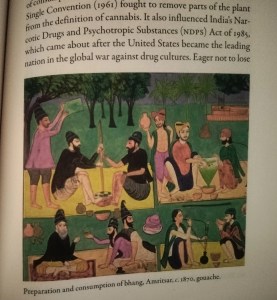
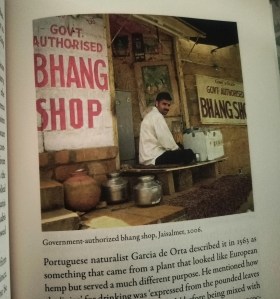
I specifically enjoyed the photographs, including one depicting the process of making bhang in Punjab. I have witnessed this in real life; I’ve even tasted it and found it not intoxicating at all. Another photo features a shop selling bhang products in Jaisalmer—a shop I have seen in person, though I never had the chance to try their wares.
The book also explores the “accidental” way the plant became a staple in culinary creations like brownies, cakes, and cocktails. Borougerdi notes:
Canada became an attractive country for beverage company start-ups after it legalised cannabis in 2018… The market has been flooded with various types of teas, tonics, liquors and brews… including hempseed beer… as well as coffees infused with THC or CBD.” (p. 112)
It was fascinating to read about the pioneers who crafted these recipes, such as Warren Bobrow, the self-described “Cocktail Whisperer,” and the legendary Alice B. Toklas, known for her fudges. The book even traces the “Hashish Trail,” stretching from Europe through Turkey and Iran all the way to Bangkok. Reading this has even sent me on a search for the 1968 film I Love You, Alice B. Toklas.
Depending on your interest and maturity, the book offers varied recipes ranging from cookies and salads to Bhang Thandai. Overall, it is an educative read for anyone keen to understand the complex world of plants—and the history of their use and misuse. Personally, it changed my perspective towards recipe books, making them storehouses of cultural significance, historical narration, and societal preferences.
About the Author
Bradley J. Borougerdi is professor of history at Tarrant County College in Arlington, Texas. He is the author of Commodifying Cannabis: A Cultural History of a Complex Plantin the Atlantic World.
Book Details
- Publisher: Pan Macmillan India
- Language: English
- Print length:168 pages
- Price: INR 599

From the Archives
If you enjoyed this book, you may like to read these posts:
- Desi Delicacies: Food Writing from Muslim South Asia
- Book Review: Forgotten Foods: Memories and Recipes from Muslim South Asia
- Nashik Travel Guide: Wine, Food, Art & Artillery Museum
- CSR & Culinary Trails: Discovering Flavours of India
This blog post is part of ‘Blogaberry Dazzle’ hosted by Cindy D’Silva and Noor Anand Chawla.

 Queen of Treasures
This was a very interesting rrd, Ambica.
Pharma companies will never allow Bhang/Cannabis to be legitimised.
Smiling at how you experienced Bhaang. I have heard about the laughter from others as well.
LikeLiked by 1 person
I was very young . I thought it was a great experience 🤩 in Rajasthan, people have afeem ceremonies during weddings. 😻 Not experienced that though.
LikeLike
I have seen many references of Opium in old Bengali literature. In old mythological stories of Bengal, Mahadev is said to be a regular user of Ganjika (Ganja). These are all the same, I suppose.
LikeLiked by 1 person
Interesting review. I liked how you highlighted the historical angle of the book. It makes the topic feel much broader than just current debates.
LikeLiked by 1 person
I’m amazed at your reading and reviewing skills, Ambica. They are varied, honest, and alluring, a deadly combination for book lovers like me. I’ve tried Bhang (in limited quantities and I’ve enjoyed the effects, especially the deep sleep and laughter bit).
I need to restart my nonfiction journey, and this book of Bradley J. Borougerdi could be an intoxicating start.
LikeLiked by 1 person
It is truly fascinating! We should really educated ourselves on the wonders of our planet. It reminds me that we can never have enough lives to know it all, so vast and ever evolving our planet is.
LikeLike
It’s fascinating how the book traces cannabis from its cultural and spiritual roots to its modern global debates.
LikeLiked by 1 person
Exploring food is a great way of engaging our senses through a culinary journey. Plants being used in different beverages is one of ancient methods.
LikeLiked by 1 person
This is a very interesting review of the book, Canabis. Mythology has references to it, which means it must have been used in ancient India.The author’s name sounds like a mouthful- Bradley J. Borougerdi’s :)! I have had bhang leaves pakode at a writing retreat. I thought the laughter was just a spoof in movies. You seem to have experienced it.I hope they don’t legalise it in India. It will create havoc.
LikeLiked by 1 person
Wow Ambica. Your blogs are always a source of information. Never knew that bhang products has a store in Jaisalmer. I have tasted bhang once during Holi ..had enough for a lifetime. Though I am yet to visit that place. Will do so when I go. Though I may never read this book it is interesting nevertheless.
LikeLiked by 1 person
this seems to be a rare but an interesting book. Thanks for sharing your views
LikeLike
There is so much taboo on this subject that one often forgets the science and healing properties of this plant. A book that can demystify it is a good addition to the book world.
LikeLiked by 1 person
Interesting. For me, Bhang is always the drink one has during Holi and then doesn’t know what’s happening. It’s interesting to note its medicinal properties and also of shops selling bhang products. Never heard of that!
LikeLiked by 1 person
Interesting! Honestly, this is one topic I won’t look up in the internet but am now loving the added knowledge. It’s fascinating how the book traces cannabis through culture, history, and medicine—it made me see this controversial plant differently. Great insights!
LikeLiked by 1 person
Such an interesting review, Ambica. The way you explore books from so many angles always makes them tempting to read. It’s fascinating how cannabis appears in mythology and ancient traditions too.
LikeLiked by 1 person
It is interesting to know how deep authors go for truth, so many layers.
LikeLike
A very different yet Interesting review. Such books connect us back to the ancient times. But I never developed an interest to even taste Ganja…. and liqueurs are far away from my list. No Its not because I dont like it but because it never attracts me. I will try to grab a copy.
LikeLiked by 1 person
Super interesting! In fact cannabis is being increasingly used for pain management – chronic as well in disability. I have come across it most in my groups of special needs parents.
LikeLike
That’s interesting to know.
LikeLike
Fascinating to know that there is an entire book on bhaang! Before I travelled to Europe, I had no idea how harmlessly it’s sold on the streets! Because here back at home, my parents had always told me that it’s forbidden! 🙈
LikeLiked by 1 person
As a doctor, you would understand the scientific pros and cons well.
LikeLike