
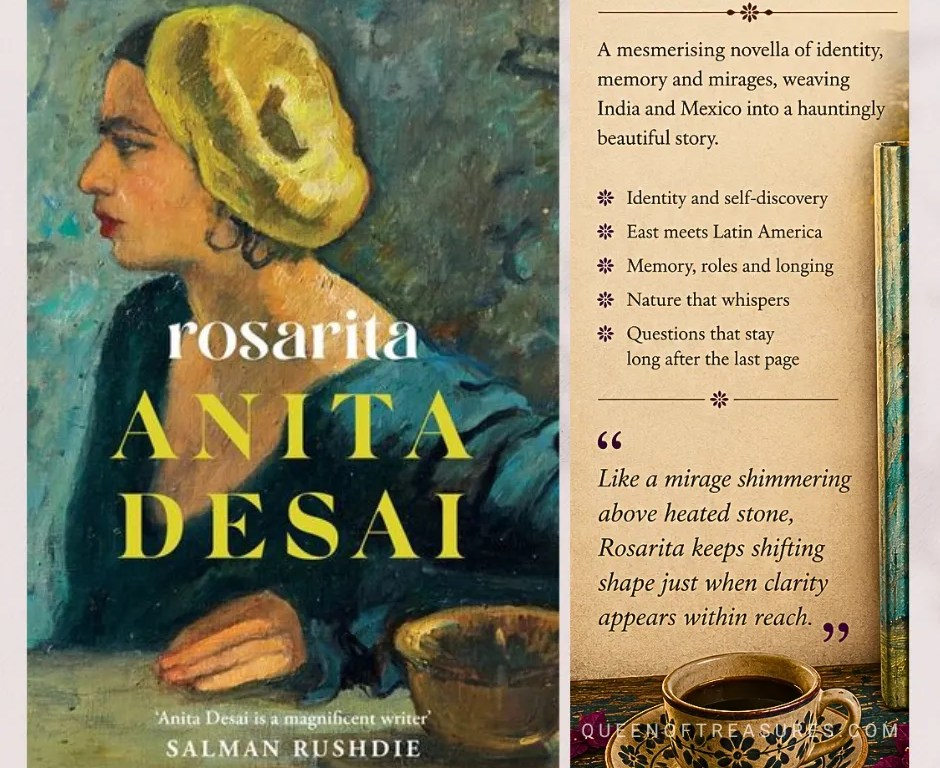
Through the “intricate wickerwork” of her prose, Anita Desai explores the dissolving boundaries of identity and memory as an Indian student in Mexico finds her past reimagined by a mysterious stranger.
Rosarita is my introduction to the acclaimed Anita Desai. Fascinated by the three-times Booker Prize-shortlisted author, I found this novella to be prose worth pondering: layered, elusive, and the kind of writing no algorithm can emulate.
While I am still trying to grasp the riddling thoughts behind this story, the uniquely descriptive framing is unmatchable. Desai weaves sentences like a master artisan crafting intricate wickerwork—complex for a novice, perhaps, but effortless in a master’s hand.
Rosarita follows Sarita (aka Bonita), an Indian girl who arrives in San Miguel, Mexico, to study Spanish. She spends her afternoons in the Jardín, where a colorfully dressed Mexican lady befriends her, claiming Bonita is the spitting image of her former artist-friend, Rosarita. And therefore, her daughter. Bonita remains skeptical of this claim, yet finds herself strangely unable to shrug the woman off.
Written in the second person, the story is a deceptively fluid read. It carries the weight of the world around Bonita alongside her secretive inner thoughts. The sky, the sounds, the flowers, the colours, the flora, the fauna, the daily grind—elements so enmeshed in our lives that we often cease to notice them—are captured by Desai like rhythmic ocean waves, knowing precisely when the tides must rise and retreat.
We travel between the daily grind in Mexico, abandoned artsy communes, ancestral homes, and seaside towns where life gains clarity through slowness. There are subtle bridges to the old-world homes of Old Delhi and the movement from village to modernity. Leaving behind the patriarchal home of her grandfather, Sarita arrives in Mexico searching for a newer self, shedding the old skins of her life in India.
Perhaps to free her from the weight of the past, the “Stranger”—later referred to as the “Trickster”—emerges as a bridge. Between speculative thoughts about her mother, doubts surrounding her travels, and the authoritarian structure of her upbringing, Bonita moves constantly between disbelief and belief until certainty itself begins to dissolve.
Like a mirage, Rosarita shifts shape just as clarity appears within reach. The interplay between an imagined Rosarita and a real Bonita is magnificently rendered. Maybe, Bonita does find a new identity, for Desai ends with, “You have come as far as you can, you tell yourself: You can go no further.”
Desai’s story is perhaps about the roles humans play and the lack of understanding that accompanies the many robes we wear through life. While their story may emerge from a fictional past the Mexican woman conjures, it forces us to ask why we rarely delve deeply into our own histories. Bonita’s fragile, unsettled mental state is visible within the shadows of her ancestral home and her final goodbye to all known relationships.
Much of the novella reveals inherent cultural similarities between Mexico and India: the values, the camaraderie, and the gruesome histories of the Partition and the Mexican Revolution. The warmth of student life and the process of claiming a new identity in a foreign land become the novella’s strongest themes.
For me, however, it is the natural world in Desai’s writing that casts the real spell. The novella drew my attention to Mexican species—grackles, iguanas, parrots, cactii and more—and the quiet role they play in everyday moments. Like a breeze, they flow in and out of the narrative unnoticed, until suddenly the entire emotional landscape comes to life with their presence.
Book Details
Publisher: Picador India (Pan MacMillan India)
Pages: 112
Price: INR 399
Available on Amazon
Ambica Gulati is a journalist and editor whose work explores global affairs, travel, environment, and the intuitive arts. From short stories to wellness mantras, she focuses on meaningful experiences in a complex world. She has authored books for children, a series of six books on Monuments of the World published by Om Books International.
From the Archives
If you enjoyed reading this, you may like to continue the journey


