
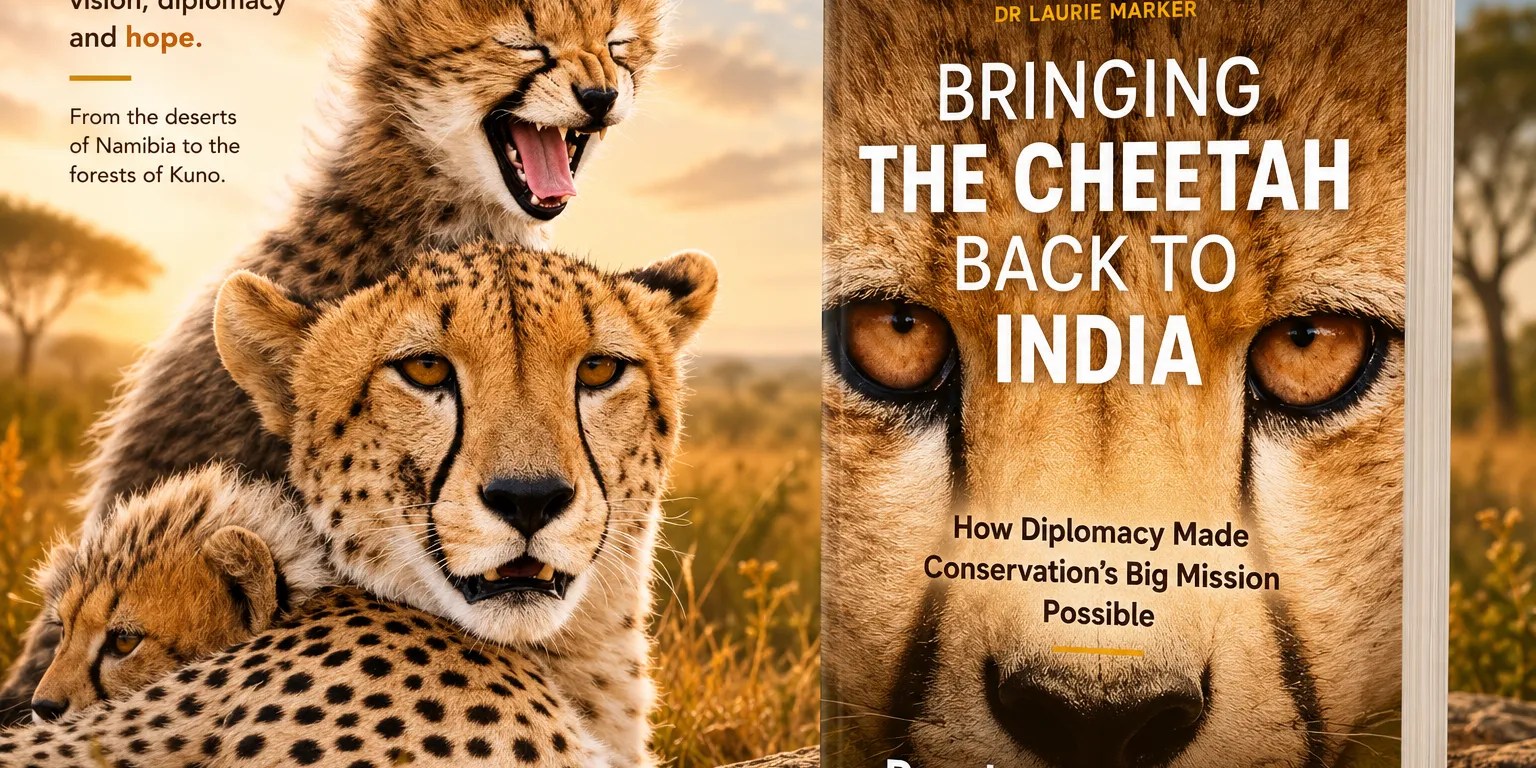
Prashant Agrawal’s Bringing the Cheetah Back to India is an unputdownable, insider look at Project Cheetah, transforming a complex diplomatic and ecological mission into a cinematic thriller.
…The cub was quickly hooked to an intravenous line, her vitals were taken, ticks were removed from her coat, and the treatment was begun. Her tiny emaciated frame, ravaged by viral infections, responded immediately to hydration and nutrition flowing into her body, providing much needed nourishment.
I knelt down and gently stroked her forehead. She looked at me, her enormous, innocent eyes that felt like an ocean of sadness, seemingly asking, ‘What about me? What about us? Can you humans save us, your fellow travellers on this planet?’…” (pages 102-103)
While this little cub never made the historic voyage from Namibia to the forests of Kuno, Madhya Pradesh, she holds a special place in author Prashant Agrawal’s heart. Watching the dedicated veterinarians at the Cheetah Conservation Fund (CCF) in Namibia work, his invisible connection to these spotted apex predators grew manifold. He named her Kaveri, after the life-giving river flowing through Karnataka and Tamil Nadu.
Leaving behind dry bureaucratic reports, Prashant Agrawal’s lyrical narrative turns ‘Project Cheetah’ into a cinematic thriller. From the beautiful sunsets of Namibia to electrifying safaris, interlaced with facts about these ‘supermodel felines’, this book has an unputdownable quality.
A Project Revived
For most of us, the cheetahs of Kuno have been mere headlines or touristy moments. But this book changes that—it brings them alive as we get to know their names, history, and genetics. I, for one, need a ‘meet and greet’ with them now, despite their deadly status as apex predators. As mentioned in the book, they are truly ‘Very Important Cats’.
The ambition to bring cheetahs back to the subcontinent had been in the offing for decades, yet it lay dormant. When Agrawal was appointed as India’s High Commissioner to Namibia in 2018, he was reminded of a historical proposal that had repeatedly run into dead ends. Namibia had previously declined the arrangement for its own internal reasons.
Back home, the Supreme Court of India had stayed the project since 2012. The Ministry of Environment had bypassed the National Board for Wildlife entirely; prominent biologists argued that African and Asiatic cheetahs were genetically distinct; and IUCN guidelines strictly warned against introducing exotic species into non-native habitats.
Agrawal had nothing to begin with. To complicate matters further, when the Supreme Court finally cleared the reintroduction framework in January 2020, the global COVID-19 pandemic arrived within weeks, grounding international negotiations before they could even take off.
What followed was a two-year chess match of diplomatic movement and administrative challenges. Agrawal narrates these dead ends and breakthroughs like a student treading examination halls.
The signing of the formal Memorandum of Understanding (MoU) on July 20, 2022—with External Affairs Minister S. Jaishankar and Environment Minister Bhupendra Yadav on one side, and Namibia’s Deputy Prime Minister and Foreign Minister Netumbo Nandi-Ndaitwah on the other—was merely the visible milestone. The real, grinding work occurred behind closed doors.
The Challenges to Project Cheetah
The target date was set for August 15, 2022: India’s 75th Independence Day. What stood between that historic date and the signed treaty was a mandatory 30-day biosecurity quarantine for every selected cheetah.
The selection process itself was a logistical nightmare: one shortlisted animal suddenly died, another was found to be pregnant, and last-minute replacements had to be sourced, tested, and cleared under extreme pressure.
The final cheetah on the list completed its isolation on September 16, 2022. The eight chosen cheetahs arrived on Indian soil the morning of September 17.
Why the Cheetah Matters to India
Like a master storyteller, the author narrates why the cheetah is ecologically vital for India. The cheetah went officially extinct in India in 1952; bringing them back is a powerful act to undo the colonial legacy of rampant, indiscriminate trophy hunting.
The loss of an apex predator invariably causes cascading degradation through every trophic level beneath it in the food chain. By conserving the vast open ranges necessary for a large carnivore, an entire suite of threatened grassland biodiversity is saved from encroachment. These are the very same landscapes that support the elusive caracal, the Indian wolf, and critically endangered avian species like the Lesser Florican and the Great Indian Bustard—animals whose survival depends entirely on the protected grasslands that Project Cheetah demands into existence.
Agrawal skillfully establishes that the mission was scientifically designed from its inception, rather than politically improvised. Kuno was selected not merely for its prey base, but for the deliberate absence of resident tigers. The presence of another dominant big cat during the initial acclimatization phase would have risked severe territorial mortalities. Furthermore, the cheetahs themselves were selected based on criteria that balanced wild instincts with human tolerance—choosing animals accustomed to the sight of tracking vehicles so they would not panic, yet retaining their wild hunting capabilities intact.
Some critics maintained that African and Asiatic cheetahs were too genetically distinct, rendering Namibian animals ill-suited for Indian landscapes. However, Agrawal highlights what global cheetah geneticists have long established: Acinonyx jubatus is among the least genetically diverse mammals on earth. Due to an ancient evolutionary bottleneck, all cheetah subspecies are so closely linked that genetic variations carry far less biological weight than critics implied.
The Friction of One Vantage Point
The book is honest about challenges. Agrawal writes with controlled, palpable frustration about the international administrative machinery—how an endless disagreement over a single clause in a legal document could stall weeks of field progress, and how months of delicate diplomacy could be instantly undone by the apathy of a distant bureaucrat.
Despite the extensive accounts of the events unfolding in Namibia—a memoir written from Windhoek—the details of simultaneous developments in New Delhi are not as prominently featured. The details of the negotiations with South Africa, which secured the second major cohort of cheetahs in 2023, are also a notable gap.
For me, these didn’t matter, as Agrawal’s storytelling—interwoven with life in Namibia, the information on CCF’s activities, and experiential situations—kept me hooked. With him, I experienced the project’s erratic rhythms: the frantic months of progress contrasted against the agonizing weeks when a single word brought everything to a standstill, the bottlenecks at the airport, and the palpable tension of seeing the cats caged for 27 hours before being released into the special bomas of Kuno.
The book is praiseworthy for pulling back the curtain on the exhausting realities of negotiation, policy formulation, and the profound biological insights required to manage these magnificent predators.
Cheetahs in Motion
Three years down the line, as of mid-2026, India’s cheetah population has stabilized at 53 individuals, of which 33 were born on Indian soil. Out of 49 cubs born since the initial translocation, 33 have survived to adolescence—marking one of the highest survival rates in the world for comparable large-carnivore reintroduction projects. A resilient second generation has officially transitioned our “non-resident” cheetahs into true natives.
What I feel like doing right now is booking my tickets to meet these Very Important Cats. Bringing the Cheetah Back to India reminds us that the cheetah is far more than a tourist’s momentary thrill or a spectacle of speed. It is the return of the prodigal cat, a testament to what can happen when human will aligns with ecological necessity.
Project at a Glance
| Aspect | Highlights & Perspectives |
|---|---|
| Diplomacy | High-level statecraft with Namibia and South Africa; navigating CITES and international sovereign biosecurity frameworks. |
| Conservation | The first transcontinental translocation of a large carnivore in global history. |
| Leadership | Driven by a centralized political vision and long-term institutional backing. |
| Narrative Style | A blend of policy record and personal memoir; structured yet highly evocative. |
| Target Audience | Diplomats, conservation scholars, general readers who appreciate a good story. |
Book Details
- Title: Bringing the Cheetah Back to India: How Diplomacy Made Conservation’s Big Mission Possible
- Author: Prashant Agrawal (India’s former High Commissioner to Namibia)
- Publisher: Hachette India
- Length: 224 pages
- Price: INR 599
Ambica Gulati is a journalist and editor whose work explores global affairs, travel, environment, and the intuitive arts. From short stories to wellness mantras, she focuses on meaningful experiences in a complex world. She has authored books for children, a series of six books on Monuments of the World published by Om Books International.
From the Archives
If you enjoyed reading this, you may like to continue the journey


A nice, detailed review. Good to know about the transcontinental translocation of the cheetah. This is new information for me. May its tribe increase.
LikeLiked by 1 person
Yeah, the long process and the involvement of multiple agencies was quite a task. The book reads more like a novel and is very nicely written.
LikeLike
Fascinating essay/review. Do you think the book in question will find a sizable audience?
Neil S.
LikeLike