
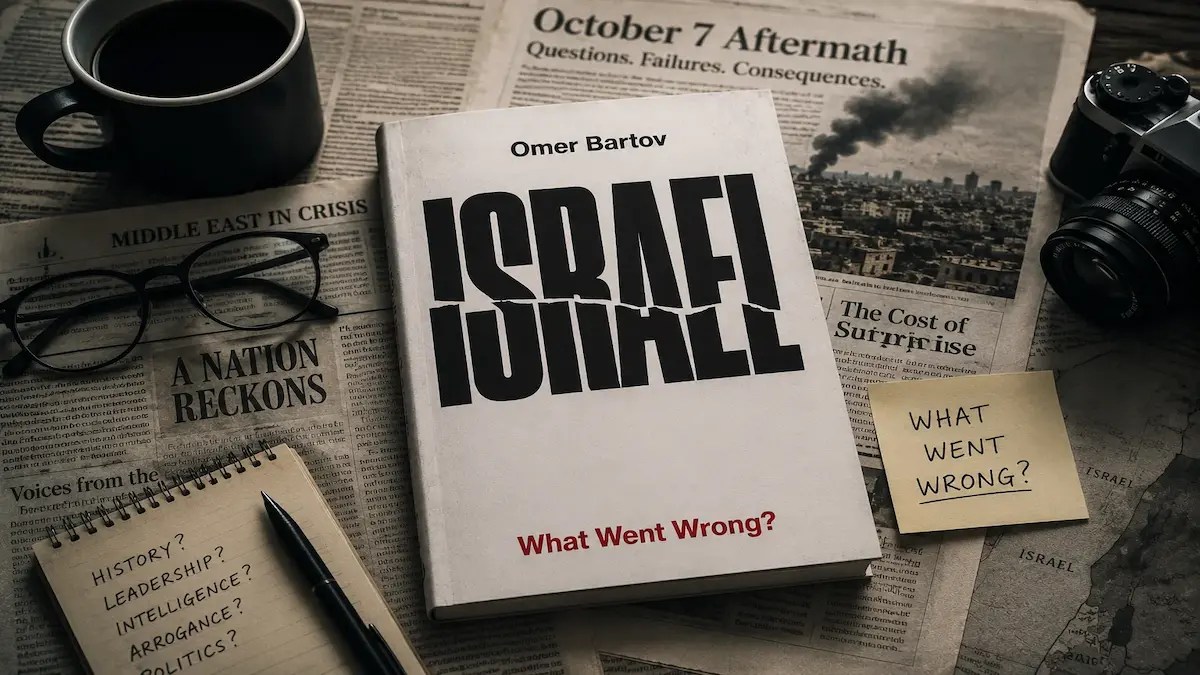
In Israel: What Went Wrong?, renowned genocide scholar Omer Bartov delivers a searing, deeply personal critique of how Israel’s fixation on its historical trauma transformed a vision of Jewish liberation into a devastating ethno-nationalist crisis.
What happens when a nation wears its past too long? It risks becoming a ghost, haunting the present instead of growing into a better version of itself.
In his intensely personal book, Israel: What Went Wrong?, genocide scholar Omer Bartov explores the moral and political crisis gripping his homeland. He reveals the peril of living beneath a historical shroud that blinds both heart and head, leading a nation down a forsaken path.
Coming from a writer whose family endured the tragedies of the Holocaust and believed in the early promise of Zionism, the book offers a vital, though painful, education. Undeterred and unsparing, Bartov – currently the Dean’s Professor of Holocaust and Genocide Studies at Brown University – takes us back to the beginning. He recalls the aftermath of the Second World War, when the international community, shaken by the unthinkable atrocities inflicted upon European Jewry, supported the creation of Israel. At its inception, the state was widely viewed as a form of global redemption and a necessary sanctuary.
Yet Bartov argues that, by anchoring its identity so deeply in past trauma, Israel gradually transformed Zionism from a movement of Jewish self-emancipation into a rigid ethno-nationalist state ideology.
The tragic irony, as he shows, is that a nation founded in the shadow of catastrophe has arrived at a point where it stands credibly accused of war crimes and of the “genocidal annihilation” of Palestinian life in Gaza following the horrific Hamas attacks of October 7, 2023.
Bartov’s account is not that of a distant academic but of a true insider. Born on an egalitarian kibbutz and raised in Tel Aviv, he served as an officer in the Israel Defense Forces during the Yom Kippur War of 1973.
As a renowned expert on the German Army and on modern mass violence, he frequently draws parallels to historical patterns of state radicalization. He reminds us how the Nazi regime progressively indoctrinated a generation, contrasting that history with modern Germany’s formal apologies for colonial crimes and its postwar effort to rebuild itself as a peaceful, democratic partner.
For the lay reader, Israel: What Went Wrong? offers an accessible yet devastating account of structural decay. Bartov highlights critical historical turning points, including the state’s failure to draft a formal constitution that would have legally safeguarded its Palestinian minority citizens. He traces how decades of occupation and militarization paved the way for the current political climate.
Under the hardline leadership of Prime Minister Benjamin Netanyahu and his extremist coalition partners, this deep-seated radicalization found room to unfold with near-total impunity. A shocking revelation is the fact that Netanyahu funded the Hamas via Qatar.
Bartov does not spare the international community. He argues that Israel’s allies, particularly the United States, acted far too late, offering unconditional diplomatic and military cover while Gaza was systematically devastated. He shows how entrenched political regimes become consumed by preserving their own power, obscuring the human rights of ordinary people in the process.
Ultimately, Israel: What Went Wrong? is a warning. Healthy societies must retain the capacity to question their leaders and demand a justice that applies to all humanity rather than to a single community.
The book’s most chilling revelation lies in the mindset of the younger generation. Bartov recounts a deeply unsettling moment from his lectures, when Israeli students justified the destruction of Gaza – a stark indication of how deeply the shroud of history has blinded the future.
Bartov’s grief at the inhumane attitude stands out as he describes a scene of normal life in Tel Aviv, where the public is living without a thought to the atrocities people are undergoing in Gaza. The principle of eye for an eye, the loss of compassion and a veil of impenetrable iron has a jostling effect.
However, he does emphasise that Germany can provide a long-term solution as the country has changed its narrative, giving the younger generation a new mentality and better society, acknowledging the ill deeds of its forefathers.
For those who value a just society, civil liberties, and human dignity in every corner of the world, this book is a bible of vigilance – a reminder of how sanity is preserved when power is questioned before it hardens into impunity.
Question, question, question – until power is checked, and never stop questioning.
Book Details
Publisher: Fern Press (Penguin UK)
Language: English
Pages: 256
Price: INR 999
Ambica Gulati wears many hats: independent journalist, editor, multimedia storyteller, author and fiction writer. Her work moves between global affairs, conscious travel, the environment, culture and the intuitive arts, while her fiction explores the territories where nature, memory, mystery and imagination converge.
Beyond the laptop, she nourishes her creative practice through meditation, birding, reading, journaling, oracle cards, and yoga.
She is available for reported features, interviews, analysis, profiles and multimedia stories on international affairs, India and beyond.
From the Archives
If you enjoyed reading this, you may like to continue the journey


“Healthy societies must retain the capacity to question their leaders and demand a justice that applies to all humanity rather than to a single community.” Applicable to many countries now, including India.
You’ve aroused my interest in this book.
LikeLiked by 1 person
It’s a good read, giving all sides of the story, including the author’s personal views. And looking for peace and empathy rather than ‘eye for an eye’ formula.
LikeLike