
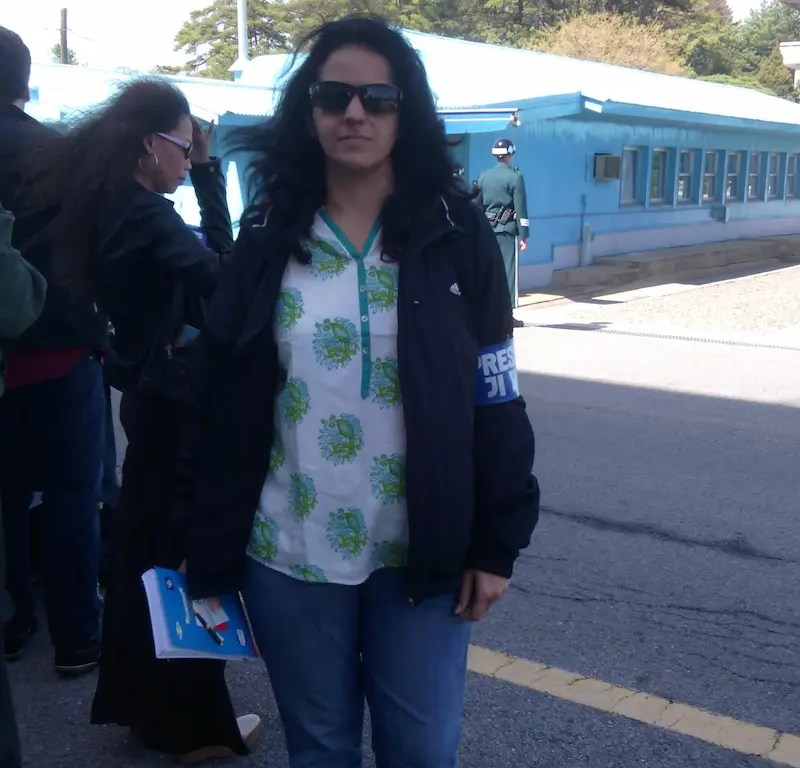
A decade after visiting the Korean Demilitarized Zone, I still think about its watchtowers, divided villages and the strange paradox of a landscape where nature thrives in the shadow of war.
Archives are everywhere, inside our minds, inside our memory zones. Some places keep jolting you time and again, like the Demilitarized Zone (DMZ). Even after a decade, I think about it often.
Among the world’s most guarded no man’s land, it is now occupied by the joint armed forces and rare species.
Established in 1953 after the Korean War Armistice, the 250km-long Demilitarized Zone (DMZ) serves as a buffer between North and South Korea. While it remains a site of high geopolitical tension, the absence of widespread human interference has also made it an important ecological refuge.
Watching CIA on Amazon Prime Video, with its episode on North–South Korean spies, abductions and betrayals, brought back that sense of déjà vu. I replayed my 2015 trip to the DMZ.
My trip wasn’t about wars, but about seeing the results of war, ravaged by time and, in places, reclaimed by Nature. I saw the location, but I didn’t get to see the flora and fauna. I guess that’s why it replays again and again in my head.
Invited by the Journalists Association of Korea, we were a large group of 80 journalists. Some had been to North Korea, leaving me awestruck and making me wonder what it felt like to cover such a closed society.
Unlike my trip to the Wagah border in Amritsar, where India and Pakistan stand just a few steps away and there is the familiar spectacle of the Change of Guard ceremony, this border was under strict vigil. There was no cultural mingling here, no easy crossing from one side to the other.
The war had left deep wounds, the people had donated their gold and other valuables to the government for the war, my guide informed.
History tends to soften the pain, but the scars remain. And this trip was all about understanding those scars. It was about the politics and policies of countries sharing roots but divided at heart.
The Road to the DMZ
The road from Seoul to the DMZ is all barbed wire, special permits and discipline. The long road, interspersed with watchtowers, can be an intimidating sight for a lone traveller, but we were travelling in several buses.
The paradox is that while the DMZ is claimed to be a divider, it isn’t peaceful. It is always under vigil. I would say it is among the most closely watched places on earth, where peace is alive for Nature alone.
The approximately 4km-wide dividing zone and its surrounding areas have become a refuge for wildlife, including rare and endangered species. I have not stepped there, but I read about it on Earth.org.
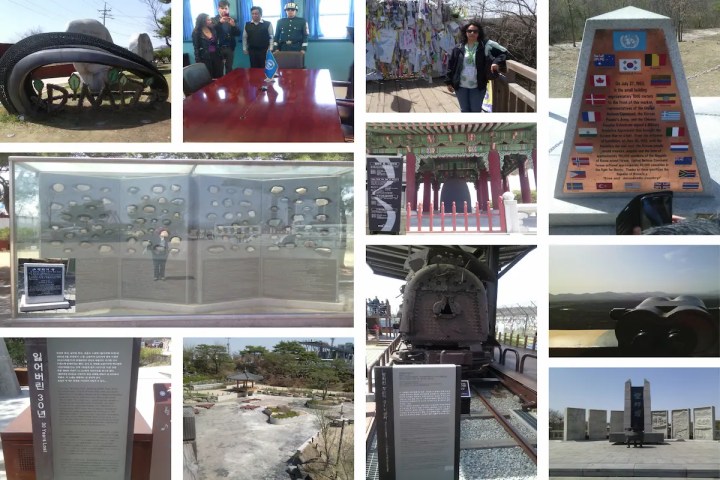
After a brief stop at Jangdan Station, inside the Imjingak tourist area near the South Korean border, we took in the sight of the shelled train, the peace bell, the peace wall of stones, the bridge of ribbons and the souvenirs.
Then we found ourselves at the briefing centre. Here, the United Nations Command and the Korean People’s Army work in unison.
From there, we moved to the observatory, where guards study each other through telescopes.
Our instructions were simple: do not step out of the bus, do not make eye contact.
It was ironic and exciting, adventurous to some extent.
Even the names of the villages on either side, associated with freedom and peace, felt ironic. Daeseong-dong, also called Taesung-dong or Freedom Village is in South Korea. Kijong-dong, officially called Peace Village, sits on the North Korean side.
There are strict protocols governing life in the South Korean village near the border. Residents require permission and follow particular rules to move in and out, and life there comes with both privileges and restrictions.
It was impossible not to think of the India–Pakistan border as I peeked at the North Korean side through the huge telescopes. There is no cultural mingling here. All that remains is distance: political, emotional and generational.
The idea of reunification lingers, but sometimes it feels more like a figment of imagination.
Would Korea Ever Be One Again?
It made me wonder about reunification, like the fall of the Berlin Wall. Would that ever happen? Would the DMZ one day simply become one stretch of land?
The DMZ remains in my memory not because of the military presence alone, but because of its contradictions.
Here is a land divided by war, guarded by soldiers and watched through telescopes. Yet, in the spaces where human movement has been restricted, Nature has quietly found room to survive.
As a journalist, I have also covered South Korea for Deccan Chronicle and The Patriot, writing about the country’s culture, diplomacy and transformation.
How to Reach the DMZ
Reaching the Korean Demilitarized Zone is not a casual outing. Access depends on the area you plan to visit and the security situation at the time.
Start from Seoul
Most DMZ visits begin in Seoul. It is roughly 50–60 km north.
Join an Authorised Tour
Access to several parts of the DMZ is controlled, and visitors may need to travel with an authorised tour operator. Tours typically handle transport, documentation checks and access procedures.
Common Places Included in DMZ Visits
Imjingak Park
A starting point for many visitors, with monuments, the Freedom Bridge and other reminders of Korea’s division.
Dora Observatory
On clear days, visitors can look across into North Korean territory.
The Third Tunnel
A tunnel discovered beneath the border area and included in some DMZ itineraries.
Panmunjom / the Joint Security Area (JSA)
One of the most recognisable sites connected with the Korean division. Access and tours can change according to security conditions.
What You Will Need
- Passport
- Advance booking
- To follow security and photography rules
- To remain with your designated group
There are restrictions: You cannot wander off, and photography may be limited in certain areas.
How Long Does a Visit Take?
Depending on the itinerary, visits from Seoul can range from a half-day trip to a longer full-day excursion. Access to particular locations may change, so it is always best to check current conditions before planning a visit.
You can read more about the DMZ in the U.S. Department of State Archive.
Ambica Gulati wears many hats: independent journalist, editor, multimedia storyteller, and author. Her work explores global affairs, conscious travel, the environment, culture, and the intuitive arts. Beyond the laptop, she nourishes her creative practice through meditation, birding, reading, journaling, oracle cards, and yoga.
From the Archives
If you enjoyed discovering DMZ, you may like to continue the journey.


3 thoughts on “The Korean DMZ: Inside the World’s Most Silent Border”