

AI will write a high-school essay by 2026, drive a truck by 2027, work in retail by 2031, write a bestselling novel by 2049, and work as a surgeon by 2053, predicts a June 2017 survey done by a team from University of Oxford and Yale University. (Page 45)
If you are a science geek, then this will raise your adrenaline. But if you are layman like me, then this will probably make you feel like Tom Cruise in Mission Impossible: Dead Reckoning (Part I). The world is under threat from AI and we must stop it overtaking our lives and turning humans into robots.
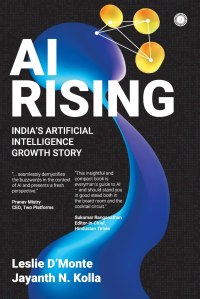
For the novice, Artificial Intelligence (AI) is like magic, somewhat eerie and a technology that is seen in movies. However, AI is a lot of hard work, research and vision, backed by accurate data and analytics. AI Rising: India’s Artificial Intelligence Growth is a layman’s guide to AI. This technology has changed the way ‘we live, work and play’.
While all of us use AI, I am not sure how many know what goes on behind the scenes. I was shaken when I saw the movie The Social Network (2010) on Netflix. It was scary to have a machine walk into your inner world, know everything about you and then turn is upside down to use it for profits.
Well, this book explains a lot of what goes into the world of AI in a simple language. Co-author Leslie D’Monte is a part of the Mint (Hindustan Times product) editorial leadership and presents the AI story in a clear manner. Jayanth N. Kolla is a technocrat and founder of Convergence Catalyst, a digital technologies research and consulting firm.
The duo plunges us headlong into the dynamics of AI, introducing us to the history, the evolvement, the godfathers, the incubation labs, the companies and the uses. They traverse the path across the globe, talking about the West, China and India’s potential. The book is also interspersed with infographics.
You might like to know about my experiments with ChatGPT.
There are pros and cons and the numbers are staggering. You get to know it all, if you read it at a slow pace. Large companies, small companies, everyone wants to tap into this potential which can help India reach the ambitious aim of becoming a $5 trillion economy.
Let’s begin with the pros: AI is a technology that is used to make work simpler and faster. It has shown good results in sectors such as education, agriculture, healthcare, banking and financial services. It was the reason that the world did not come to standstill during COVID-19. It helped people stay connected, bring in information needed at that time. It has helped with new technologies such as Magnetic Resonance Imaging (MRI), diabetic retinopathy. Drones are used to assess and deliver aid to the remotest corners.
In the education sector, it has been instrumental in connecting remotely located students with digital books in multilingual formats. It has helped in predicting weather and aided farmers in making the right choices when sowing seeds. I have seen this with ICRISAT in Andhra Pradesh, the NGO authors also mention in the book. It has helped in disaster management as well, predicting floods and storms.
AI has helped the unbanked or underbanked people secure loans as it studies their social media, bill payment patterns and more to check their viability. It has helped small farmers and vendors garner loans to tide over bad times. UPI has been a game changer in digital payments.
Now, the cons: Companies are collecting data to study spending patterns and diving deep into the person’s life, thereby invading privacy. There are sites and apps that generate illegitimate content such as porn photos, avatars of celebrities, wrong chats. There is a new world of unregulated cryptocurrencies. Biased algorithms cut down the grades of students in the UK, leading to protests.
India’s remote and rural population is unable to benefit on a large scale as data collection is not done in a systematic manner. This widens the gap between urban and rural areas, with the urban population being at an advantage.
Robots replacing humans and AI softwares replacing jobs of people in research, content creation, photography, assembly lines and more is a potential threat for a country like India where the large population is dependent on these for livelihood.
Then the case of self-driven cars which are being manufactured by Tesla, Google and others firms. There have accidents by self-driven cars, which again need a new policy framework. The authors have cited the case of where the avatar of a woman was raped in Metaverse, Chat bots which started conversing in their own language with each other, maligning tweets by the AI.
The authors talk about all this, the global scenario and the potential India has. China leads the way with super apps and a primarily mobile-friendly populace. India with its diversity, multiple languages, inaccessibility to internet in many parts, lack of smartphones and more does have its work cut out.
Organisations such as IBM, Microsoft, Google, Meta, Amazon and others have been instrumental in taking AI to the next level. The authors touch upon the research, unicorns in India, and how companies in India such as Reliance, Adani Group are working on creating AI empires.
So, do we need to be suspicious of AI? All through the book, the authors have mentioned the role of NITI Ayog and highlighted the need for stringent policies and regulations so that AI does not cause potential harm, but works for the intended good. The perils of AI led Pope Francis, head of the Roman Catholic Church, to pray that “the progress of robotics and AI may serve humankind”. AI isn’t God, though it does seem to be attaining a god-like status. It is a collection of data, codes and computer language that is being optimised for ease.
I did see a good part such as robots cleaning manholes in Indore, saving human lives from danger. And the people employed were safai karmacharis or cleaning staff, trained by the firm Kerala-based Genrobotics.
Maybe we need to view it as a helping hand, much like Irona, the robot maid, that we saw in Richie Rich comics series by Harvey Comics.
As the authors say, read the book to form your own opinions and most of us might not see the predictions turning into reality, as AI needs much more work than we anticipate. You will surely gain insights into the technology era we live in and the AI-verse or Planet AI in creation.
Book Details
Publisher: Jaico Publishing House
Language: English
Paperback: 272 pages
Price: Rs 599 (Kindle edition available)
This review is powered by Writersmelon

 Queen of Treasures
5 thoughts on “Book Review: AI Rising: India’s Artificial Intelligence Growth Story by Leslie D’Monte and Jayanth N Kolla ”