
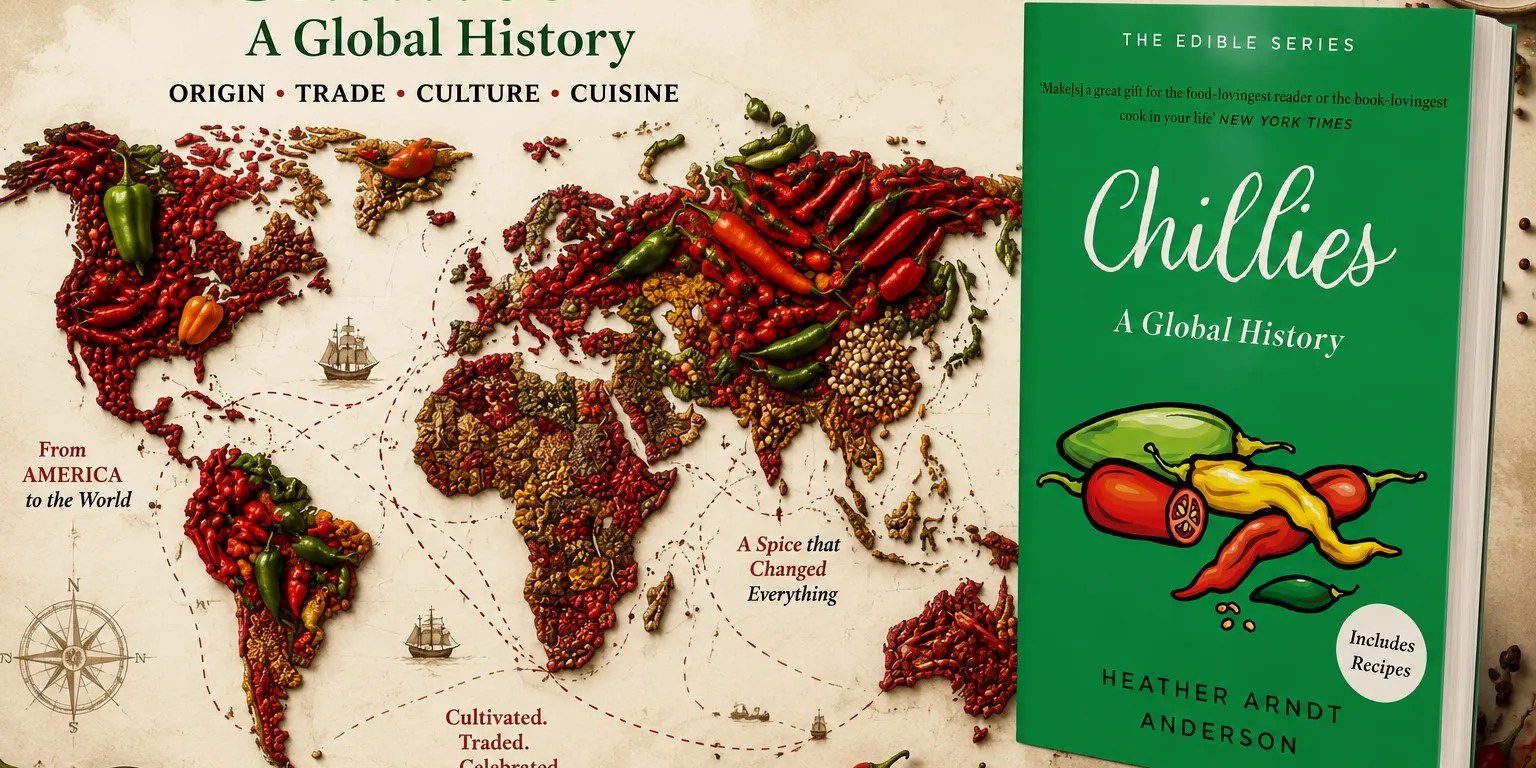
From ancient Mesoamerican mythologies to modern subcontinent kitchens, this is the story of how a single spice mapped global taste.
A few years back, while walking through a field of green chillies as a farmer explained the intricacies of the yield, I would never have imagined that this ubiquitous ingredient travelled all the way from Mesoamerica. Looking back, no one had ever mentioned to me that this fiery spice has roots on the other side of the world.
Interspersed with photographs and references to archival cookbooks, Chillies: A Global History by Heather Arndt Anderson is an eye-opening spice trail.
Sun Gods and Sacred Worms: The Lore of the Pod
The book begins with a fabulous Native American folklore of how the Sun fell in love with an Earth girl. He kidnapped her, and when her father tried to save her, the sneaky Sun filled the father’s blowgun with chilli pepper. And therein begins the use of pepper sprays for beating the enemy!
The book is an accessible, engaging read, mixing taxonomy, ecology, myth, trade routes, cultural evolution, and ultimately, global embrace. The chilli’s journey is quite a hot trail.
The chilli, as we know it today, rewrote global trade routes, reshaped botanical landscapes, and recalibrated human tolerance. Because ancient civilizations universally worshipped nature, the chilli was no different; in its native Central and South America, it was a sacred tool of spiritual veneration. In the section ‘Myths and Legends’, the author notes: “The Tupi people of the Amazon believe that after death, two giant worms consume the stomach and the entrails of the soul… and then a god called Patobkia administers chilli juice to the spirit’s eyes, restoring its sight and granting it entry into the afterlife.”
Another fascinating tale reveals the Incas revering the chilli as the deity Ayar Uchu, or “the peppery one,” who is hailed as a primary ancestor of the Incan civilization.
The Democratic Traveler: Navigating the Silk Routes
The author’s research shows that on Columbus’s second voyage to the New World, the journalist and physician Diego Álvarez Chanca noted that the native people ate a bread made with fish, seasoned extensively with chillies.
Over time, numerous writers recorded the versatile use of chillies across Mesoamerica. Eventually, they reached different corners of the world via the maritime Silk Route, navigated across continents by Spanish and Portuguese traders.
Like most things, the chilli too faced rejection in Europe, but later it was genetically transformed to milder forms.
Unlike more exotic, heavily monopolized spices, the chilli became a democratic ingredient. It was readily grown in home gardens and small agricultural patches alike.
Today, countless varieties span the globe—some mildly peppery, others intensely hot, some used liberally as staples, and others strictly for seasoning. Through these shifting corridors, different flavors met different palates, and chillies became deeply integrated into Asian, African, and European cuisines.
Capsaicin as a Catalyst
Anderson explores capsaicin—the chemical anomaly responsible for the heat—not just as a plant defense mechanism, but as a catalyst. The book delves into the dual nature of the ingredient: its ancient role as a healing agent capable of preserving food and treating ailments, contrasted against its modern cultural evolution, where it is subjected to intense hybrid cultivation.
Tracing its passage to India, the author notes how the subcontinent’s famous bhut jolokia and traditional pickles form an important part of the global chilli heritage. Arriving on Indian shores through Portuguese explorers and traders, the hot and fiery spice found a permanent home. Today, it exists in multiple forms across Indian kitchens and markets: powders, pickles, dried pods, pastes, and sauces.
The Unwritten Recipes of the Subcontinent
The final chapter is devoted to historical and contemporary recipes from across the globe. Yet, while Europeans often favour milder profiles, and India’s pickles and curries are famously hot, many of those intense regional recipes didn’t make it into this list.
Overall, Chillies: A Global History reveals how our most guarded culinary traditions are actually born from cross-cultural collisions and ancient trade corridors. The book serves as a worthy introduction to how a foreign botanical element became an indispensable household staple—and perhaps, a reminder of the history growing in your own garden today.
About Heather Arndt Anderson
Heather Arndt Anderson is a Portland, Oregon-based food writer, culinary historian, and botanist, as well as a regular panelist on the podcast The Four Top. She is the author of Breakfast: A History and Portland: A Food Biography.
Book Details
Publisher :Pan Macmillan
Language : English
Pages:
Price: INR 599
Available on Amazon
Ambica Gulati is a journalist and editor whose work explores global affairs, travel, environment, and the intuitive arts. From short stories to wellness mantras, she focuses on meaningful experiences in a complex world. She has authored books for children, a series of six books on Monuments of the World published by Om Books International.
From the Archives
If you enjoyed reading this, you may like to continue the journey
- Bradley J. Borougerdi’s Cannabis: From Shiva’s Elixir to Global Commodity
- Desi Delicacies: Food Writing from Muslim South Asia
- Nashik Travel Guide: Wine, Food, Art & Artillery Museum


Looks like an interesting read
LikeLiked by 1 person
Yes, these edible series trace the ingredients well, though more for a western audience.
LikeLike