
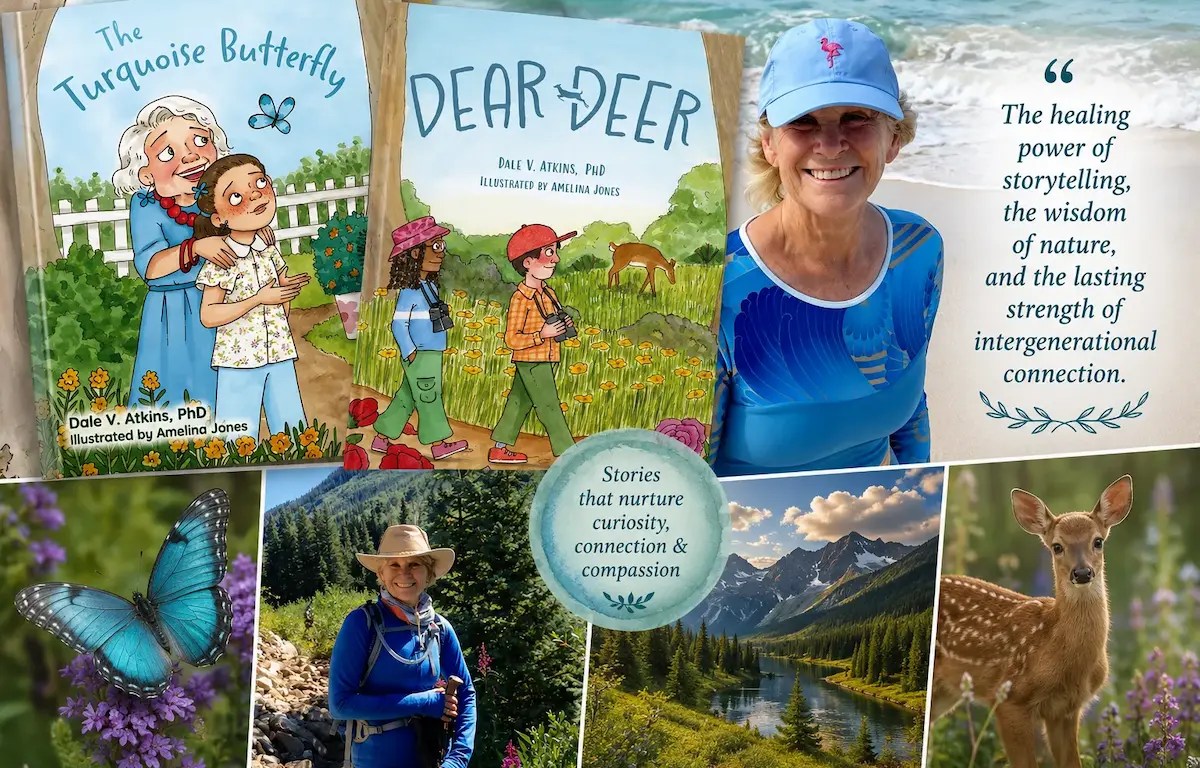
In this conversation, psychologist and author Dr. Dale Atkins discusses grandparents, nature, children’s wellbeing, screen culture, storytelling, and the future of illustrated books.
I could never imagine a time when illustrated books would become a rarity. Like most Gen Xers, I was obsessed with stories that came alive through artistic illustrations. Screens and digital graphics may have changed that storybook world, but art has a life of its own because it is your deepest creative instinct.
Discovering Dr Dale Atkins’ books was like reclaiming a piece of my childhood. Her thoughtfully crafted books, focused on connecting children with their roots, ancestors, grandparents and, above all, Nature, are a delightful addition to any child’s library, and perhaps adults’ too.
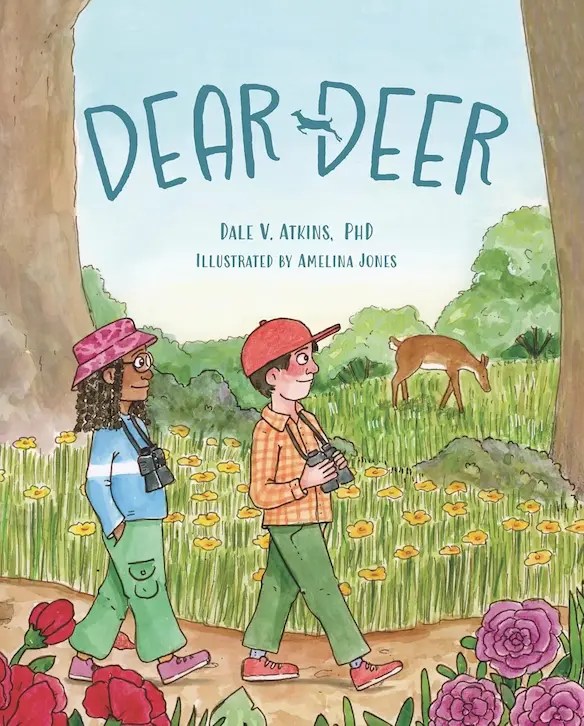
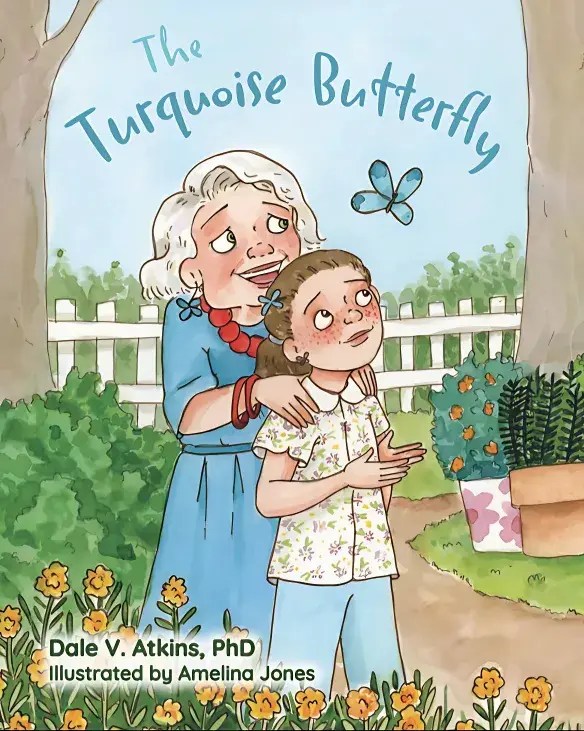
I’ve read two of her books, The Turquoise Butterfly and Dear Deer. Charmingly illustrated by Amelina Jones, these books highlight the web of life, and promote harmonious relationships (books are available on Amazon).
The Turquoise Butterfly made me wistfully look back at my childhood and the regretful fact: I never knew my grandparents, nor experienced their loving influence.
Dear Deer is a reminder that we are inseparable from Nature. Over the last few years, I have rediscovered my love for Nature. Written in the form of a letter, the book celebrates the colours, scents, sounds, beauty, and quiet healing power that we have forgotten to tap into. Both these books stem from Dr Atkins’ personal experiences.
A licensed psychologist, educator, storyteller and nature enthusiast with more than 40 years of experience focusing on families, wellness, managing stress, and living a balanced, meaningful life, Dr Dale Atkins has a private psychology practice in New York City. A resident of Connecticut, Dr Atkins’ work reflects her belief in the healing power of storytelling, the wisdom of nature, and the lasting strength of intergenerational connection.
In Conversation With Dr Dale Atkins
- In India and most ancient cultures, grandparents are normally associated with stars. How did you come up with the idea of connecting a turquoise butterfly with a grandparent?
While some cultures look to the stars, the moon, specific birds, or unique animals to remember their ancestors, for Grandma Sylvia’s family, that eternal bond lives on the wings of a turquoise butterfly.
The character of Grandma Sylvia is directly inspired by my late mother, for whom the butterfly held profound personal significance. She loved these creatures during her lifetime.
Whenever a butterfly appears, whether fluttering through a garden or catching our eye in an image, her children, grandchildren, and great-grandchildren feel her immediate presence. It is a living, breathing connection to her memory.
While writing this book, I discovered that our family’s experience is far from unique. Across diverse cultures, the butterfly is one of the most widely recognized symbols for loved ones who have died. This connection is deeply rooted in the creature’s biological journey. The butterfly undergoes radical metamorphosis. It serves as a perfect metaphor for:
• Transition and Transformation: Moving from one state of being to another.
• Struggle and Renewal: Overcoming the confinement of the chrysalis to find new life.
• Endurance of Hope: Believing in beauty after a period of darkness.
Ultimately, the turquoise butterfly represents the endurance of the human spirit. It embodies the comforting idea that love does not vanish when life ends; instead, it simply changes shape, existing energetically in the world around us. This provides a profound source of comfort for anyone seeking an eternal connection to those they have lost.
2. In a city-centric world, wildlife is reduced to boundaries. How can adults keep their children in sync with Nature, when they too are losing their connection with the natural world?
Nature is not a luxury for children. It is part of healthy human development. Even in highly urban places across India, the United States, Europe, and elsewhere, children need regular contact with the natural world to support emotional well-being, curiosity, focus, resilience, and a sense of wonder.
The challenge today is that both children and adults are increasingly disconnected from nature because of screens, indoor lifestyles, limited green space, and busy schedules. Children do not need wilderness to feel connected to nature.
Small, repeated experiences matter deeply. Especially in communities where children may carry stress early and often, nature can offer moments of restoration that are both simple and profound.
In urban settings, we can create small rituals around nature. Children remember rituals. Even brief, predictable experiences create emotional security and deepen attention.
Families everywhere can create simple nature rituals:
• Walk in a local park or neighbourhood regularly
• Watch the same tree change through the seasons
• Grow herbs or flowers on a balcony or windowsill
• Feed birds or notice butterflies and bees
• Look at the moon together each evening
• Collect leaves, stones, or seed pods
• Keep a simple weather or nature journal
• Simply observe pigeons, squirrels, insects, clouds, rain, and changing skies
Establish and/or visit:
• Community gardens
• Rooftop gardens
• Botanical gardens
• Urban parks and waterfronts
• Farmers markets
• Nature centres
Perhaps most importantly, children connect to nature when adults do. Curiosity is contagious.
Instead of saying, “Go outside,” we can accompany them and use language that invites discovery:
“What birds do you hear?”
“What changed since last week?”
“I wonder what lives under this rock?”
One of the greatest gifts nature offers children is freedom from constant performance and overstimulation.
3. Even during the holidays, children remain indoors, sometimes due to the heat, other times due to designated activities. What are the trends in America regarding children’s outdoor time?
In the United States, research suggests screen time has increased significantly, while free outdoor play has decreased. Safety concerns, academic pressure, busy schedules, and digital entertainment all contribute to this shift.
Many parents today, wherever they live in the world, keep children highly scheduled with lessons, tutoring, camps, and indoor entertainment. While these activities can be valuable, children must have unstructured time outdoors for healthy emotional and physical development.
However, there is a growing movement among parents, schools, pediatricians, and mental health professionals encouraging more outdoor learning, nature play, gardening, hiking, camping, and “green time” to balance excessive screen exposure.
Nature supports attention, creativity, resilience, emotional regulation, and a sense of wonder that cannot be fully replicated on screens or indoors.
For many children growing up in cities, especially inner-city neighbourhoods where green space may be limited and daily stressors can be high, regular connection with nature is not simply a pleasant activity. It can be restorative, regulating, empowering, and deeply healing.
Richard Louv, the American journalist and author who coined the term “nature-deficit disorder,” described how excessive indoor living and screen-centred lifestyles may contribute to stress, anxiety, reduced attention, diminished creativity, and emotional disconnection in children.
Jonathan Haidt, American social psychologist and author, emphasizes that children need more real-world play, independence, movement, manageable risk, face-to-face interaction, and less constant digital stimulation.
These researchers remind parents that children do not thrive through screens, schedules, and constant performance alone. Children need opportunities to explore, imagine, move freely, engage their senses, tolerate uncertainty, and experience wonder. Nature helps provide all of this in ways that are deeply restorative and developmentally essential.
Even in cities, small rituals matter. A balcony garden in Mumbai, a walk through Central Park in New York, or feeding birds in London can help children feel connected to the living world.
Children need repeated opportunities to slow down, use their senses, experience awe, and feel that they are part of nature, not separate from it.
4. Your books are educational as well as endearing. How do you decide on a topic that resonates with current needs?
What guides me in choosing a topic is rarely a marketing trend or a sudden inspiration disconnected from life. My books emerge from paying attention: to the emotional climate around me, to what people are struggling with privately, to what is missing from public conversation, and to the questions I hear repeatedly in my office, seminars, media appearances, and everyday life.
I do not begin by asking, “What should I write?”
I begin by asking, “What is needed?” What pain, confusion, longing, or silence keeps appearing? What human experience is not being adequately explored with compassion, honesty, practicality, and hope? And perhaps most importantly, is this a subject where my professional experience, personal life experience, and perspective can genuinely contribute something meaningful?
My books have grown organically out of my life, my work, and my observations of society.
My early work, Families and their Hearing Impaired Children, which I edited and also contributed a chapter to about siblings, emerged from my professional work in the field of deafness and family systems.
Later, while serving as the advice columnist for WeddingChannel.com, I saw tremendous stress surrounding weddings. Brides often became consumed by perfection, pressure, family conflict, comparison, and expectations. Joy was getting lost. That realization inspired Wedding Sanity Savers: How to Handle the Stickiest Dilemmas, Scrapes, and Questions That Arise on the Road to Your Perfect Day.
My work with women in therapy revealed another painful cultural reality. So many women were trying to “do it all” flawlessly: career, marriage, parenting, caregiving, friendships, volunteerism, and community obligations. Self-care was often treated as indulgent rather than necessary. I saw exhaustion, guilt, imbalance, and quiet depletion. That awareness became Sanity Savers: Tips for Women to Live a Balanced Life.
To honor my mother and explore the profound emotional value of intergenerational relationships, I wrote my first children’s book, The Turquoise Butterfly. At its heart is the belief that love does not disappear. The story reflects resilience, reassurance, emotional inheritance, and the ways grandparents help children feel safe enough to face uncertainty and grow.
And finally, my lifelong love of nature underscored an increasing concern that many children were growing up disconnected from the natural world, substituting screen time for green time, I wrote my second children’s book, Dear Deer. Inspired by a deeply personal encounter in nature, the book encourages children to slow down, engage their senses, develop empathy, and rediscover that we are part of nature, not separate from it.
Looking back, I see that each book represents both observation and response. I notice what feels emotionally absent, under-discussed, or urgently needed in the culture. Then I ask myself whether I have something authentic, useful, compassionate, and hopeful to contribute. My books are not simply projects. They are responses to life as I witness it, professionally and personally.
5. How do we break the ‘screen time, all the time’ phenomenon?
I think many adults feel concerned and even a little heartbroken that so many children across the world are now experiencing nature primarily through screens instead of through their senses. But I do not believe the answer is guilt, criticism, or nostalgia for a different time.
Parents and educators today are navigating enormous pressures and a rapidly changing world. Technology is part of modern life, and it also offers many benefits. The goal is not to reject it, but to restore balance and help children remember that they are part of the living world, not separate from it.
Children do not need extraordinary wilderness experiences to develop a relationship with nature. They need repeated, meaningful contact with the natural world in ordinary ways.
- Watching clouds move across the sky.
- Listening to birds in the morning.
- Planting herbs on a windowsill.
- Walking slowly enough to notice ants carrying food or the shape of a leaf after the rain.
These moments may seem small, but they help develop curiosity, patience, sensory awareness, emotional regulation, empathy, and a feeling of belonging in the world.
In a world that is increasingly loud, fast, stimulating, and performance driven, the natural world offers something different. It does not demand perfection. It does not constantly evaluate or compare.
Nature teaches children to wonder, to observe, to wait, to ponder, and to tolerate uncertainty. A child watching a butterfly emerge or quietly noticing a deer in the woods is learning far more than facts about nature. They are learning presence.
Children are more likely to value nature when they see adults valuing it too. If a parent pauses to admire the moon, tends to a garden, walks without constantly looking at a phone, or expresses delight at the return of spring blossoms, children absorb that emotional orientation toward the world.
Educational institutions also have an important role to play. Outdoor classrooms, gardening projects, nature walks, observing seasonal changes, caring for living things, and integrating nature into storytelling, science, art, and reflection can help children feel connected rather than detached from the world around them.
One especially meaningful practice is encouraging children to go into nature and then write stories afterward, either about what they experienced or stories they imagine inspired by what they saw.
Storytelling helps children organize experience and make meaning from the world around them.
And yes, children still do read, especially when stories touch something emotionally meaningful and when adults make reading relational rather than transactional.
Reading aloud remains one of the most powerful ways adults and children bond. A child sitting beside a parent, grandparent, or teacher listening to a story is not only developing literacy. They are developing attention, imagination, emotional understanding, memory, and connection.
6. How will AI impact children’s books, especially illustrated ones? Are they going to be a lost art?
Believe me, I wish I knew the answer. Time will tell. At this moment, these are my thoughts (with some wishful thinking) about “the unknown” influence of AI on children’s illustrated books.
I would like to believe that children’s books, especially illustrated ones, will not become a lost art because of AI. In fact, I think beautifully created children’s books may become even more emotionally valuable in the years ahead precisely because they are human made.
AI may make it easier for people to generate images quickly, experiment with story ideas, or produce books more rapidly and inexpensively. But abundance is not the same as emotional depth, wisdom, originality, or soul.
What children respond to most deeply is emotional authenticity. A memorable children’s book carries the imprint of human experience. It reflects observation, love, longing, humor, tenderness, grief, curiosity, delight, fear, reassurance, and relationships. Children may not articulate that consciously, but they feel it. We all do.
I think there may be a renewed appreciation for illustrated books that feel personal, tactile, thoughtful, and emotionally layered. Original artwork, distinctive illustration styles, and stories rooted in lived experience may become even more treasured in a world increasingly saturated with fast generated content.
A lovingly illustrated children’s book invites children to pause, notice, imagine, and wonder. The illustrations are not merely decorative. They help children develop visual literacy, emotional understanding, symbolic thinking, attention, and imagination.
At the same time, I think AI can also be used thoughtfully. It can (and already does) help educators create supplemental materials, support accessibility, encourage storytelling exercises, or assist children in experimenting creatively. Like most tools, its impact depends on how humans choose to use it.
But I do not think children will stop needing stories created from the heart. Nor do I think they will stop needing illustrations that reflect a particular artist’s way of seeing the world. Children hunger for connection, meaning, beauty, reassurance, and imagination. Those needs are timeless.
Perhaps in the future, truly human storytelling will become even more precious.
7. What more would you be penning in the coming times?
I am very intrigued by the revival of the Osprey. I see it as one of the most successful conservation stories. I live near a park (where Dear Deer was born) and have witnessed the resurgence of the Osprey population. It was nearly wiped out in the 1950s as a result of DDT induced eggshell thinning.
The Osprey population diminished by nearly 90 per cent in the 1960s and 1970s. After that pesticide was banned and humans became actively involved in their conservation, they are now flourishing. I would like to write a story about an osprey family and what children can learn about being stewards of the environment.
I hope all the readers will be engaged not only in the stories I write but in reflecting on their own lives to discover how my stories may impact them and those they love.
Ambica Gulati is an independent journalist, editor, multimedia storyteller and author whose work explores global affairs, culture, travel, the environment and the human stories behind larger events.
She is available for reported features, interviews, analysis, profiles and multimedia stories on international affairs, India and beyond.
Beyond the laptop, she nourishes her creative practice through meditation, birding, reading, journaling, oracle cards, and yoga.
From the Archives
If you enjoyed reading this, you may like to continue the journey
- Unlocking the Magic of Writing Books for Children
- Ostrich Girl by Lesley D. Biswas: Wilderness on a Tightrope
- India’s Heritage Games Make a Modern Comeback at Rootopia 2025
This blog post is part of ‘Blogaberry Dazzle’ hosted by Cindy D’Silva and Noor Anand Chawla in collaboration with Mister Tikku.


A very indepth interview. Present day children are not attuned to nature as we were and efforts must be made to help them commune with nature. I had a lovely childhood and can still vividly recall the open spaces, flowers, plants and trees I grew up in and with.Those were the days.
LikeLike
A very indepth interview. Present day children are not attuned to nature as we were and efforts must be made to help them commune with nature. I had a lovely childhood and can still vividly recall the open spaces, flowers, plants and trees I grew up in and with.Those were the days.
LikeLike
A very indepth interview. Present day children are not attuned to nature as we were and efforts must be made to help them commune with nature. I had a lovely childhood and can still vividly recall the open spaces, flowers, plants and trees I grew up in and with.Those were the days.
LikeLiked by 1 person
I realised the power of Nature so late in life. That’s why I wish people would see this more now, as cities engulf our lives.
LikeLike
Me too. My mom was a plant lover but I hardly appreciated her love and efforts for her plants until late in life. Now I find so much peace tending to them.
LikeLike
Me too. My mom was a plant lover but I hardly appreciated her love and efforts for her plants until late in life. Now I find so much peace tending to them.
LikeLiked by 1 person
i must says it’s very important
Hyderabadbeautyblog.com
LikeLike
I am a creature of nature. I have always felt a strong connection and even right now, I carry it forward. How do you land such interviews with authors? It was very insightful. I miss the colourful story books and comics we read as kids. I feel that short stories with pictures should be priced reasonably so that all have easy access to them. They are a one time read and if they are priced high, there are few takers.
LikeLiked by 1 person
I loved comic books, even now I enjoy illustrated books a lot. And some authors are so intentional with their work, it’s good to get the message correct.
LikeLiked by 1 person
Loved reading the interview and about these books. I will definitely add them to my wishlist and get them for my little girl. I loved the story as I’ve spent my entire childhood with my grandmother. Today, I’m in my 30s and I still miss her as I stay away in a different city but every year I visit her. It is difficult to see her aging but that is life. In my case, we live in a nuclear family and my daughter doesn’t have the same freedom to stay with her grandparents and that is something I feel she will crave when I tell her my childhood stories. do visit her grandparents during vacations or on weekends. Also, I stay in coastal Sindhudurg and it is so important to ground with the nature. The best thing to regulate the mind and body is walk barefeet or close eyes and sit amidst nature to just hear all the sound around.
LikeLiked by 1 person
Wow, you live in such a cool place. I’m glad the interview was worth your time and I hope your little one is happier after reading the book and collecting more memories of her grandparents.
LikeLiked by 1 person
Wow, this is such an insightful and engaging interview. I understand the connection the author brought between a butterfly and grandma in his book, I think that’s how women look at them when it comes about transformation.
LikeLiked by 1 person
An insightful interview. My grandparents weren’t the story-telling kind. I thought I would make a great grandmother! Alas, still watiting to be one. I do tell stories to my apartment kids but taking the nature route is very intriguing. Time to expand my skills, I guess and learn afresh to look around and learn from nature.
LikeLike
Comment part 2:
I should checkout the books. Looks like great books to read and gift.
LikeLike
Wow, this one really got me. That bit about the butterfly carrying Grandma Sylvia’s memory forward, love just changing shape instead of disappearing, honestly gave me chills. I never grew up close to my grandparents, so reading about how much of a role they can play in a kid’s emotional world hit a little different for me. And I love that the advice isn’t “unplug completely,” it’s more like, just notice the moon tonight, or watch the same tree outside your window through the seasons.
LikeLiked by 1 person
Yeah, the grandparents part got me also. I now feel the need of knowing them. It would have been nice.
LikeLiked by 1 person
I enjoyed reading the conversation, and you’ve asked very relevant questions. I wish to be as optimistic as the author about the future of a good illustrated book, but truth be told, I am worried. I’m so glad that she has laid out simple, doable steps to connect with nature; we now need to make space and time to implement it before all is lost.
LikeLiked by 1 person
Loved reading these interviews. In this fast moving digital world, the time children spend with their grandparents is more precious than ever. We spend so much time focusing on giving our children the best education and the latest technology that we often forget the greatest gifts are time, stories, warm hugs, and moments in nature. Those are the memories that truly stay with them for a lifetime.
LikeLiked by 1 person
the books seem to be wonderful and i absolutely loved the conversation. Much apt to the situation we are in currently
LikeLiked by 1 person
A very interesting interview, and you have touched on so many points which are important and relevant in these times.I see a decline in basic habits like reading, creativity and spending time in nature across all age groups and i do worry and wonder where we will all end up! These kind of articles are important to jar us, and make different choices.
LikeLiked by 1 person
I really enjoyed reading this. And somehow i found the author very gentle in her thoughts.
LikeLike
Yeah, even I found the author very soft and genuine.
LikeLike
Quite an interesting discussion. Kids today have many distractions and over-stimulated due to gadgets. It’s important to keep them connected to nature with small nature breaks. I like planning small trips where we can explore a place as well as understand it’s natural diversity.
LikeLiked by 1 person
Nice. It’s always good to be outdoors.
LikeLike
The butterfly and grandmother story stayed with me. I never knew my grandparents either. Small nature rituals feel doable now. Watching the same tree through seasons sounds simple. Will try that with my own kids soon.
LikeLiked by 1 person
Happy nature meets 👍
LikeLike
An ideal book for my little Ani and his children story lover mommy. We have started nature study with Ani visiting zoos in many cities , gardens and definately garden at his garndparents place. Caring for nature and especially the plants he is learning slowly… Butterflies are very attractive for him… he loves them
LikeLiked by 1 person
How wonderful. I wish I could rewind and do all this all over again. Nature is the best teacher.
LikeLike