
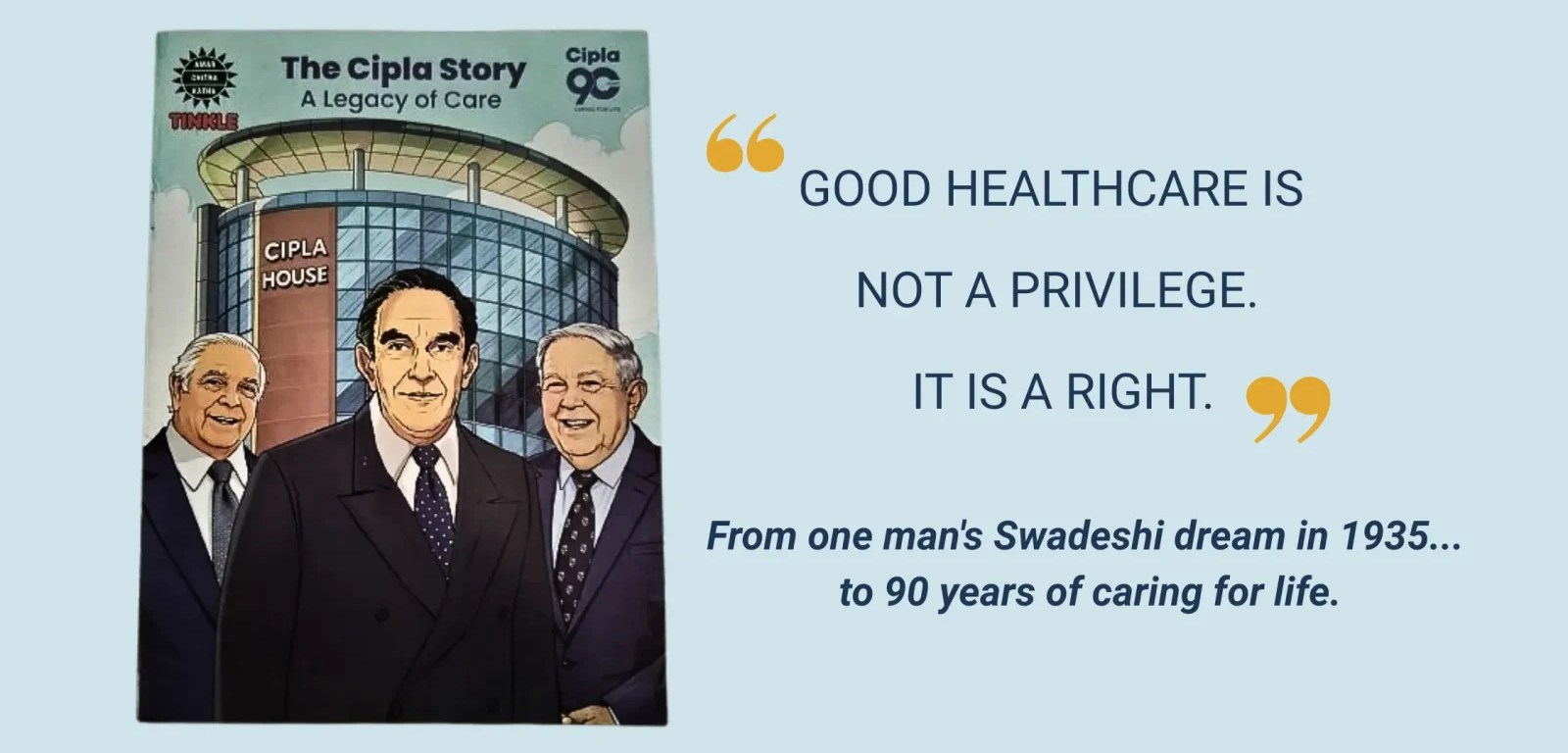
Everything begins with a dream. That’s what I call ideas because dreams are warm and personal; they have an ethereal quality. Dreams are powerful motivators for finding your life’s purpose. For Dr. Khwaja Abdul Hamied, that dream was simple yet extraordinary: to provide accessible healthcare to every Indian. If you’re wondering who this scientist was, let me introduce you to the legacy he created in pre-independent India and how he went on to revolutionise the Indian pharmaceutical industry.
Let’s travel back to 1935.
India was fighting for freedom from colonial rule, striving for self-reliance, and dreaming of becoming a nation where every citizen had access to healthcare. Dr. Hamied believed that good healthcare was not a privilege but a right.
With this belief, he envisioned what seemed impossible: building a pharmaceutical and chemical research laboratory at a time when the industry was dominated by foreign companies and restrictive patent laws allowed them to sell medicines at exorbitant prices.
The road ahead was anything but easy.
But dreams have a unique way of finding their path.
Despite every challenge, Dr. Hamied brought together a group of friends and founded The Chemical, Industrial and Pharmaceutical Laboratories, better known today as Cipla.
Their vision was simple: Caring for Life.
It was a bold beginning: producing medicines using locally available ingredients with the larger goal of making healthcare affordable and accessible to every Indian.
We buy medicines from pharmacies, read dosage instructions, and check the ingredients, but rarely do we stop to think about how those medicines came into the picture in the first place.
Now is the time we talk about it.
If you’ve followed me for a while, you know I have a soft spot for illustrated books.
To celebrate its 90th anniversary, Cipla partnered with another Indian icon, Amar Chitra Katha (ACK), to create a beautifully illustrated 36-page comic, The Cipla Story: A Legacy of Care.
Inspired by true events, thoroughly researched, and brought alive through engaging artwork, the comic captures milestones that would make any Indian proud.
The Legend of Cipla
At its heart, this is the story of an Indian who dreamed of a healthier India while embodying the Gandhian principle of Swadeshi.
The comic follows a fictional retired Cipla research scientist, Anil Sharma, who has been invited to Cipla’s annual gathering. As he shares stories of Cipla’s humble beginnings with his initially reluctant grandchildren, their curiosity grows. They accompany him to the event, where he walks them through the company’s milestones, introduces them to an old scientist friend, and brings history to life through personal memories.
While the book helps younger readers understand what makes Cipla a household name, it also teaches adults like me something equally valuable.
Someone dared to dream!
Someone worked tirelessly to make those medicines accessible and affordable. That perspective stayed with me long after I finished reading this comic book.
90 Years of Healthcare: The Milestones
1942: during World War II Cipla manufactured-malarial medicines using chemicals derived from locally grown cinchona plants when European supplies became scarce. These medicines helped save Allied troops across Myanmar and neighbouring regions.
1960: Cipla pioneered inhalation therapy in India. In 1972, Cipla produced its first indigneous inhaler and today, is a leader in respiratory care.
1970s: Cipla advocated for lowering import duties on Active Pharmaceutical Ingredients (APIs) to help make our country self-reliant. Along with other Indian pharmaceutical companies, it co-founded the Indian Drug Manufacturers’ Association (IDMA), whose efforts eventually led to the landmark Indian Patents Act of 1970.
1985: Three of Cipla’s API manufacturing facilities received US FDA approval, making them among the first Indian pharmaceutical plants to achieve this distinction.
1995: Cipla introduced an oral iron chelator that significantly improved the life expectancy of patients living with thalassemia.
1996: The company launched the world’s first transparent dry powder inhaler (DPI), making respiratory treatment more accessible.
Cipla also introduced medicines for rare diseases, including pulmonary fibrosis and pulmonary arterial hypertension.
2001: Cipla offered its specially developed AIDS combination therapy at just USD 350, absorbing substantial losses to improve access. Doctors Without Borders distributed these medicines across African nations, transforming HIV treatment for thousands of patients.
2020: During the Covid-19 pandemic, Cipla continued supplying medicines while also supporting doctors and nurses through education and awareness initiatives.
What Appeals to Me Most
What resonates with me most about Cipla is its humanitarian approach. It is a company willing to take risks, invest consistently in research and development, and challenge conventions. More importantly, it proved to the world that India could manufacture medicines of the highest quality while building world-class research facilities.
And perhaps the biggest reminder from this story is:
Medicine is so much more than pills. To support patients and families facing serious illnesses, Cipla established its free Palliative Care & Training Centre (CPC) in 1997 in Pune while also training caregivers, nurses, and health educators.
Healthcare, after all, is as much about compassion as it is about treatment.
The Cipla Story Meets Amar Chitra Katha
When two legends come together, history finds a new way to inspire.
In an age of endless scrolling and fleeting content, there is something deeply satisfying about seeing an important chapter of Indian pharmaceutical history preserved as an illustrated story. It reminds us that nations are built by people who dare to dream, and choose to give back to their country.
You can read the high-resolution version of The Cipla Story: A Legacy of Care on the Cipla website https://www.cipla.com/comic-book-view to discover this remarkable journey for yourself.
Have you come across stories of healthcare innovation that are truly Made in India, For India, By Indians?
We’d love to hear them. Two best comments win a free copy of The Cipla Story! (Valid for people residing in India)
This blog post is part of ‘Blogaberry Dazzle’ hosted by Cindy D’Silva and Noor Anand Chawla in collaboration with Mister Tikku.


Aravind Eye Care System – An innovative, low-cost model for cataract surgeries and eye care.
One healthcare innovation that has truly impressed me is the Aravind Eye Care System. It is a shining example of healthcare that is Made in India, For India, By Indians. My family and I have been visiting Aravind for our eye check-ups for several years. Every visit has shown us how quality eye care can be made accessible and affordable without compromising on excellence.
What stands out is the hospital’s efficient system—from registration to consultation, diagnosis, and treatment. Patients from all walks of life receive the same level of care with dignity and compassion. Their pioneering low-cost cataract surgery model has restored the gift of sight to millions, proving that world-class healthcare can be both affordable and sustainable.
As someone who has personally benefited from their services, I believe Aravind Eye Care is more than a hospital; it is an Indian innovation that has transformed lives and become a global model for accessible healthcare. It truly reflects the spirit of healthcare created in India, for the people of India, by Indians.
You can read more about their vision in the book : INFINITE VISION. Review of it here in this link ;https://bookfoodlanguage.blogspot.com/2017/04/infinite-vision.html
LikeLiked by 1 person
Please mail your address to ambicagulati@gmail.com.
LikeLike
This is a unique way of storytelling by Cipla. Generally Amar Chitra Katha is associated with different kind of stories, but real life case studies is something new.
LikeLiked by 1 person
That’s true. Really an out of the box approach to creating more milestones.
LikeLike
Some brands are an inherent part of our lives that we never go into reading about them. Cipla is one such. Thank you for enlightening us with its history, Ambica. I was missing our comins and here you lead me to one- Thank you.
LikeLiked by 1 person
This copy looks quite interesting with what you have told about it. I recently watched Made In India: A Titan Story, and just got so much inspiration. Now i think it’s time to check out Cipla Story. Thanks for sharing about it.
LikeLiked by 1 person
I have to watch the titan story.
LikeLike
When you talk of healthcare innovation, two names come to mind. One is Aravind Eye Care, which Soumya has mentioned in one of the previous comments. Many families, including mine in Tamil Nadu, have benefited from this. Not just that, people from all walks of life, esp. the poor, travel from various parts of the country to derive benefit from their cataract surgeries and other problems related to the eye at a subsidized or free of cost treatment.
The next one is Innaccel, which is Bangalore-based and has developed a one-of-its-kind portable neonatal breathing support system called Saans. It is considered the world’s first infrastructure-independent, continuous positive airway pressure (CPAP) device designed specifically for low-resource settings. The best thing is it can run on electricity, a battery backup, when power completely fails. Because of this, healthcare workers in remote and rural hospitals can stabilize newborns in respiratory distress during critical hours and transit, thereby lowering infant mortality rates in rural regions.
Have read about these two, Ambica. Of course, Cipla is a household name, and reading your post gave me new insights about a company we have known and trusted for years.
LikeLiked by 1 person
Please mail your address to ambicagulati@gmail.com or Whatsapp me.
LikeLike
Great tribute to an incredible healthcare legacy. It’s amazing to see 90 years of commitment to accessible healthcare. Thanks for sharing this thoughtful look at Cipla’s legacy and congratulations on covering such an important story.
LikeLiked by 1 person
I have read and enjoyed this book from the core of my heart . There were so many things I was not aware about Cipla. One reason I will not deny to accept that me being unaware was because my childhood and a huge part of adulthood I worked with Homeopathy for my medical needs in 90% cases. So Cipla in very rare cases came in my sight in regards to medicine. Once I became a mother Cofsils Naturals Cough Syrup a product of Cipla I saw. Recomended by my child’s pediatrician for Cold and cough. But once I read this book… It was a unique experience which I tried to narrate and explain in childish way to my son. Cipla truly demonstrated a legacy of care.
LikeLiked by 1 person
Yes, I wasn’t aware of the history also. But a dream touching lives decades on is a true commitment. 👍
LikeLike
What a heartwarming way to tell Cipla’s story – I had no idea it began in 1935 with Dr. Hamied’s Swadeshi dream, or that they offered AIDS combination therapy at USD 350 while absorbing the losses. Pairing it with Amar Chitra Katha is genius; some histories deserve to be preserved in a form the next generation will actually pick up.
LikeLike
Love this review plus the way of talking about the book. Great work.
LikeLiked by 1 person
Knowing ACK, they must’ve created a visually appealing and interesting story to honour Cipla’s legacy. That’s one book I would love to read and gift to my kids too.
LikeLiked by 1 person
When i look at businesses, their only motive to have come into being, and for running is pure profit. In such a world, to read about a company like CIPLA, it is a legend and its legacy well-deserved.
It warmed me to read your article about their story and progression through the times. What an interesting history and book. I am sure the illustrations will be quite a treat too.
LikeLiked by 1 person
Such an engaging style of story-telling! You have told the entire history of a pharmaceutical company in easy language. Made me proud of Cipla!
LikeLiked by 1 person
Such an inspiring story and makes me proud as an India. Just today I was reading a presentation on the pharmaceutical industry in Central Asian countries and was proud to see that a large majority of their imports of API come from India. Shows our manufacturing capabilities.
LikeLiked by 1 person
So good to know India has taken a leap in the pharma industry.
LikeLike
I have been an ardent consumer of Cipla medicines since childhood. One of the most trusted pharma brands.
Your post beautifully highlights how trust is built over decades through consistent care and innovation. The journey of Cipla feels inspiring when presented with such clarity. The blend of history, impact, and purpose keeps the reader engaged. Informative writing with a meaningful message.
LikeLiked by 1 person
I was checking some medicines online and realised that Cipla has one of the most affordable ranges.
LikeLike
this was a brand that I’ve seen people around me use since I was a kid. Good to know about their legacy
LikeLiked by 1 person