
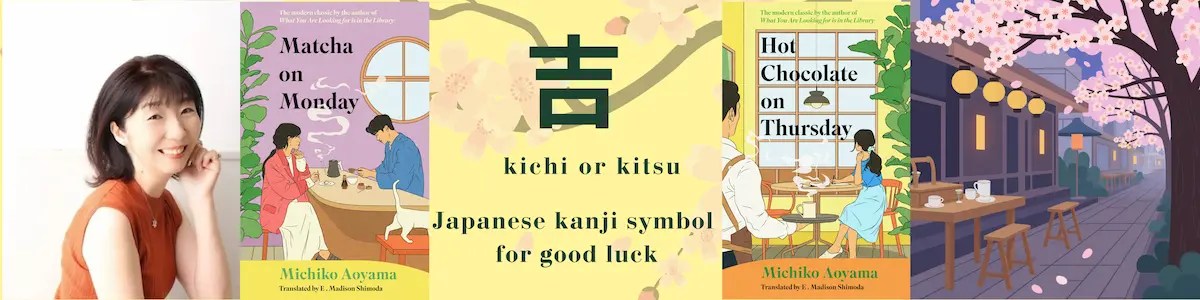
A gentle journey through Japan, life’s invisible threads, and the idea that perhaps there is no such thing as bad luck.
“If you trace things back, the number of linked hands multiplies exponentially. If one of those hands let go, we wouldn’t have made it here…. That’s what’s great: unbeknownst to you, simply working on your own life can impact the life of complete strangers.”
The second book in the Marble Café series, Matcha on a Monday is an invitation to surrender to life’s flow, while you enjoy some matcha tea and wagashi by the river where cherry trees bloom. Aoyama’s philosophy, rooted in Nature and the planet’s rhythm, helps us understand the web of invisible threads—moments, choices, and chance encounters that create a ripple impact in ways we may never fully comprehend.
The book has been translated by E. Madison Shimoda.
Like Hot Chocolate on a Thursday, it opens at Marble Café. This time, a quiet matcha event, sans the publicity, is being hosted there. The owner, Maestro, doesn’t believe in creating digital footprints, yet it finds customers whose lives are interlaced through the invisible strands of life. We could call it synchronicity.
It’s difficult to categorise Aoyama’s books, but there is a lyrical healing quality to her plots and characters.
The book encourages us to treat every incident not as an obstacle or an annoyance, but as a stroke of good fortune. Through 12 chapter-long vignettes aligned with the calendar months, Aoyama shows us the rhythmic pulse of Japan: the contrast between Kyoto’s deep-rooted heritage and Tokyo’s bustling modernity, the tactile comfort of analogue habits like postcards and physical books, and the quiet beauty of seasonal festivals, tea ceremonies and confectionaries.
This book introduces us to Japan with the familiarity and ease of a trusted neighbour. The USP: there is no such thing as bad luck. Every situation has a reason, and the reason unfolds with time. Then we see the good fortune. The pattern of good luck reinvents itself in every story, and we also see the Japanese Kanji symbol, kichi or kitsu.
With Aoyama’s stories, we experience a Japan that thrives on age-old traditions such as kamishibai paper theatre, and its ageing and wise population. Her characters are interested in books, gentleness, wisdom and the acceptance of Western ways in larger cities.
While Marble Cafe doesn’t have a digital presence, Aoyama acknowledges its importance through the lingerie designer in Sparrows in Early Spring.
Aoyama’s world isn’t hurried; it moves through the seasons, the beautiful natural world where insects are as important as people, and seasonal scents are treasured memories.
A character who reminded me of loss of identity and making peace with oneself after realising one’s limited understanding was Ms. Tazu, the 82-year-old matriarch. Displaced within the very family business she dedicated her life to, Ms. Tazu’s silent and strict exterior makes her a much misunderstood person in her family. Yet, she has a friend in her younger daughter-in-law.
She sneaks into her own shop to taste the best seasonal sweet, a symbol of self-preservation and sweet memory. When her long-held belief system breaks, it does not destroy her; instead, it creates the precise rupture needed for transformation.
Ms. Tazu’s journey proves that self-discovery has no expiration date. By letting go of the need for control, she sheds her rigid armour and becomes a sweet participant like the famous sweet, miniazuki, from her family business.
However, what got me smiling big time was the mention of White Day and love letters, a parallel to Valentine’s Day, something I’d written about sometime ago. It also reminds me that writers are indeed custodians of their times, cultures, for without them we would never know another country, another way, another treasure.
Marble Café is a beautiful world created by Michiko Aoyama and her Maestro, the wise mentor whom we all need. Closer home, it does remind me of the web series Musafir Café, where slow is joyful, dreams are hope, and Nature is cheer.
About Michiko Aoyama
Michiko Aoyama was born in 1970 in Aichi Prefecture, Honshu, Japan. After university, she became a reporter for a Japanese newspaper based in Sydney before moving back to Tokyo to work as a magazine editor. What You Are Looking For Is in the Library was short-listed for the Japan Booksellers’ Award and became a Japanese bestseller. It is being translated into more than fifteen languages. Michiko Aoyama lives in Yokohama, Japan.
Verdict: An ode to analogue comforts, home, and grace.
Book Details
- Publisher: Doubleday (Penguin Random House India)
- Language: English
- Print length: 208 pages
- Price: INR 899
Ambica Gulati wears many hats: independent journalist, editor, multimedia storyteller, author and fiction writer. Her work moves between global affairs, conscious travel, the environment, culture and the intuitive arts, while her fiction explores the territories where nature, memory, mystery and imagination converge.
Beyond the laptop, she nourishes her creative practice through meditation, birding, reading, journaling, oracle cards, and yoga.
From the Archives
If you enjoyed reading this, there’s more to explore in the archives.


Thanks for the review. I’ve ordered the book. These books create a sense of well-being and joy, which is missing in the world today.
LikeLike
I’m sure you will enjoy it. It’s so uplifting. and always a good read.
LikeLike