
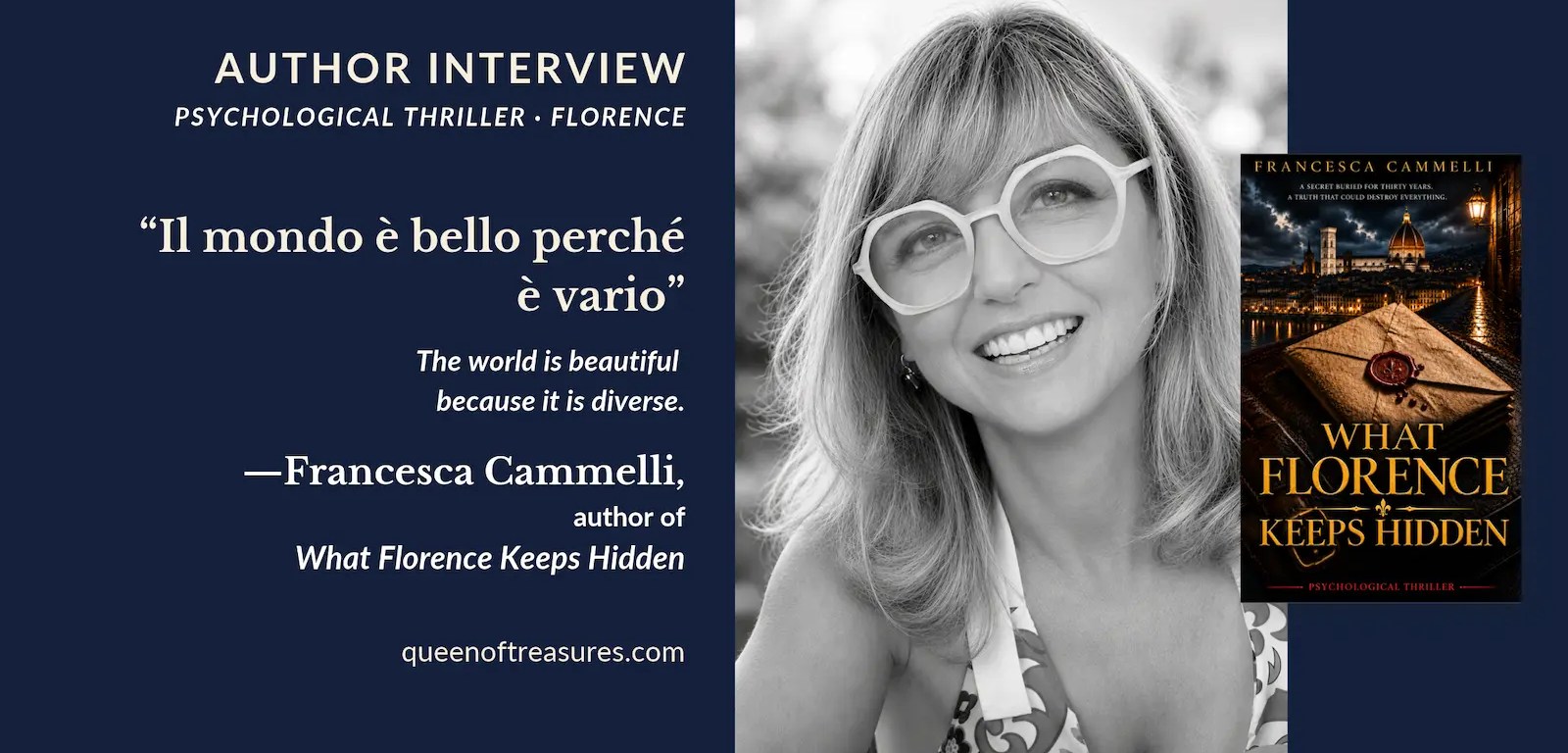
Meet Italian author Francesca Cammelli, discover the inspiration behind What Florence Keeps Hidden, and explore Florence, Pistoia, Tuscan food and culture.
Social media still throws up surprises. I discovered Francesca Cammelli there, and her debut psychological thriller, What Florence Keeps Hidden, kept me on tenterhooks until the final page.
It opens with an ordinary encounter: Dr Matteo Valli meets Monica Rinaldi by chance, and the meeting draws him towards a puzzle connected to the historic Maison Fucini. As he and Inspector Conti investigate, a thirty-year silence begins to give way, and the story moves to what happens when a truth that a family or an institution has buried finally comes to light.
This is unmistakably human writing—shaped by real observation and real hands. Her sensory descriptions bring Florence, Tuscany, the food, and the tangled relationships to life.
As a professional from the fashion industry, she is fascinated by layers. So, I decided to understand Francesca Cammelli’s creative process. Excerpts from our conversation:
What first sparked What Florence Keeps Hidden, and when did you realise it was a novel?
The first spark for What Florence Keeps Hidden came from my fascination with Florence. It is a city full of beauty, history and art, but I have always felt that behind its extraordinary façade there are countless stories waiting to be told. I was particularly intrigued by the idea that every family, every place and every person might be hiding something.
At first, it was just an idea, a few characters and a mystery. But as I began developing the story, the characters took on a life of their own, the secrets became more complex, and I realised I had something much bigger than a short story. That was when I understood it could become a novel.
Did you study creative writing, or did you learn on your own?
I didn’t study creative writing or attend any formal writing courses. I am largely self-taught. I believe that a lot of what I have learned has come from reading different authors, observing people and places, and, above all, writing, making mistakes and rewriting.
For me, writing is also about emotions and atmosphere. I want readers not only to follow a mystery, but to feel as though they are actually there, surrounded by the places, the people and the secrets of the story.
Why did you choose Florence as the setting for a psychological thriller? Is any of the story inspired by real events or people?
I live in Pistoia, a small and beautiful city not far from Florence, but my family has Florentine roots, so I have always felt a strong connection to the city.
I believe Florence has a unique atmosphere, particularly for a psychological thriller. Behind its beauty, historic palaces and artistic heritage, there is an intriguing, almost mysterious side. I wanted to explore the contrast between the elegance and charm of the city and the darker secrets that can hide beneath the surface.
Florence is almost a character in the story itself. Its streets, buildings and atmosphere help create the tension and mystery I wanted readers to experience.
The story and its characters are fictional. However, like many writers, I draw inspiration from real life: from people I meet, conversations I hear, places I visit and situations I observe. Sometimes a small detail from reality can become the starting point for something entirely imaginary.
“Il mondo è bello perché è vario”
The world is beautiful because it is diverse.
I think this makes writing so fascinating: every person has a story worth telling, and every reader experiences a book in their own unique way.
The story turns on a silence that lasts thirty years. Why that length of time, and what did you want to explore in it?
I chose thirty years because I wanted enough time to show how deeply a secret can become rooted in people’s lives. I wanted to explore how the silence of one generation can become the burden of the next, and how decisions made in the past can continue to shape other people’s lives decades later.
For me, the most interesting question is not simply what happened thirty years ago, but how many lives have been affected by the decision to keep it hidden. Sometimes, what is never said can be just as powerful as what is spoken.
The things left unsaid don’t necessarily disappear with time. They can be passed down from one generation to another, influencing choices, relationships and even the way people see themselves, often without them knowing the whole truth.
How do you protect time and space to write, and what has publishing your debut taught you?
I usually write during my lunch break at work. It has become a way for me to switch off from everyday routines, recharge my batteries and dedicate some time to something I truly love. I also write during weekends and holidays, whenever I can find a quiet moment to immerse myself in the story.
Publishing my debut novel has been an incredibly intense and rewarding experience. It has taught me so much, not only about writing but also about the entire publishing process. I worked on the editing with the support of professionals, took care of the cover design and layout, and even managed the promotion myself.
It has been a very demanding journey, but every effort is rewarded when I read people’s comments and discover how deeply my story has touched them.
Knowing that my words can reach someone’s heart and stay with them is, without a doubt, the greatest gift of being an author.
The novel has convincing details from the medical world. Did you work in that field, or did you research it, and how did you check the details?
I have never worked in the medical field. I did my own research to better understand the medical environment and terminology. I wanted the medical elements to feel authentic, not just to add realism to the story, but because I believe that credibility is essential, especially when writing a psychological thriller involving medical professionals.
Fortunately, I have doctors in my family who were very helpful and supported me by providing information, clarifying medical procedures and answering many of my questions.
The smell of leather is a striking detail in the book. Where did it come from: research, memory, or something you came across in Florence?
The smell of leather comes mainly from my personal and professional experience. I have worked in the fashion accessories industry for over thirty years, so the world of leather goods and leather craftsmanship is very familiar to me.
Florence, after all, is one of the world’s capitals of luxury leather goods. It has a very strong tradition of craftsmanship, and many of the most prestigious fashion houses and international brands manufacture their bags in this area.
When you walk through the streets of Florence’s historic centre, you come across countless leather shops and artisan workshops. The smell is unmistakable: you can recognise it simply by walking past one of these shops. It is almost part of the identity of Florence’s historic streets.
I wanted readers to experience that same scent, almost as if they were walking through the streets of Florence alongside the characters in the novel.
Given the ending, are you planning to make this a series of novels or do we expect something totally different?
In the little pockets of time I can find, I have already started writing the second part of the story. It will once again be set in Tuscany, and readers will have the opportunity to meet some familiar characters and discover what happens next.
However, the book won’t be published anytime soon. I don’t expect it to be released before mid-2027. For now, I’m enjoying the process of developing the new story and seeing where it takes me!
If What Florence Keeps Hidden describes the side of Florence that visitors do not see, what is one place or habit in the city they should look for?
I would suggest exploring the artisan workshops in the Oltrarno district, where traditional crafts and ancient skills are still very much alive. These small workshops offer a glimpse of authentic Florence, far from the usual tourist attractions.
I would also recommend wandering through the less crowded streets of the historic centre, stopping at a traditional trattoria and, of course, discovering the leather shops.
Another experience I would not miss is visiting Piazzale Michelangelo. From there, you can admire Florence from above, with a breathtaking panoramic view over its rooftops, churches and historic buildings.
When she is not writing, Francesca enjoys discovering new places and finding inspiration in the people, landscapes and traditions of Tuscany.
From Florence to Pistoia, any recommendations on what to see, do, eat, phrases.
Florence is undoubtedly a wonderful city, but Tuscany has so much more to offer. Travelling across the region, in every direction, you can discover little medieval villages and charming towns that may be less famous internationally but are just as beautiful, fascinating and full of character.
Sometimes, the most unforgettable places are not the ones everyone knows, but the hidden gems you discover along the way.
How would you introduce Pistoia to someone who has never been there?
Pistoia is a charming little city in the heart of Tuscany, just 30 minutes from Florence. It is often overlooked by tourists, but it has so much to offer.
It is a city rich in history, art and traditions, but with a more intimate and authentic atmosphere than some of Tuscany’s better-known destinations. I would describe it as a little hidden gem, a place where you can slow down, enjoy a coffee in a historic square and experience the genuine rhythm of Italian life.
My advice is to explore Pistoia on foot, without rushing. Its real charm lies in its narrow medieval streets, hidden corners and authentic atmosphere. It’s a city best discovered slowly, like a little secret in the heart of Tuscany.
Is there a real connection between Pistoia and the word “pistol”, or is it a legend?
As far as I know, it is more of a legend than a historically proven connection. There are different theories about the origin of the word “pistol” and its possible link to Pistoia, but no definitive evidence confirms it. It is certainly a curious story that adds a little mystery to the city’s history.
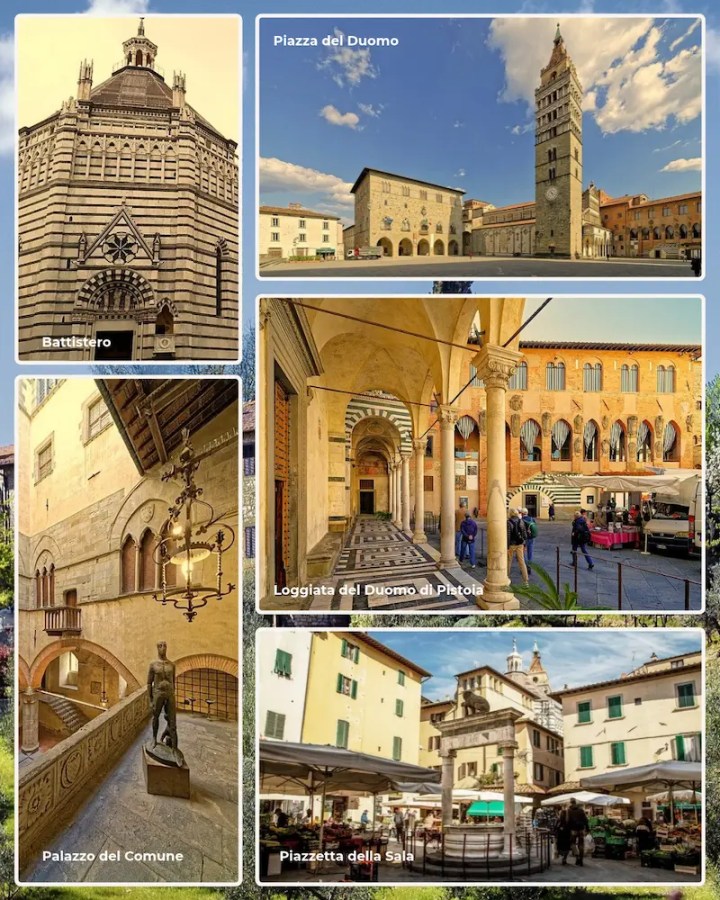
Three places to see in Pistaio:
- Piazza del Duomo: The heart of Pistoia and, in my opinion, one of the most beautiful medieval squares in Tuscany. Here you can admire the Cathedral of San Zeno, the Baptistery and the historic Palazzo Comunale.
- Ospedale del Ceppo: A fascinating historic hospital dating back to the 13th century, famous for its beautiful glazed terracotta frieze depicting scenes of the Seven Works of Mercy.
- Pistoia Sotterranea: An opportunity to discover the city from a completely different perspective, exploring the underground passages and the remains of its ancient history.
Three things to eat:
- Maccheroni all’anatra: A traditional Tuscan dish of pasta served with a rich duck ragù.
- Il Carcerato: A very traditional Pistoia soup made with bread and meat broth, with a history dating back centuries. It is a very particular local speciality.
- Il Berlingozzo: A traditional Tuscan ring-shaped cake, simple and delicious, traditionally prepared around Carnival time.
One experience you shouldn’t miss in Pistaio:
Spend some time in Piazza della Sala, one of the liveliest and most characteristic corners of Pistoia. During the day, it hosts the traditional market, while in the evening it becomes a lovely meeting place, with small restaurants, wine bars and outdoor tables.
Three Italian authors to read, and one book of each you would start with.
- Donato Carrisi – The Whisperer. A gripping psychological thriller full of twists and suspense. A great introduction to one of Italy’s most talented thriller writers.
- Andrea Camilleri – The Shape of Water. A wonderful introduction to Inspector Montalbano and to the atmosphere of Sicily, with its mysteries, characters and local traditions.
- Umberto Eco – The Name of the Rose. A captivating historical mystery combining history, philosophy and suspense. A truly unforgettable read.
Three dishes or specialities worth travelling for.
- Bistecca alla Fiorentina: A traditional Florentine T-bone steak, usually served rare. A must for anyone visiting Tuscany.
- Ribollita: A traditional Tuscan soup made with bread, beans and vegetables. Simple, rich in flavour and deeply connected to local traditions.
- Cantuccini with Vin Santo: Traditional almond biscuits served with a sweet Tuscan dessert wine. The perfect way to end a meal.
One tour or experience for travellers.
Exploring the Chianti countryside, visiting a traditional winery, discovering the vineyards and enjoying a wine tasting accompanied by local food.
Three everyday Italian expressions and what they mean.
- “Mamma mia!” – An expression we use to show surprise, excitement, disbelief or even frustration. It can mean so many things, depending on the situation!
- “Boh!” – A very typically Italian way of saying “I don’t know” or “I have no idea”. It’s short, informal and used all the time.
- “Magari!” – One of my favourite Italian expressions. It can mean “I wish!”, “Hopefully!” or “That would be wonderful!”, depending on the context. It captures a little bit of the Italian ability to dream and hope.
Two or three Italian words about storytelling, literature or writing that have no exact English equivalent.
- “Intreccio” – It refers to the way the events of a story are woven together to create the plot. It is more than just a sequence of events; it is how everything connects.
- “Suggestione” – A feeling or impression created by something that captures your imagination, emotions or senses. It is difficult to translate with just one English word.
- “Brivido” – Literally, a shiver or a thrill. In literature, it can describe that special sensation a reader experiences when a story creates suspense, fear or excitement.
Francesca’s advice for travellers: The best way to discover Italy is to slow down, explore beyond the famous tourist destinations and allow yourself to be surprised by the places and people you meet.
Ambica Gulati wears many hats: independent journalist, editor, multimedia storyteller, and author. Her work explores global affairs, conscious travel, the environment, culture, and the intuitive arts. Beyond the laptop, she nourishes her creative practice through humourous tales, meditation, birding, reading, journaling, oracle cards, and yoga.
From the Archives
If you enjoyed discovering Italy through Francesca, you may like to explore other countries too.


