

While the tiger is the showstopper, the forest is full of more treasures. Mahua Bose recounts her thrilling adventure of walking in the forest’s core area to find evidence of some magnificent species.
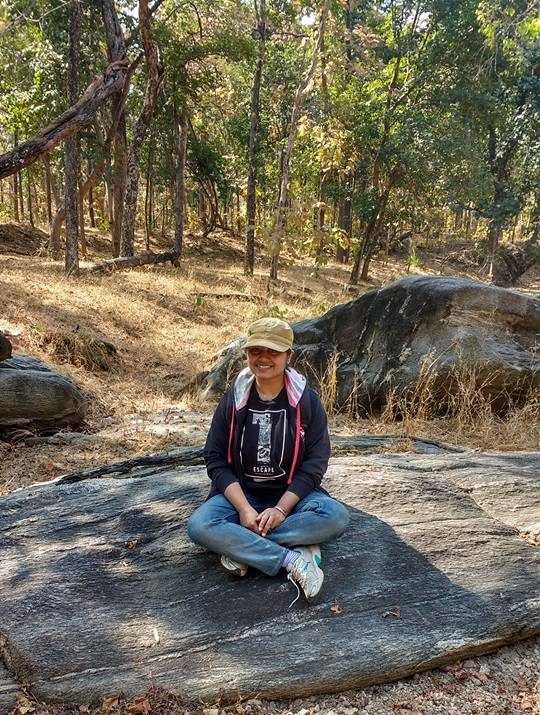
On a winter afternoon, my better half received a message on social media—‘Tiger Census 2018’ in Pench Tiger Reserve, Madhya Pradesh. This was an ‘All India Tiger Estimation 2018’ from February 5-10. I listened casually, until he said, “We can participate in this.” And waves of thrill travelled through my body, my sparkling eyes said it all. By then Mr. Husband knew that I would not let go of this chance.
At The Forest Department
My head was spinning—I wanted all the information about the census. Curious and thrilled, contacting the forest department was the first step. As I stay in Pench Tiger Reserve, it was easy for me to visit the forest department office. My enthusiasm tripled when I was told that “it is one of the biggest wildlife surveys around the globe and happens once in four years”. My heart was jumping with joy. Imagine exploring the core area of the forest on your feet, walking miles and miles for full six days! I could not even think of missing this once-in-a-lifetime chance.
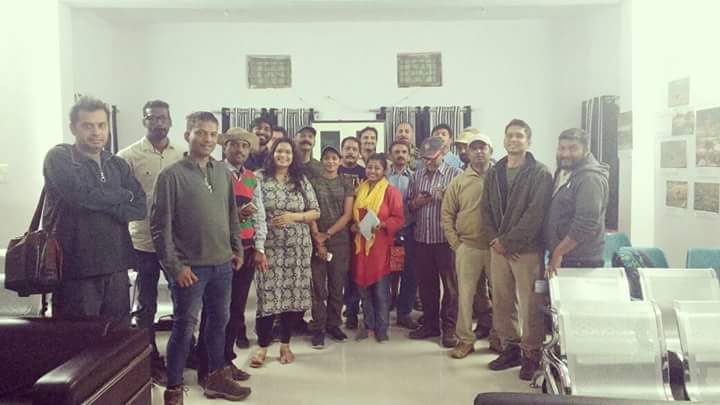
All formalities done, the two-day wait kept me on tenterhooks. Viola! Jackpot and I was part of the thrill. An orientation programme was held on February 4 at Turria gate, Pench Tiger Reserve. What a meeting it was with wildlife lovers that day. Many had taken a break from their mundane life to connect with the wild. There were first-timers too like me, some were veterans, repeating the experience for the fifth or sixth time.
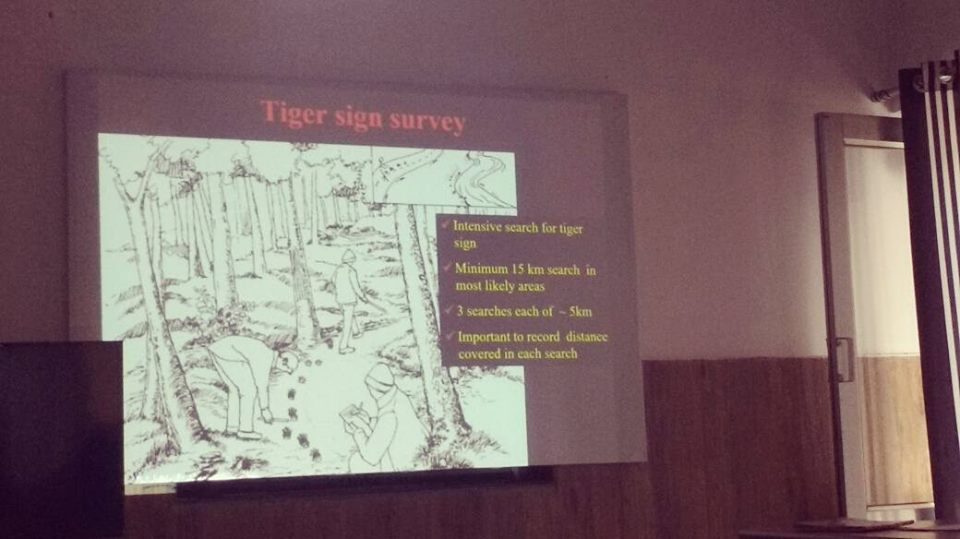
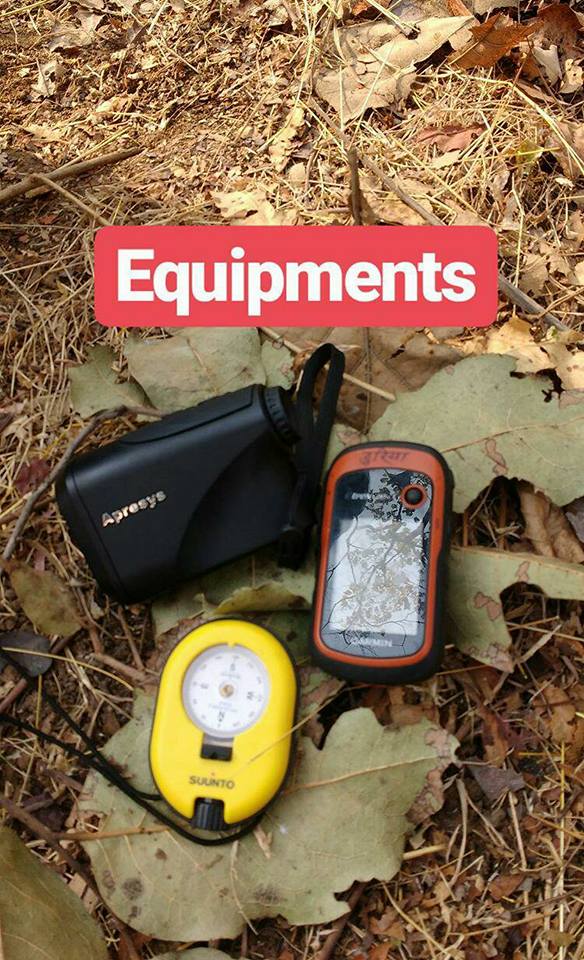

Shubharanjan Sen, Field Director, Pench Tiger Reserve, briefed us and later we were taught the technicalities and the use of the apparatus—a compass, GPS and a range finder. This time, there was a new mobile app to record the census. As per the forest department, the use of this app during the census walks would save time “as everything till now is done in a written format which is time consuming”, and increase efficiency and accuracy of the recorded observations.
In a nutshell, this time tiger census was based on double sampling. The evidence of the tiger’s presence along with geo-tagged pictures would be fed into the app and stored in the memory of a central database. This application would capture every minute detail of the designated pathway during the walks. It would help in recording accurate locations and evidence. The department would then tally these evidence with the pictures stored in the camera traps situated in several parts of the forest. And that would complete the tiger census.
We were then given a demo of how to record the data and the brief ended with Do’s and Don’ts of the stay in the forest. Personal cameras, especially the big ones, were not allowed and every participant was assigned a beat.
I was assigned the ‘Turria beat’. The three-member team comprised a forest guard and a watcher. Pravesh Rahi (the forest guard), Chintesh Bhalavi and Hiralal (the watcher) were my teammates. We would cover approximately 8-10 km in a day.
Filling in the forms and signing an indemnity form which stated “If anything happens to the participant during the census, forest department won’t be responsible for the same”, we went back home.
As Mr. Husband read these lines, even though I could read the thoughts in his mind, he said ‘let the fun begin’ with a smile—well…“he was hiding that worry coiling in his stomach”. And the excitement wouldn’t let me sleep the entire night, not even a 15 minutes power nap.
February 5, 6:30am, Turria Beat
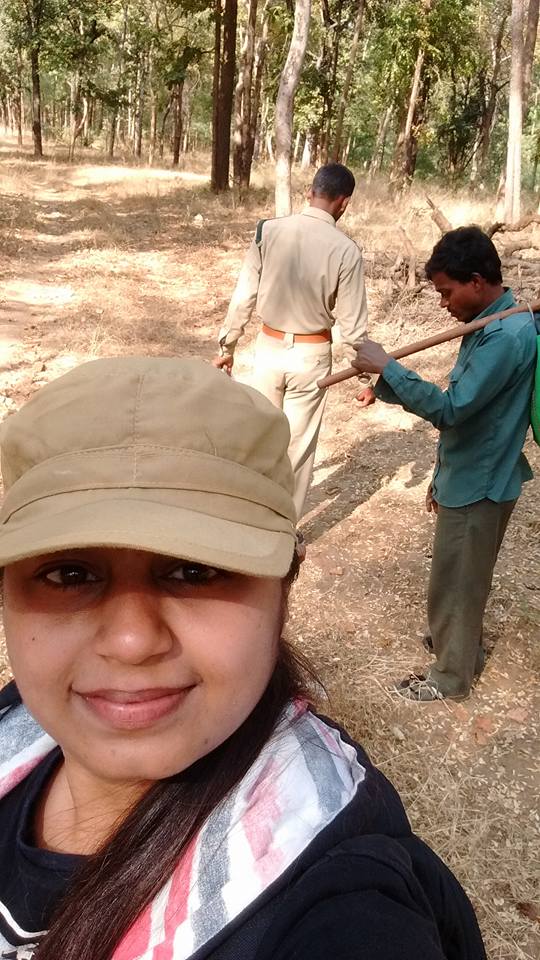

With dawn, I saw myself at the entry of Turria gate and that’s my selfie memory. I had visited this part numerous times in a Gypsy, as part of the jungle safari. I’d spent almost two years close to the jungle, but now I was going to walk in the mysterious core of Turria. I would witness wildlife close-up. The thrill was indescribable. Everything I needed was in a light backpack—notebook, pen, safari cap, sunglasses, binoculars, candies, few packets of food, light beverages and water bottles.
A groupie or team selfie was uploaded in the ecological app because the app would not start until the team selfie was uploaded. Tiger Census 2018 had now officially begun.
We were walking through the dense parts; no one crosses this pugdundy, it’s completely off the tourist routes. It was electrifying to walk in the core area early in the morning. The dawn was alive with the song of hundreds of birds. I had goosebumps, my heart was thumping hard. It seemed the air was talking to me, whispering several forest stories.
The First Trail


The beat started from Sewanala. This was very long and wide, full of sand which made it difficult to walk. We had to find the pugmarks in the sand. And this was a test of my patience.
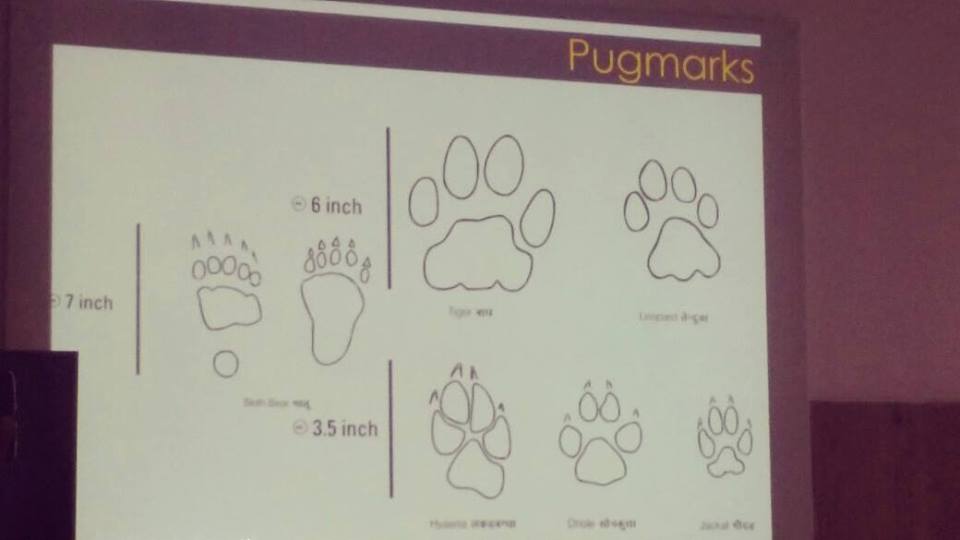
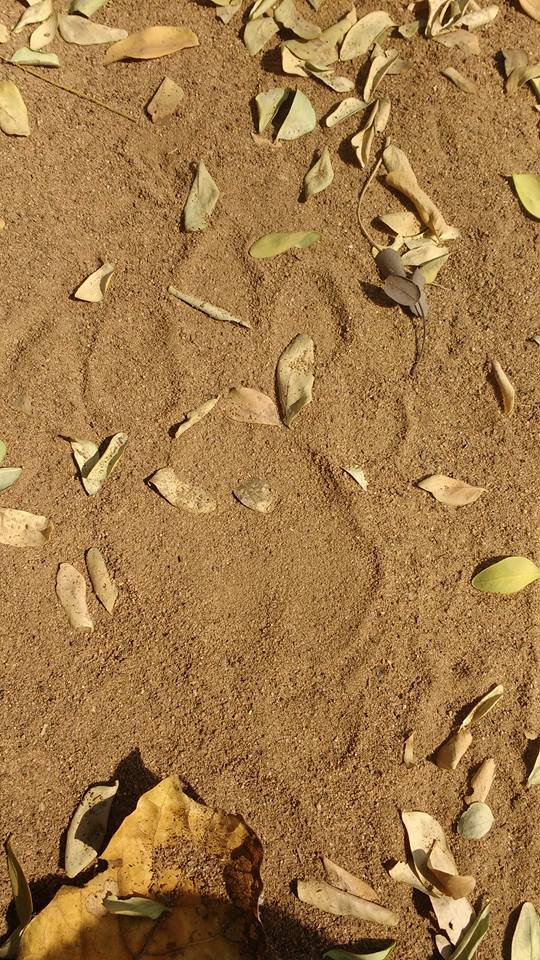
We discovered pugmarks of sloth bear and the marks are similar to those of humans. We clicked pictures and registered the GPS location simultaneously.
For the first three days, we were told to collect evidence of leopards, wild dogs, sloth bear, jackals, fox, civet cat, rudi mongoose, leopard cats, fishing cats and rusty spotted cats, along with the tigers, as “some of them are rare species”.
Apart from taking pictures of the pugmarks, we had to geo-tag and register the pictures containing direct sightings, scats, roars and sounds, spray marks, nail scratches.
In Denser Parts
After finishing at Sewanala, we walked into the dense and bushy areas. This was even headier. As the forest got denser, we witnessed pugmarks of tigers and leopards. Suddenly we heard strong calls of a spotted deer and they seemed to be quite near, totally startling us.
We stopped moving, hoping to see ‘the tiger’ in front of our eyes. We waited, stood still for a long time but the “Yes, We saw it!” moment didn’t come.
Hiralal bhaiya engaged us with some amazing stories. Finally, after hours of walking, ‘Census Day1’ came to an end.
On our return to the main gate, we noticed a tiger’s fresh pugmarks. He had probably crossed this area after we left. With sighs of regret and hope for the upcoming days, we captured the evidence in our camera and recorded the relevant data. I learned a valuable lesson at that moment—Determination to achieve goals.
We continued towards the Turria gate entry point after completing the most important part of our census—a brunch somewhere in the middle of the forest, sitting on thousands of fallen dried leaves, enjoying nature’s enchanting aura, the flora and fauna. Who can imagine a workplace in middle of a dense forest? It was a dream come true for me.
Back at the camp, we checked the GPS and realized we had covered around 15km. I didn’t even realize that I had walked that much, the adrenaline was pumping.
February 6, Sighting The Tiger
We had to cover the pathway starting from Turria main gate till Kadopen road. On the main road, we saw a tiger’s fresh pugmarks, recorded them and moved ahead.
The roads in this part were much more difficult and challenging than the first day. We had to cross steep rocks to check the nearby water bodies for evidence and this required more stamina and effort.
We were in the middle of the forest and suddenly we heard strong calls. A guard said in a trembling voice, “Madam, Madam, see, there comes the tiger!” As soon as these words came out, everyone went on high alert.
A tiger was on the other side of the water body, drinking water and then slowly he climbed the steep mountain and was lost again in the dense forest. My body, mind and soul went, “Yes! Finally you saw it Mahua, that too on foot”. Census goal no 1 was achieved.
We took a few seconds to grasp it all and then moved forward for more wild surprises.
The route was tougher in this part, full of ‘ulat kaanta’, a tiny thorn which gets sucked in the thread and is harder to remove. Day 2 ended with some major thrills.
February 7, Last Of The Carnivores
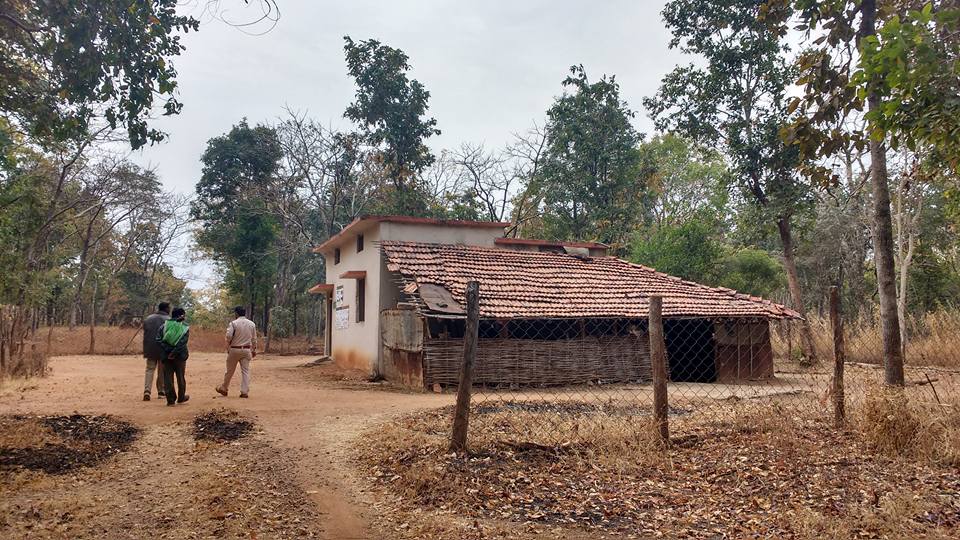

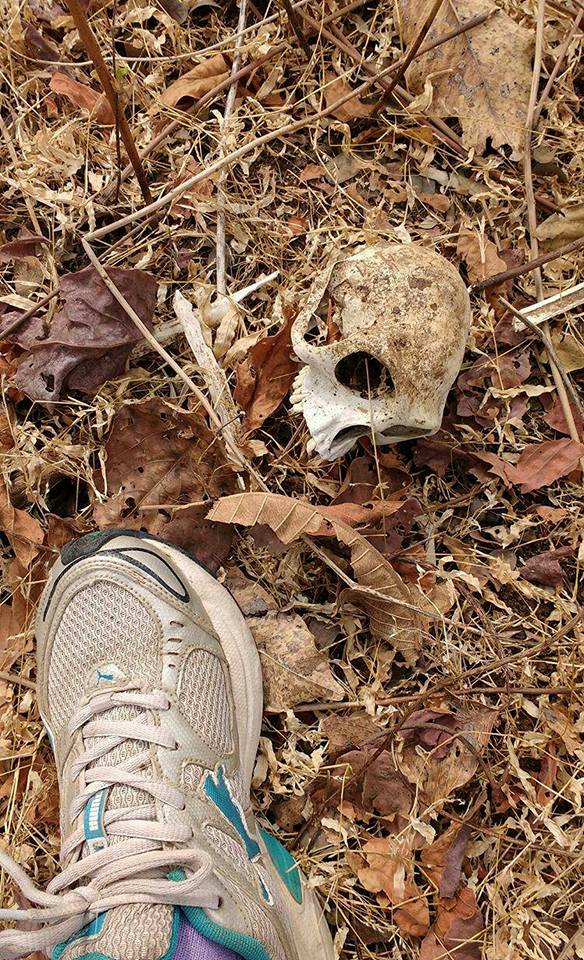
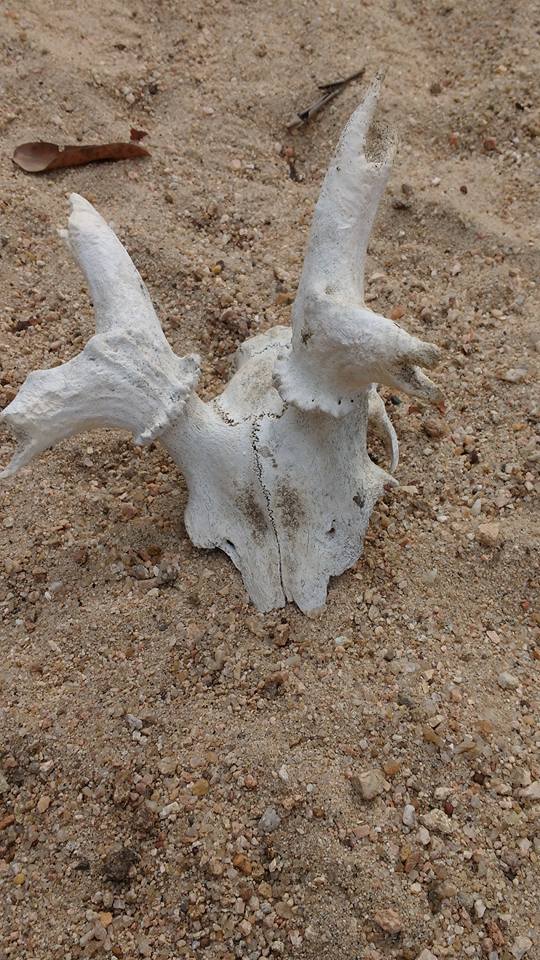
The third day of Tiger Census 2018 was the last day of survey for the carnivores. The trail was from Base Camp 36 to Baansnala pond. This path was dense with teak trees. Spotted deers were everywhere.
We walked on dry teak leaves and the sound was like the ones heard in those suspense thriller movies. Suddenly we heard the calls of a sambar deer (calls from this species indicates 100% presence of tigers). We took our positions and stood still, waiting for the tiger to greet us (not really). But it was not in a mood to welcome humans in his kingdom. So, we moved ahead.
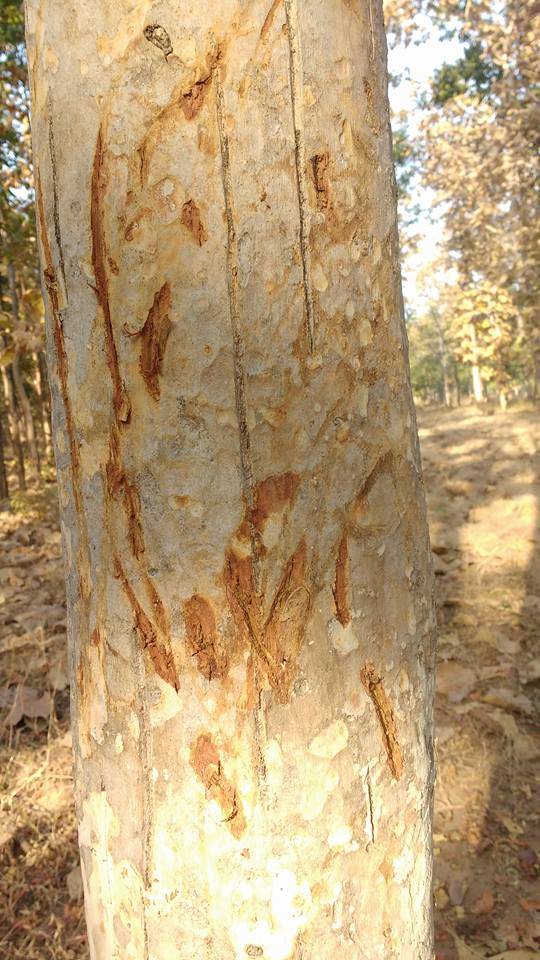
On the way, we saw nail scratches by Mr. Tiger on several trees. We did our work and kept moving.
The fauna kept chattering behind the foliage as we ate our lunch. We did not sight anything. On the way back to the base camp, we clicked some pictures of the pristine forest areas. Only three more days were left.
February 8, 9, 10, Herbivore Survey
In this, we had to record the presence of herbivores, keep count of the animals as well as the number and types of species, shrubs, bushes and trees, and then upload the data on the app.
We had to cover 4-5km daily in transect walking. Transect walking is more of a technical practice, and you have to be knowledgeable (about plants) to successfully get the required data.
The pathway had been marked previously and we had to walk along the same route. Diversions were not allowed.
We searched for fauna and with the range finder measured the distance from our location. We had to count the number of wild species, males and females, cubs.

The first of anything is exciting and so was this. The moment we started walking on the transect lines, we heard the tiger growling loudly. That was the first time I sensed a semblance of fear. The intensity of those growls can’t be described in words. The sound was so loud and clear, as if the tiger could see us. We had goosebumps, even as we stood still. There was pin-drop silence, apart from the growls.
In some time, the growls started fading away and then stopped. We gathered courage and moved forward. Guess what? We saw fresh tiger pugmarks, leaving no doubt that the growls belonged to this beast. But the fear also went away, with the tiger, of course!
The ‘census days’ were a mixed bag of emotions. Anxiety, curiosity, excitement, thrill, energy to explore, courage to discover and new learnings—all landed in this bag.
The programme taught me that it is possible to survive in the worst of conditions by giving your best. The six days of enthusiasm and adventure were over. In these six days, I faced my fears, fought with them and won.
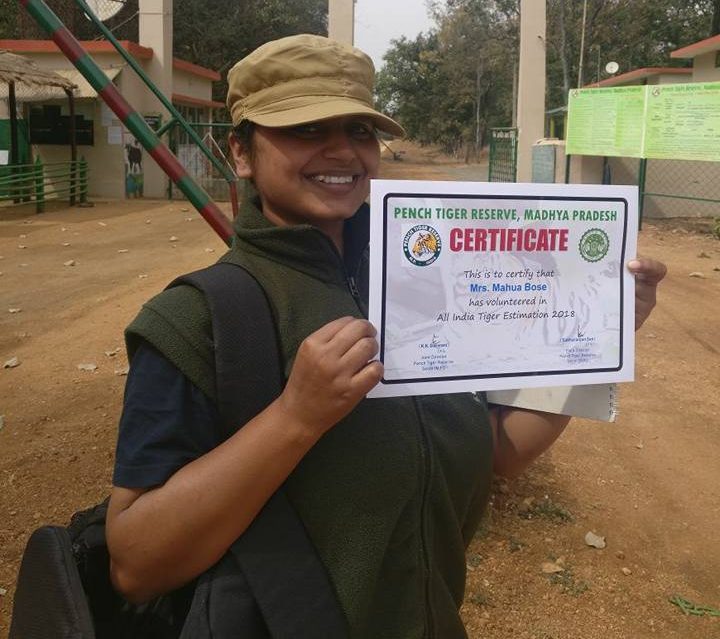
And now I have a certificate of participation from the forest department for this once-in-a-lifetime experience.
My Learnings
- Patience is the key to success.
- Determination makes your goals easier to achieve.
- Tiger Census is not everyone’s cup of tea.
My mundane routine is on, but my eyes flip through the calendar daily, waiting for the dates of the next Tiger Census.
About Mahua Bose
Settled in Pench Tiger Reserve, Madhya Pradesh, Mahua gave up the concrete jungle life of Delhi for a peaceful and soulful life around the green forest area. A media professional, she has turned to supporting sustainable livelihood for the tribes in the area through Kohka Organics. Her husband, Shourabh Ghosh, is co-owner of Kohka Wilderness Camp.
From the Archives
If you enjoyed reading this, you may like to continue the journey
- In the Shadow of Pench National Park: Kohka Wilderness Camp
- The Healing Power of an Urban Forest Bath
- Unleash Your Soul in Bijnor’s Whispering Forests & Soulful Wetlands
Have an adventure to share?
While the tiger is the showstopper, the forest is full of more treasures. Mahua Bose recounts her thrilling adventure of walking in the forest’s core area to find evidence of some magnificent species.
On a winter afternoon, my better half received a message on social media—‘Tiger Census 2018’ in Pench Tiger Reserve, Madhya Pradesh. This was an ‘All India Tiger Estimation 2018’ from February 5-10. I listened casually, until he said, “We can participate in this.” And waves of thrill travelled through my body, my sparkling eyes said it all. By then Mr. Husband knew that I would not let go of this chance.
At The Forest Department
My head was spinning—I wanted all the information about the census. Curious and thrilled, contacting the forest department was the first step. As I stay in Pench Tiger Reserve, it was easy for me to visit the forest department office. My enthusiasm tripled when I was told that “it is one of the biggest wildlife surveys around the globe and happens once in four years”. My heart was jumping with joy. Imagine exploring the core area of the forest on your feet, walking miles and miles for full six days! I could not even think of missing this once-in-a-lifetime chance.
All formalities done, the two-day wait kept me on tenterhooks. Viola! Jackpot and I was part of the thrill. An orientation programme was held on February 4 at Turria gate, Pench Tiger Reserve. What a meeting it was with wildlife lovers that day. Many had taken a break from their mundane life to connect with the wild. There were first-timers too like me, some were veterans, repeating the experience for the fifth or sixth time.
Shubharanjan Sen, Field Director, Pench Tiger Reserve, briefed us and later we were taught the technicalities and the use of the apparatus—a compass, GPS and a range finder. This time, there was a new mobile app to record the census. As per the forest department, the use of this app during the census walks would save time “as everything till now is done in a written format which is time consuming”, and increase efficiency and accuracy of the recorded observations.
In a nutshell, this time tiger census was based on double sampling. The evidence of the tiger’s presence along with geo-tagged pictures would be fed into the app and stored in the memory of a central database. This application would capture every minute detail of the designated pathway during the walks. It would help in recording accurate locations and evidence. The department would then tally these evidence with the pictures stored in the camera traps situated in several parts of the forest. And that would complete the tiger census.
We were then given a demo of how to record the data and the brief ended with Do’s and Don’ts of the stay in the forest. Personal cameras, especially the big ones, were not allowed and every participant was assigned a beat.
I was assigned the ‘Turria beat’. The three-member team comprised a forest guard and a watcher. Pravesh Rahi (the forest guard), Chintesh Bhalavi and Hiralal (the watcher) were my teammates. We would cover approximately 8-10 km in a day.
Filling in the forms and signing an indemnity form which stated “If anything happens to the participant during the census, forest department won’t be responsible for the same”, we went back home.
As Mr. Husband read these lines, even though I could read the thoughts in his mind, he said ‘let the fun begin’ with a smile—well…“he was hiding that worry coiling in his stomach”. And the excitement wouldn’t let me sleep the entire night, not even a 15 minutes power nap.
February 5, 6:30am, Turria Beat
With dawn, I saw myself at the entry of Turria gate and that’s my selfie memory. I had visited this part numerous times in a Gypsy, as part of the jungle safari. I’d spent almost two years close to the jungle, but now I was going to walk in the mysterious core of Turria. I would witness wildlife close-up. The thrill was indescribable. Everything I needed was in a light backpack—notebook, pen, safari cap, sunglasses, binoculars, candies, few packets of food, light beverages and water bottles.
A groupie or team selfie was uploaded in the ecological app because the app would not start until the team selfie was uploaded. Tiger Census 2018 had now officially begun.
We were walking through the dense parts; no one crosses this pugdundy, it’s completely off the tourist routes. It was electrifying to walk in the core area early in the morning. The dawn was alive with the song of hundreds of birds. I had goosebumps, my heart was thumping hard. It seemed the air was talking to me, whispering several forest stories.
The First Trail
The beat started from Sewanala. This was very long and wide, full of sand which made it difficult to walk. We had to find the pugmarks in the sand. And this was a test of my patience.
We discovered pugmarks of sloth bear and the marks are similar to those of humans. We clicked pictures and registered the GPS location simultaneously.
For the first three days, we were told to collect evidence of leopards, wild dogs, sloth bear, jackals, fox, civet cat, rudi mongoose, leopard cats, fishing cats and rusty spotted cats, along with the tigers, as “some of them are rare species”.
Apart from taking pictures of the pugmarks, we had to geo-tag and register the pictures containing direct sightings, scats, roars and sounds, spray marks, nail scratches.
In Denser Parts
After finishing at Sewanala, we walked into the dense and bushy areas. This was even headier. As the forest got denser, we witnessed pugmarks of tigers and leopards. Suddenly we heard strong calls of a spotted deer and they seemed to be quite near, totally startling us.
We stopped moving, hoping to see ‘the tiger’ in front of our eyes. We waited, stood still for a long time but the “Yes, We saw it!” moment didn’t come.
Hiralal bhaiya engaged us with some amazing stories. Finally, after hours of walking, ‘Census Day1’ came to an end.
On our return to the main gate, we noticed a tiger’s fresh pugmarks. He had probably crossed this area after we left. With sighs of regret and hope for the upcoming days, we captured the evidence in our camera and recorded the relevant data. I learned a valuable lesson at that moment—Determination to achieve goals.
We continued towards the Turria gate entry point after completing the most important part of our census—a brunch somewhere in the middle of the forest, sitting on thousands of fallen dried leaves, enjoying nature’s enchanting aura, the flora and fauna. Who can imagine a workplace in middle of a dense forest? It was a dream come true for me.
Back at the camp, we checked the GPS and realized we had covered around 15km. I didn’t even realize that I had walked that much, the adrenaline was pumping.
February 6, Sighting The Tiger
We had to cover the pathway starting from Turria main gate till Kadopen road. On the main road, we saw a tiger’s fresh pugmarks, recorded them and moved ahead.
The roads in this part were much more difficult and challenging than the first day. We had to cross steep rocks to check the nearby water bodies for evidence and this required more stamina and effort.
We were in the middle of the forest and suddenly we heard strong calls. A guard said in a trembling voice, “Madam, Madam, see, there comes the tiger!” As soon as these words came out, everyone went on high alert.
A tiger was on the other side of the water body, drinking water and then slowly he climbed the steep mountain and was lost again in the dense forest. My body, mind and soul went, “Yes! Finally you saw it Mahua, that too on foot”. Census goal no 1 was achieved.
We took a few seconds to grasp it all and then moved forward for more wild surprises.
The route was tougher in this part, full of ‘ulat kaanta’, a tiny thorn which gets sucked in the thread and is harder to remove. Day 2 ended with some major thrills.
February 7, Last Of The Carnivores
The third day of Tiger Census 2018 was the last day of survey for the carnivores. The trail was from Base Camp 36 to Baansnala pond. This path was dense with teak trees. Spotted deers were everywhere.
We walked on dry teak leaves and the sound was like the ones heard in those suspense thriller movies. Suddenly we heard the calls of a sambar deer (calls from this species indicates 100% presence of tigers). We took our positions and stood still, waiting for the tiger to greet us (not really). But it was not in a mood to welcome humans in his kingdom. So, we moved ahead.
On the way, we saw nail scratches by Mr. Tiger on several trees. We did our work and kept moving.
The fauna kept chattering behind the foliage as we ate our lunch. We did not sight anything. On the way back to the base camp, we clicked some pictures of the pristine forest areas. Only three more days were left.
February 8, 9, 10, Herbivore Survey
In this, we had to record the presence of herbivores, keep count of the animals as well as the number and types of species, shrubs, bushes and trees, and then upload the data on the app.
We had to cover 4-5km daily in transect walking. Transect walking is more of a technical practice, and you have to be knowledgeable (about plants) to successfully get the required data.
The pathway had been marked previously and we had to walk along the same route. Diversions were not allowed.
We searched for fauna and with the range finder measured the distance from our location. We had to count the number of wild species, males and females, cubs.
The first of anything is exciting and so was this. The moment we started walking on the transect lines, we heard the tiger growling loudly. That was the first time I sensed a semblance of fear. The intensity of those growls can’t be described in words. The sound was so loud and clear, as if the tiger could see us. We had goosebumps, even as we stood still. There was pin-drop silence, apart from the growls.
In some time, the growls started fading away and then stopped. We gathered courage and moved forward. Guess what? We saw fresh tiger pugmarks, leaving no doubt that the growls belonged to this beast. But the fear also went away, with the tiger, of course!
The ‘census days’ were a mixed bag of emotions. Anxiety, curiosity, excitement, thrill, energy to explore, courage to discover and new learnings—all landed in this bag.
The programme taught me that it is possible to survive in the worst of conditions by giving your best. The six days of enthusiasm and adventure were over. In these six days, I faced my fears, fought with them and won.
And now I have a certificate of participation from the forest department for this once-in-a-lifetime experience.
My Learnings
- Patience is the key to success.
- Determination makes your goals easier to achieve.
- Tiger Census is not everyone’s cup of tea.
My mundane routine is on, but my eyes flip through the calendar daily, waiting for the dates of the next Tiger Census.
About Mahua Bose
Settled in Pench Tiger Reserve, Madhya Pradesh, Mahua gave up the concrete jungle life of Delhi for a peaceful and soulful life around the green forest area. A media professional, she has turned to supporting sustainable livelihood for the tribes in the area through Kohka Organics. Her husband, Shourabh Ghosh, is co-owner of Kohka Wilderness Camp.
From the Archives
If you enjoyed reading this, you may like to continue the journey
- In the Shadow of Pench National Park: Kohka Wilderness Camp
- The Healing Power of an Urban Forest Bath
- Unleash Your Soul in Bijnor’s Whispering Forests & Soulful Wetlands
Have an adventure to share?
Have you had an unusual adventure, wildlife encounter, cultural experience or journey worth sharing? Queen of Treasures welcomes guest stories. We don’t pay for guest contributions, but selected stories are published and shared with our social audience, and we can help you shape and polish your experience into a compelling story.
Share Your Story at ambicagulati@gmail.com


It was really thrilling to read Mahua Bose’s experience of the Tiger Census. What a way to get really close to the wilderness. Pench is really beautiful, we really loved the place when we were there a few years ago.
LikeLiked by 1 person
Wow congratulations Mahua. It feels really adventureous and thrilling. But same time it’s scary and dangerous too. What a great experience…
LikeLiked by 1 person
It is really a great experience . It is adventures, scary and dangerous at the same time . Pench is wonderful.
LikeLiked by 1 person
OMG! Such a brave soul and absolutely on awe with your adventure! Great life experience! Appreciate you sharing your stories. A Happy New Year to you and to more adventure this year!
LikeLiked by 1 person