
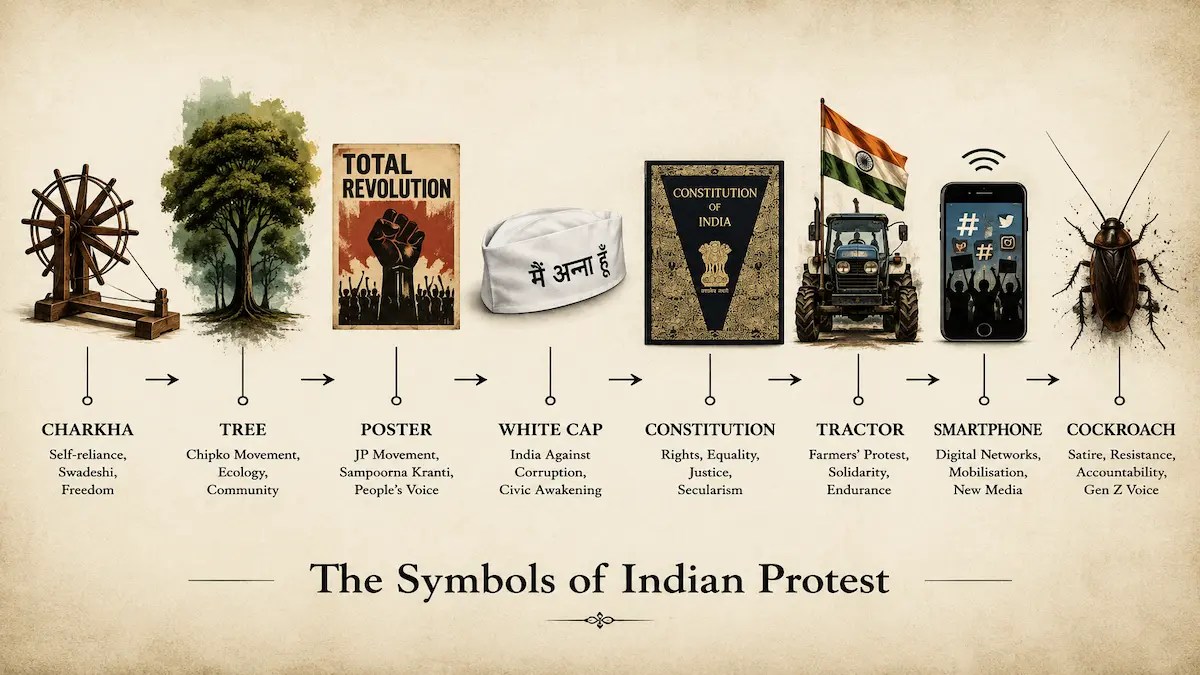
From Gandhi’s spinning wheel to AI-generated memes, every generation invents its own symbols of dissent.
Way back in 2001, I stood alone in the Gandhi Museum at Rajghat in Delhi, gazing at a statue of Mahatma Gandhi beside his wooden charkha. I was the museum’s only visitor. The silence made me wonder if the Father of the Nation had become just another historical figure, confined to textbooks and bronze.
Years passed. One day, I found myself slipping off my shoes to enter his samadhi area. I had returned to shoot a video of Delhi’s heritage sites for a brand campaign. Somewhere along the way, I had become a multimedia storyteller; journalism had quietly expanded from words to pictures and video in ways I had never imagined.
This time, amid lush greenery and soft bhajans, the grounds were inundated with visitors—quiet, civil, and patient. As I watched the eternal flame guarding his spirit, the same question returned: Was this merely a tourist attraction, or did something vital still live here?
Like most Gen X Indians, I grew up surrounded by his image—the frail man in a dhoti, leaning on a walking stick, leading the Dandi March. We memorized these icons in school, recited them on national holidays, and moved on. They belonged to another century, another India.
I admired the charkha as an artifact, but I never fully grasped how an ordinary spinning wheel could shake an empire.
Perhaps that was because I grew up in the 1970s, an era when conformity was the norm and public dissent was intimidating. India and the internet had not yet intertwined. Who could have imagined that barely two decades later, the smartphone would replace the television, the camera, the newspaper, and the pamphlets? India had moved from slow media to hyperconnected immediacy.
Yet the underlying aspirations remained unchanged: justice, equality, liberty, and the desire for a progressive nation.
The Cockroach
Algorithmic Dissent (2026)
Fast forward to July 2026.
At Delhi’s Jantar Mantar in July 2026, crowds of students gathered with smartphones held high. The square reverberated with familiar cries of Azadi and Inquilab Zindabad. Unlike earlier movements that took years to gather momentum, this one leapt from smartphone screens to public squares within days.
On May 15, 2026, the Chief Justice of India Surya Kant stated that “some unemployed youngsters become “media persons, social media users, RTI activists and other activists” who “start attacking everyone”, likening them to “cockroaches” and parasites of society, as per thelogicalindian.com.
In response, on May 16, Abhijeet Dipke, a 30-year-old Indian student in Boston University, USA, tweeted a satirical Cockroach Janta Party with the slogan: Voice of the Lazy and the Unemployed.
Gaining momentum, the satire became a rapid action force for accountability. Taking the critical public commentary surrounding exam paper leaks further, their demand began with the resignation of the education minister of India, Dharmendra Pradhan, and compensation for the families whose children committed suicide due to the NEET paper leak. Later, the demands included no FIRs against protestors and no future action against them.
The movement culminated in the resignation of Education Minister Dharmendra Pradhan, which many supporters regarded as a victory.
Few recent movements have relied so completely on digital satire, memes and decentralised online mobilisation.
Driven by modern digital networks, the very networks that had been dismissed, the youth coupled Gandhian principle of Ahimsa and Dr B. R. Ambedkar’s constitutional vision to protest across the country. Anchored in old world values of constitutional rights, peaceful assembly, and accountability, Gen Z took the internet by storm, placing public pressure on the government.
They didn’t go from door-to-door in the darkness, distributing pamphlets. They didn’t wear kurta-pajamas, dhotis, salwar kameez and saris. They came in the brightness of the day, unabashed, bold and focussed, wearing jeans, tank-tops, jumpers, meeting insult with razor-sharp satire. Girls didn’t shy away either, braving lathi charge, tear gas, pellet guns and water cannons and arrest.
AI-generated artwork, viral video loops, and irreverent internet humor became the armor of a generation refusing to yield its voice or its sense of irony.
Watching them on my phone, the insight that had eluded me years ago in that quiet museum finally clicked: The charkha was never just a spinning wheel. It embodied courage, self-reliance and the determination to define one’s own destiny without surrendering to power.
Every era creates the symbols it needs. For Gandhi, the spinning wheel demonstrated that self-reliance began at home. Today’s youth demand institutional integrity, and their tools are memes, hashtags, and viral art.
Grasping this shift made me look back at the lineage of symbols that have shaped Indian democracy.
The Tree
Eco-Citizenship in the Hills (1973)
In the Himalayan valleys of Uttarakhand, an everyday element of rural life became extraordinary.
When state authorities allotted forest tracts to commercial loggers, indigenous women—led by figures like Gaura Devi—physically wrapped their arms around tree trunks during the Chipko Movement to shield them from axes.
The tree became a declaration that forests were lifelines rather than commodities, proving that environmental stewardship was a matter of community survival long before it became a global policy debate.
We are still fighting for our trees across the country.
The Poster
The Campus Laboratories (1974–1975)
By the mid-1970s, university campuses became the primary laboratories of democratic debate. The Jayaprakash Narayan (JP) Movement lacked a single mechanical icon like the charkha, but its spirit lived on hand-painted posters and student-typed pamphlets calling for Sampoorna Kranti (Total Revolution).
Sparked by acute inflation and systemic corruption, these paper manifestos covered campus walls across Bihar and Gujarat, unifying a fragmented opposition and proving that student politics could reset the national agenda.
The White Cap
The Digital Citizen Auditor (2011)
In 2011, during the India Against Corruption movement, a simple cotton Gandhi cap was reinvented. Branded with the words “I Am Anna,” the cap allowed millions of strangers to instantly recognize one another in public squares.
While early social media networks coordinated the logistics, the white cap served as the visual bridge—connecting 21st-century civic activism directly to foundational Gandhian imagery.
The Constitution
Reclaiming the Preamble (2019–2020)
During the 2019–2020 protests against the Citizenship Amendment Act, copies of the Constitution appeared in public squares alongside public readings of the Preamble.
From multi-month sit-ins led by neighborhood grandmothers at Delhi’s Shaheen Bagh to student gatherings across the country, national flags, murals, and street libraries transformed protest sites into centers of civic education.
The Constitution itself became the ultimate symbol of dissent, as ordinary citizens reclaimed patriotic emblems to defend constitutional values.
The Tractor & The Langar
Agrarian Endurance (2020–2021)
The farmers’ movement demonstrated that sheer endurance can become a visual statement. Miles of tractors, community kitchens (langars), makeshift libraries, and winter-proof tents along Delhi’s borders represented far more than opposition to agricultural reform.
They stood for solidarity, patience, and logistical mastery, proving that collective resilience could sustain a peaceful movement across seasons until its goals were met.
Why Protest Symbols Still Matter Today
The symbols have continually evolved—from wood and cloth to paper, tractors, constitutions, smartphones, and memes.
Perhaps that was what the lonely charkha in the Gandhi Museum had been trying to tell me all along. It was never just about spinning thread. It was about giving people a shared symbol around which they could gather to question power and imagine a fairer society.
Every technological revolution, from the hand-operated printing press to television, smartphones and AI, has continuously transformed the language of protest and more languages will come in as eras change. It is necessary to match the pace of the times we live in because democracy survives as each generation finds new ways to speak it.
Ambica Gulati is a multimedia journalist and editor whose work explores global affairs, travel, environment, and the intuitive arts. Away from her laptop, she enhances her creative practices through meditation, journaling, birding, reading, oracle cards, and yoga.
From the Archives
If you enjoyed reading this, you may like to continue the journey
- Strait of Hormuz and Global Austerity Age
- Board of Peace: Trump, the UN, and the Price of Unity
- COP30, Delhi-NCR Pollution, Aravallis, Article 21: India’s Fight for Green Life
This blog post is part of ‘Blogaberry Dazzle’ hosted by Cindy D’Silva and Noor Anand Chawla in collaboration with Tanvi Agarwal.


That’s a post with a profound message. The spinning wheel shook an empire and today a set of ‘crockroaches’ have driven a government to action.
LikeLiked by 1 person
Yes threads of democracy woven by Gandhi, stated by Ambedkar and lived by Cockroaches.
LikeLike
This is so much of information. Protests have been there and would be there along with the symbols.
LikeLiked by 1 person
The charkha to Cockroach Janta Party arc is such a sharp way to show dissent’s medium keeps changing while the demand for accountability doesn’t. Forcing a minister’s resignation through memes alone says everything about how far we’ve come.
LikeLiked by 1 person
Your posts are so informative. Times change and with it the ways of protests
LikeLiked by 1 person
This is such a deep and extensive post, Ambica.It is a learning for me. Charkha to Cockroach-you have shared in detail, all the symbols of protest.It is actually pathetic that the Chief Justice used such a word for the youth of the country.It is sad that the PM has not understood Gen Z except for the midnight vertical selfie videos. If there were some steps taken to improve things in the country, it would show that our elected government is taking proper steps to lead the kids into a bright future.
LikeLiked by 1 person
You have explored an extremely interesting topic—symbols of protest. The symbols may have changed according to the times and their needs, but they did help unify people under a common factor to protest and get what was rightfully theirs.
LikeLiked by 1 person
What an interesting topic! I loved how you framed it through your own two visits to Rajghat, that shift from an empty museum to grounds full of people mirroring the essay’s whole point. The line that every era creates the symbols it needs will stay with me.
LikeLiked by 1 person
That protest by CJP has changed the wind, and I believe that is going to change a lot for good hopefully.
LikeLiked by 1 person
I dont know what should I say about you and your literary brain. You are mind blowing and you and only you can think in this way. What an saga from Charkha to Cockroach you created with you powerful. Commandable.
LikeLiked by 1 person
Thank you! I’m glad you enjoyed reading it.
LikeLike
Protests have been significant throughout history and have paved the way for future generations on how to ask for accountability. Interesting how the symbols change over time but the underlying emotion stays the same.
LikeLiked by 1 person
That’s the way we live, no… on the upper level the changes reflect but at the end of the day, we seek the same things.
LikeLike
Really enjoyed reading about all the symbols of protest. Reminded me of all the protests over the years. It was really interesting how the latest protest used memes and satire as an effective tool of protest. And how it spread organically.
LikeLiked by 1 person
This piece stayed with me because it beautifully connects something as simple as Gandhi’s charkha with the memes and digital symbols of today’s generation. I loved how the journey through different protest movements made me realize that while our tools have changed—from charkhas and posters to smartphones and AI—the desire for justice, freedom and accountability remains the same. The personal opening at the Gandhi Museum made the story especially relatable and gave the historical narrative an emotional connection. It left me thinking that every generation may speak differently, but the spirit of questioning power never really disappears.
LikeLike
The contrast between the cockroach and charkha is striking. Such powerful symbols reveal different sides of protest. Loved how history, symbolism, and public expression come together so thoughtfully.
LikeLiked by 1 person
i love how you have thoughtfully curated this.alomg the chronology.
LikeLiked by 1 person