
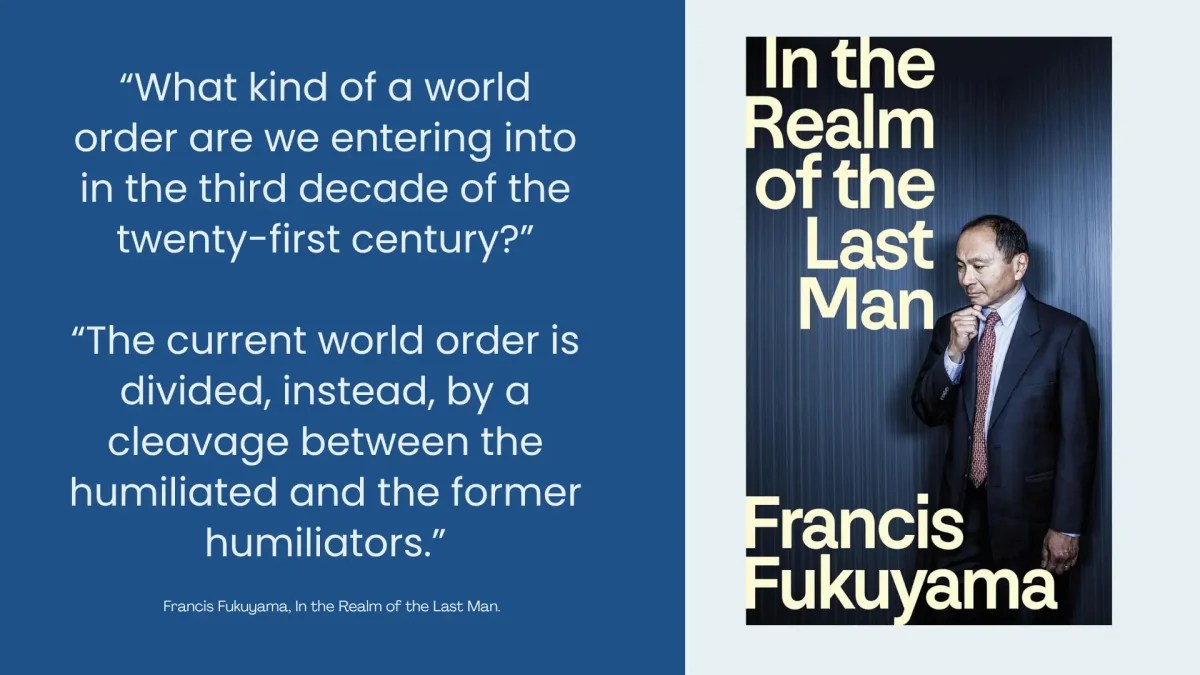
Confucius said, “If you study without thinking, you will be lost; if you think without studying, you will be in danger.”
Most likely, you will pick up In the Realm of the Last Man by Francis Fukuyama because you are interested in geopolitics and political scientists. But if you are uninitiated, it is a goldmine for understanding states and systems of governance, and not just contemporary ones but those across history.
With my limited knowledge of American politics and Fukuyama’s writing, I read the book slowly. Francis Fukuyama is the Olivier Nomellini Senior Fellow at Stanford University’s Freeman Spogli Institute for International Studies (FSI) and a faculty member of FSI’s Center on Democracy, Development and the Rule of Law (CDDRL). He is also Director of Stanford’s Ford Dorsey Master’s in International Policy and a professor (by courtesy) of Political Science.
Though it carries the seeds of a memoir, the book breaks away from the conventional format. It is not merely about his journey through ancestry and career. It is also about his mentors, political scenarios, political philosophy, sociology, human behaviour, classical theories and contemporary change.
Failures and Modern Power
Having spent a lifetime reading, studying and engaging with governments around the world, he brings remarkable depth to this work. Societies have moved from small settlements to megacities and finally to a global village, with many speed breakers and diversions along the way.
From monarchies, anarchies and religious regimes to democracy, the USA changed how the world viewed liberal democracy after the Second World War. But human beings, he argues, are complex and violent by nature, and peace isn’t their inherent state. They run on thymos, the spiritedness and passion for recognition and power.
With the advent of the second Trump administration, we are entering a new phase in American history, with a president who abhors the term “democracy” and has prioritized the crudest form of self-interest—both national and personal—as the guiding principle of his foreign policy. It constitutes a return to the nineteenth century, in which great powers sought to expand their territorial extent and divided the world into spheres of influence.
He lists the failures of American foreign policy: the miscalculation over weapons of mass destruction in Iraq, the prolonged difficulties in Afghanistan, and a tendency to leave the state before durable institutions could take root.
He emphasises that societies do not share the same historical experiences or social structures. Institutions are built slowly, alongside shifts in society and mindset, and they are destroyed when the pursuit of power and recognition overshoots common welfare and inclusive decisions.
And he has seen them all: democracy, anarchy, monarchy, tribalism. In Melanesia, for instance, he encounters systems of tribalism and shared property in which ancestors matter more than development or formal economies.
Across Latin America with its narcotics networks, Russia under Putin, the war in Ukraine, the rise of authoritarian and “macho” regimes, and the challenges facing American democracy itself, he returns to recurring themes: the desire for power and recognition, the importance of checks and balances, the fragility of trust, and the limits of formal institutions.
The Last Man and Political Shifts
Reading Fukuyama is like walking through a museum of historical facts where every plaque invites a distinct, critical perspective.
He also emphasises that this book continues the conversation begun in The End of History and the Last Man (1992). Fukuyama notes, with some frustration, that many readers did not carefully consider the final chapters of that earlier book. History did not come to a peaceful standstill under liberal democracy. In the decades since, authoritarian regimes have reasserted themselves and the world order has grown more unstable.
Since I have not read the book, this argument is incentive to read it.
In the Realm of the Last Man, Fukuyama also traces the shift from his early work in the Reagan era’s conservative circles to his break with his neoconservative mentors over the invasion of Iraq. He writes with self-awareness, laughing at his own misjudgements and acknowledging how his views evolved.
Sceptical of life extension through genetic engineering as politics changes with generational cycles, Fukuyama writes wryly that we may only learn we will never become gods when we reach our two hundredth birthdays, with the “diminished faculties of five-year-olds.”
He has tried to cover as many changes as he has seen in his lifetime, from women’s rights to technology, the information age and protests. Ultimately, the book returns to a central insight: time is cyclical, and nothing remains fixed. Looking only backward makes it harder to move forward or to build more equitable societies.
Just A Little Personal
On a personal note, we find very little about him, except at the beginning, when he sheds light on his Japanese ancestry and his family’s internment during the Second World War. Evn though he belongs to a family of educators, becoming a teacher wasn’t on his agenda, but he thinks the road was charted for him.
What also stood out for me was the range of his interests. Beyond political philosophy, he has pursued photography, music, computing and carpentry, including building a table designed to outlast the book itself.
Alongside these sit his encounters with political power, including a tense meeting with Muammar Qaddafi and his son in Libya, intellectual exchanges in China, and a diplomatic misstep in Colombia.
What I gathered at the end is that In the Realm of the Last Man is not Fukuyama’s final statement on democracy, power, human nature and the unsettled world we inhabit. Maybe, in another five years, we’ll be reading another memoir by Fukuyama, as democracies everywhere continue to be tested.
And maybe in that we will see more the individual than the teacher. Personally, I would like to read about his live encounters in the corridors of power.
Book Details
- Publisher: Profile Books (Hachette India)
- Language: English
- Print length: 256 pages
- Price: INR 699
Ambica Gulati wears many hats: independent journalist, editor, multimedia storyteller, author and fiction writer. Her work moves between global affairs, conscious travel, the environment, culture and the intuitive arts, while her fiction explores the territories where nature, memory, mystery and imagination converge.
She is available for reported features, interviews, analysis, profiles and multimedia stories on international affairs, India and beyond.
Beyond the laptop, she nourishes her creative practice through meditation, birding, reading, journaling, oracle cards, and yoga.
From the Archives
If this review stayed with you, there’s more to explore in the archives.


