
Complex, layered and the seat of emperors, Delhi is a city of extremes. Oscillating between grandeur and squalor, crowns and executions, it has always been in the eye of political storms, its story stretching back to the mythical Indraprastha.
My claim to Delhi is that I was born here, in the heart of Shahjahanabad, grew up in New Delhi, and learnt some of my most vital life lessons here. But I discovered the city’s deeper layers only when I turned to travel journalism in 2008.
Delhi isn’t the easiest of cities to capture in one book, but John Zubrzycki does a commendable job in The Shortest History of Delhi.
Taking us through the eight cities that make up Delhi, in a journey spanning more than 1,000 years, he offers a broad view of the sultanates, the famous Mughal dynasty, the British Raj, Partition, the Emergency of 1975, and the redevelopment of Kingsway and the Central Vista despite the COVID-19 lockdowns.
We learn about the origins of the city’s name, its grand forts, invasions, the rise and fall of empires, the torturous battles between families for power, and barbaric killings.
Delhi’s many stories lie in its unrivalled monuments, once graced by royalty, from the legendary Pandavas and the Slave Dynasty to the Mughals and the British. Today, the city remains the nerve centre of a raucous democracy.
Delhi has seen more bloodshed than we can imagine. Among its darkest chapters are the tragic exile of the last Mughal emperor, Bahadur Shah Zafar, and the massacres carried out by the British in Chandni Chowk following the uprising of 1857. Then there is the assassination of Indira Gandhi, the Commonwealth Games scam, and more.
The book captures important milestones in Delhi’s history, from the Mughal courts and the Peacock Throne to the grand durbar for King George V. It also recounts the encounters between architects Edwin Lutyens and Herbert Baker, whose relationship soured over the gradient of the approach to the Viceroy’s House on Raisina Hill.
In between the battles and the dreams of a resplendent kingdom, there is literature, art, poetry, music and harmony between religious sects. But everything in Delhi is transient and cyclical.
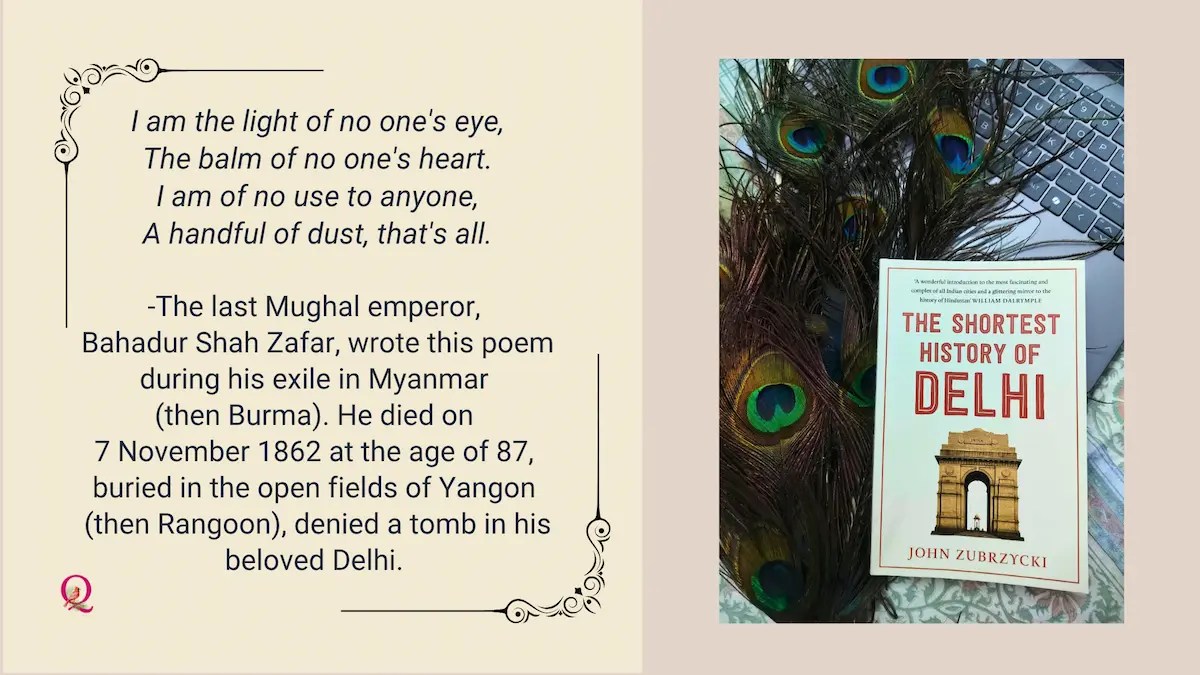
What struck me most, however, was the realisation that the emperors who envisioned the grand cities of Delhi rarely enjoyed lasting peace here. Perhaps the last Mughal emperor captured the futility of power in these poignant lines, the last poem by emperor-in-exile Bahadur Shah Zafar:
I am the light of no one’s eye,
The balm of no one’s heart.
I am of no use to anyone,
A handful of dust, that’s all.
It’s difficult to pinpoint what makes Delhi throb, but perhaps the blessings of the 22 Sufi saints whose shrines dot the city have something to do with it.
Personally, like the author, I enjoy walking through Lodi Gardens and the corridors of Connaught Place.
I like to imagine the squares filled with coffee and hukkahs, the moon shining through the squalor of Chandni Chowk, a free-flowing Yamuna which was the reason emperors built the city, and the route to Afghanistan that would be passable without visas via road.
If you are exploring Delhi, this is a book worth reading beforehand. It comes with a map of the historic cities, a bibliography and a selection of the author’s favourite spots.
My picks from the recommended reading list:
- Twilight in Delhi by Ahmed Ali
- Delhi by Khushwant Singh
- Jinnealogy: Time, Islam and Ecological Thought in the Medieval Ruins of Delhi by Anand Vivek Taneja
- Delhi: Adventures in a Megacity by Sam Miller
And a good place to begin getting to know the city? Its bookstores: Midland, Faqir Chand, Bahrisons and Oxford.
John Zubrzycki is an Australian author and historian with a PhD in Indian history. A former foreign news editor and correspondent, he also served as a diplomat in New Delhi and Jakarta.
Book Details
- Publisher: Picador India (Pan Macmillan India)
- Pages: 288
- Language: English
- Price: INR 599
Ambica Gulati wears many hats: independent journalist, editor, multimedia storyteller, author and fiction writer. Her work moves between global affairs, conscious travel, the environment, culture and the intuitive arts, while her fiction explores the territories where nature, memory, mystery and imagination converge.
She is available for reported features, interviews, analysis, profiles and multimedia stories on international affairs, India and beyond.
Beyond the laptop, she nourishes her creative practice through meditation, birding, reading, journaling, oracle cards, and yoga.
From the Archives
If this review appealed to you, there’s more on Delhi in the archives.


