
What can books tell us about a country? Quite a lot, if you ask Dr. Piotr Antoni Świtalski. A Polish diplomat, author and literature lover, he believes reading is about imagination, identity and discovering how people see themselves and the world.
“And now we’re in India. I love it here… Between 1947 and 1951, this very residence, then known as Kanika House, was the home of Dr. B.R. Ambedkar. I’m sitting in my study trying to figure out how to fix the Wi-Fi, and he was in the next room figuring out how to fix everything for a billion people…”
Reading Dr Piotr Antoni Świtalski’s blog, Laterna Diplomatica, I had already got a glimpse of what diplomacy feels like on an everyday basis.
But I hadn’t met Ambassador Dr Piotr Antoni Świtalski, Head of Mission at the Embassy of the Republic of Poland in New Delhi, at the negotiation table. I had been invited to attend the Polish National Reading Day (Narodowe Czytanie) at his residence in Delhi.
Stepping into the very grounds where Babasaheb Ambedkar lived and worked on the Indian Constitution, I was a bundle of awe and unexplained emotions. It was almost like discovering the nation’s ancestral roots.
Personally, my idea of ancestral roots travels from familial to national because we are born into a nation shaped by the ideas of great visionaries. We inherit their ideals, much like the reading I was about to witness.
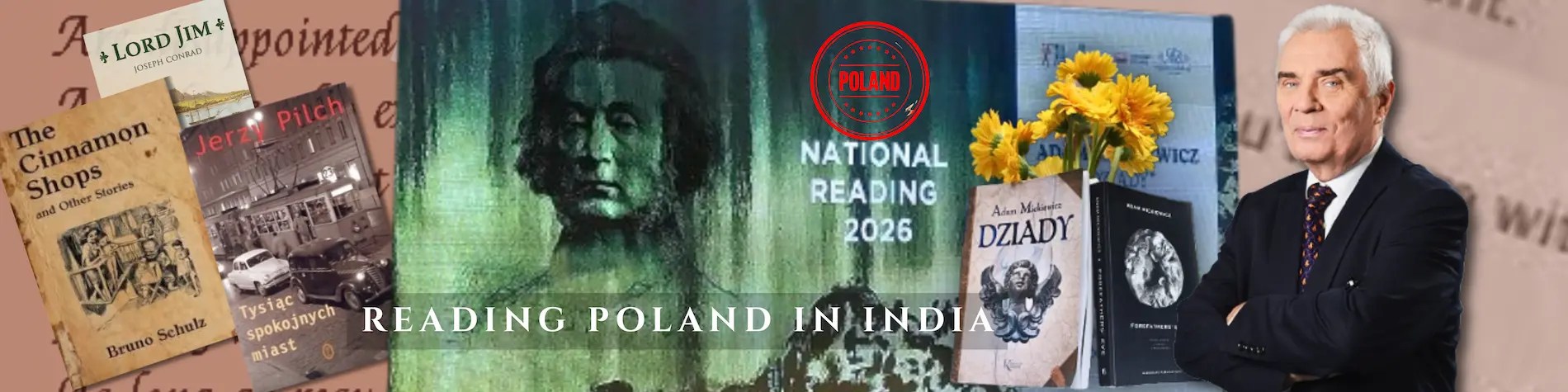
The sense of history seemed particularly apt for the 2026 edition of the Polish National Reading, which featured Dziady by Adam Mickiewicz.
Dziady, meaning ‘ancestors’, translated into English as Forefathers’ Eve, refers to an ancient Slavic and Lithuanian tradition of remembering and communing with the dead. Written by Adam Mickiewicz, Poland’s national bard, the drama evokes a nation’s anguish under partition and occupies an important place in Polish cultural memory.
Intrigued by this fascinating reading, I spoke with Ambassador Piotr Świtalski about how Poles view the literary ideals that have shaped their country, and what books can reveal about a nation.

In the era of reels, emojis and constant noise, the Polish National Reading Day brings a refreshing change. How did this initiative begin?
The National Reading symbolises unification. It is the day when Poles across the world read together the same text at the same time—a reminder of their tribe and culture.
I am proud to share that this year, the National Reading took place in more than 6,000 places and more than 40 countries, including Delhi.
The initiative was started by the Polish presidential couple in 2012 with a reading of Adam Mickiewicz’s famous poem Pan Tadeusz. Written in 1834, it is celebrated as the national epic of Poland. Every year, we choose a classic, a non-controversial pillar of our literature, as the primary book. For the 2027 edition, it will be Lord Jim by Joseph Conrad.
The National Reading helps people appreciate Polish literature, Polish poets and writers, and also enhances our cultural identity, a heritage we are proud of as Poles.
You are a prolific writer and reader. How can we, in the age of video, keep the much-needed habit of reading alive?
Our human self is oculocentric. We do prefer viewing more than reading. The Internet has shortened our attention span. This means that we wish to see or read short things.
But short things can lead to big things. We know that reading is very important. But more than the quantity, it’s the quality of reading that matters. Reading means expanding your imagination. And today, we need people with good imagination.
Reading requires effort, time and concentration. Therefore, one should read good books.
Personally, I don’t read to kill time. I read because I want to be inspired. I need mental stimulus from the books I read.
Very soon, I will be writing about College Street, which I visited in Kolkata. Just a kilometre and a half long, it is a pleasurable experience to see rows upon rows of books and bookstores.
Dziady is a classic. And with changing times, languages and cultures also change. Is it a popular drama even today in Poland?
There is an everlasting inspiring quality about Dziady. It revolves around three core ideals: Messianism, Mysticism and Prometheism. And it is popular among young people even today.
In 2021, a young Polish theatre director, Maja Kleczewska, staged Forefathers’ Eve in Kraków, at the Juliusz Słowacki Theatre. And it was a huge success.
The tickets for all the shows were sold out. And they were bought by young people, students from high school specifically. They made up almost 80 per cent of the audience.
But it has carried political weight. It was seen as a symbol of dissent during the communist era.
In 1968, a famous Polish director, Kazimierz Dejmek, staged Dziady at the National Theatre in Warsaw. It was very successful and invoked the spirit of nationalism. As Poland wanted freedom from the communist regime, the Communist Cultural Ministry banned it. This led to nationwide protests by young people.
Even today, it helps us to rediscover some of the fundamental elements of our identity.
What do you feel is the reason that Adam Mickiewicz didn’t reach the pinnacle that is enjoyed by global epics or Greek literature, for instance Homer’s Odyssey, which has been made into a movie also?
We can only speculate on the whys, although it’s difficult to assess this. Polish literature is unlike Greek literature. We don’t have big epics like the Odyssey or even large Indian epics.
Unlike other European literature, Polish literature emerged very late, around the 15th century. The first published Polish writings were primarily poetry. And even Forefathers’ Eve, although it’s a drama, is written as a poem. We are essentially a poetic nation.
We have six Nobel laureates in literature, but that was only in the 20th century. Till then, Polish literature was poetry, pamphlets and drama.
Besides, Poland is primarily an introverted nation. Unlike other nations, such as France, Russia and the UK, we don’t speak about the bigger problems on a broader scale.
And maybe this is why the world knows Byron, Goethe, Pushkin. And Adam Mickiewicz, whom I consider to be a better poet, philosophically deeper, emotionally better, is not known.
It could also be that there was no unique Polish state during Mickiewicz’s times.
Across the world, fewer people visit libraries and bookstores. Bookstagrams are more popular than traditional newspaper reviews. How would you describe the reading culture in Poland today?
Personally, I read the reviews in newspapers, but am not influenced by them. I read five pages of a book and I know whether I am going to read it till the end or not.
I am loyal to some Polish authors and buy their new books. Sometimes, I like the works, sometimes I am disappointed. At other times, I am surprised. At times, I enjoy books that have been heavily criticised as they appeal to me.
A few years back, I picked up a book by the French writer Michel Houellebecq. I read 30 pages and gave up—more than once.
Then, sometime later, I had dinner with the late sociologist Zygmunt Bauman, greatly respected in Britain, who told me: if you want to understand postmodernism, read Houellebecq. So, I tried again, and once you cross that thirty-page threshold, you start enjoying it.
He’s a star for reasons that go beyond style alone, but there’s something deeper in his books, even the ones that aren’t masterpieces—something enjoyable and thought-provoking.
I read because I want books to inspire me. And it doesn’t have to be fiction or a novel. It can be non-fiction.
Visits to libraries and bookstores have declined in Poland as well. Most people buy online because it’s cheaper.
But I like to visit the bookstores in India. I enjoy browsing through the stores in Ambience Mall at Gurugram. It is a pleasure to see good literature and a wide range of titles on the shelves. In Poland, we don’t find such good books.
What do you feel contributes to the success of a book?
I’m not a literary critic, I’m a diplomat. But I would say it’s unpredictable. It could be advertising or movies.
I’ll share with you one example of this unpredictability. My favourite movie, the best Polish movie ever, is The Saragossa Manuscript (1965), directed by Wojciech Jerzy Has.
After the movie’s success, people discovered that this was based on a novel, The Manuscript Found in Saragossa, written by a Polish nobleman, Jan Potocki, in 1815. He wrote in French about people in Spain. He was totally obscure; nobody had read his book. But after the movie, the people started reading the book.
There are many authors who have not passed the test of time. For instance, in 1937, the Polish-Jewish writer Bruno Schulz hoped to win the prestigious annual prize awarded by the influential literary magazine Wiadomości Literackie for his masterpiece Sanatorium Under the Sign of the Hourglass. But he didn’t win at that time.
So, the test of time is very important.
Do you think readers in India would enjoy reading Polish literature if it was translated into regional languages?
I would love to meet people across India who can speak Polish, read the literature in the original language and translate Polish literature into Indian languages such as Hindi, Telugu, Bengali and other languages.
But this is a huge challenge, as India constitutes 1.5 billion people. To overcome this scale, we need institutions or universities to come forward. We need good translators.
It isn’t easy to find good translators. Only some of our writers were lucky enough to find good translators. The works of Nobel Prize winner Olga Tokarczuk have been wonderfully translated into English.
In Germany, Polish literature, including contemporary writers, became popular partly because of one man, Professor Karl Dedecius. He translated tirelessly and spoke about Polish literature on television for years.
I hope, in time, to record my own presentations on Polish literature for Indian audiences. And they can read about those on my blog.
Have you read any Indian authors?
I am reading Rabindranath Tagore’s collection of short stories. He’s very popular in Poland and I enjoy the exotic, rural settings of Bengal in his stories.
The National Reading Day also introduced a new pastry — a diplomatic tribute to Mickiewicz, Chopin and Polish tradition. How did the idea for the Nocturne Cheesecake come about?
I was only the taster. It was a team effort and executed by Bogusia Sipiora Dhingra and her bakery team. I wish that they would double the size of the excellent Nocturne Cheesecake.
The Man Who Came with the Dawn
Perhaps that is what happens when literature and life cross borders: a writer carries one language and culture into another, only to find unexpected echoes.
For Ambassador Piotr Antoni Świtalski, those connection points show up in everyday moments across India—from relishing a plate of rajma-chawal in Delhi’s Connaught Place to taking the infamous auto-rickshaw ride or absorbing Hindi culture through his wife’s six years of language study.
It even manifests in a linguistic coincidence he delights in sharing. In Sanskrit, Shvita means white. In Polish, Świt marks the break of dawn. Świtalski, quite literally, translates to “the man who came with the dawn.” In Armenia, they even said, it’s the man who brought us the dawn.
It is an apt description for a diplomat whose tenure in India is defined by bringing stories from Poland to light.
Our conversation ends but another chapter opens up. While I prepare to explore Polish literature more deeply, the Ambassador continues his own discovery of India: “India is a country for travelers and foodies… To truly experience India, you have to travel a lot. You have to travel thousands of kilometers. And no other country offers such a rich, original array of flavors on this journey…”
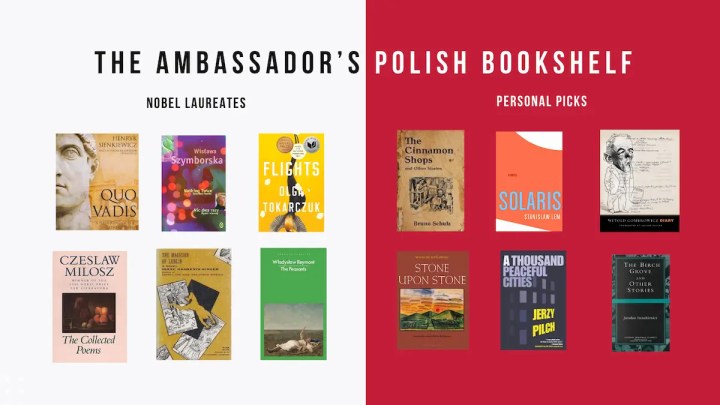
Indian readers can discover Poland through its Nobel laureates:
- Henryk Sienkiewicz: Quo Vadis: A Narrative of the Time of Nero, set in ancient Rome at the beginning of Christianity.
- Władysław Reymont: The Peasants, a powerful description of the life of simple peasants in Poland.
- Czesław Miłosz: Song on the End of the World, a stunning verse
- Isaac Bashevis Singer: The Magician of Lublin, a story written in Yiddish about Jewish life in Poland.
- Wisława Szymborska: Nothing Twice, a fantastic poem
- Olga Tokarczuk: Flights, probably her best book, she is very fond of India.
But his personal favourites extend beyond the Nobel list:
First is Bruno Schulz, whom he calls the best Polish writer ever. He recommends Cinnamon Shops and Sanatorium Under the Sign of the Hourglass, admiring the poetic style. Tragically, in 1942, Schulz was killed by a German soldier in the street, still in his thirties and working on his unfinished masterpiece, The Messiah. The manuscript was lost during the war.
Then comes Witold Gombrowicz, whose Diary is “the best piece of non-fiction you can imagine.”
Next is Stanisław Lem, the science-fiction writer whose Solaris has been adapted for film several times. “He’s not as well-known as Isaac Asimov or Ray Bradbury and other science-fiction authors, but I think he’s much better because he’s philosophical, he’s very prophetic.” Even today, the Ambassador says, Lem’s writing from the 1960s can make him stop and think, “The guy had imagination.”
He also recommends Jarosław Iwaszkiewicz, particularly The Birch Grove, a masterpiece that was also made into a movie by director Andrzej Wajda.
Another great author is Wiesław Myśliwski, whose Stone Upon Stone was translated into English and gives readers a feeling of life in Poland in the 1970s. His best novel, Horizon, has not been translated into English.
A must-read author Jerzy Pilch, his favourite author in terms of style. One book he recommends is A Thousand Peaceful Cities.
And then there is Joseph Conrad. Despite being Polish, Conrad wrote in English, which wasn’t his native language and he learnt English at the age of 16. “I like reading him in English specifically, because the way he uses adjectives is so different from other English writers of his era. He’s not Dickens, but he’s very original,” says the Ambassador.


